
मैगज़्टर गोल्ड के साथ असीमित हो जाओ
10,000 से अधिक पत्रिकाओं, समाचार पत्रों और प्रीमियम कहानियों तक असीमित पहुंच प्राप्त करें सिर्फ
कोशिश गोल्ड - मुक्त
Are leaders ready to bridge the innovation-trust gap?
DataQuest
|February 2025
AI is no longer the future-it's the now. However, as organizations race to integrate AI into their operations, a fundamental question looms: how can businesses balance rapid innovation with trust and security? Nate MacLeitch, CEO of QuickBlox, weighs in.

Nate MacLeitch, CEO of QuickBlox, collaborated with the AI Marketing Directory to survey 131 business leaders on their AI priorities for 2025.
The results indicate a dynamic tension: 72.8% of leaders cite ease of use as a top priority, but 60.3% are concerned about security vulnerabilities. This paradox underscores a critical challenge for leaders—ensuring seamless user experiences without compromising the integrity and safety of their AI tools. In this interview, MacLeitch delves into the survey insights, providing strategies for building trust, bridging readiness gaps, and leading teams into a transformative AI era.
Quickblox’s survey highlights a tension between ease of use and security concerns. How should leaders address this trade-off without compromising trust?
Yes, our survey found that 72.8% of business leaders saw ease of use as a top priority for their 2025 AI investments. However, 60.3% expressed concern about the security of their tools.
Really, easy navigation and airtight security go hand in hand. Any tools your developers build should be simple to use, and to ensure that, you need a clear purpose so they can map out the user journey in as few steps as possible. When the app itself is streamlined, and workflows are straightforward, it is much easier to track and monitor performance and security. We know that a blank page can be daunting when scoping out app development projects. We’ve built customizable software development kits (SDKs) and application programming interfaces (APIs) to help developers get a head start. They can plug and play with the various features available to suit their specific use cases.
By using SDKs that have been developed and trialed by expert security teams—built with best practices, security protocols, and vulnerability mitigations front of mind—developers write less code themselves, which reduces time-to-market and the potential for introducing security flaws.
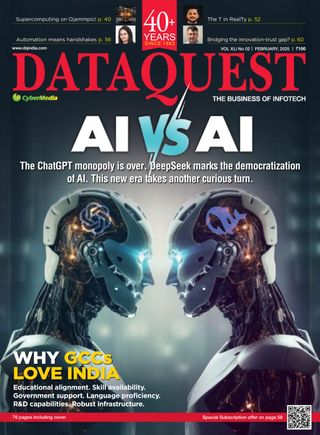

यह कहानी DataQuest के February 2025 संस्करण से ली गई है।
हजारों चुनिंदा प्रीमियम कहानियों और 10,000 से अधिक पत्रिकाओं और समाचार पत्रों तक पहुंचने के लिए मैगज़्टर गोल्ड की सदस्यता लें।
क्या आप पहले से ही ग्राहक हैं? साइन इन करें
DataQuest से और कहानियाँ

DataQuest
If Only The Mentalist Solved Cybercrimes too
Is there not a human mind sitting beneath every cyber-criminal's brain? From Stockholm effect, Lima syndrome, to how cyber-criminals neutralise guilt and can we use psychology to defeat and cure cyber- criminals- here is a social scientist and criminologist cracking some human doors of the dark cybercrime cave.

20 mins
May 2026

DataQuest
Made-in-India Chips: 'Wedge'ing the Semicon Door Open
We are doing pretty okay in design, packaging and talent availability. But can we cross the hedge with going-fabless, fully-oiled ecosystems, advanced architecture and our own IP?
5 mins
May 2026

DataQuest
AWS wants to be more than cloud in India's startup story
AWS's Tiffany Bloomquist says Indian startups are moving from AI demos to practical execution, with voice, finance, and faster product builds leading the shift.
7 mins
May 2026

DataQuest
Are You Talented Enough?
Here's a skillet of seven skills for you to consider cultivating to get and retain a job in the AI era
6 mins
May 2026

DataQuest
Where Al is already executing work in aerospace
GE Aerospace is moving AI beyond insight and into design, maintenance, and inspection, with human oversight still central to every critical decision.
3 mins
May 2026

DataQuest
Why CloudMoyo sees intelligent operations as the next AI frontier
CloudMoyo CEO Manish Kedia explains why real AI value lies beyond CLM and copilots, in unified data, real-time intelligence, and execution-led enterprise workflow.
8 mins
May 2026

DataQuest
Why India's Al future needs both sovereign control and heritage depth
India's AI next phase may depend on combining sovereign control with heritage depth, while enterprises build domain-specific models from their own knowledge.
11 mins
May 2026

DataQuest
The Tariff Turnpike - Now a Make-in-India Turnstile
India's new Soft Power on the Tariff Tables could lie in how, and when, we leverage self-reliance through Make-in-India outcomes and new import-export mathematics
4 mins
May 2026

DataQuest
As AI Reshapes IT Infrastructure, can Telecom Operators Move Up the Stack?
As AI reshapes infrastructure and value creation, Accenture's Boris Maurer explains why telecom operators may gain a bigger role in the digital stack.
8 mins
May 2026

DataQuest
From Clad-in-India to Made-in-India: How Far Have We Come?
And how much grit and gravel we need to still cover before appearing strong and bright on the global manufacturing map. Almost ten years forward- that's a good time for a quick X-Ray.
9 mins
May 2026
Listen
Translate
Change font size