कोशिश गोल्ड - मुक्त
Why We Need A Circular Economy
Down To Earth
|June 16, 2019
Reusing products is not only necessary for a sustainable future, but also makes business sense
-

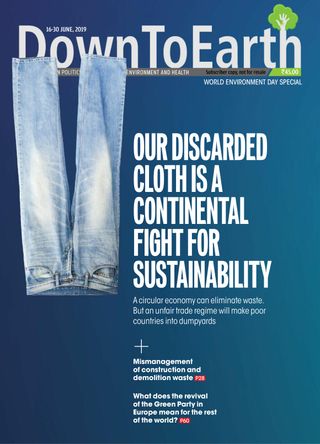
RWANDA HAS a reason for opposing used clothes. Pushed by flawed trade regimes and myopic policies, these goods have nearly decimated the textile, apparel and leather industries in Africa. But elsewhere, a movement of sorts has gained momentum with celebrities urging consumers to choose secondhand clothes for a sustainable future.
“The textiles system operates in an almost completely linear way: large amounts of non-renewable resources are extracted to produce clothes that are often used for only a short time, after which the materials are mostly sent to landfill or incinerated,” says a report by UK-based think-tank Ellen MacArthur Foundation. Globally, clothing production doubled between 2000 and 2015. During the period the number of garments purchased each year increased by 60 percent but the average number of times a garment was worn before disposal declined by 36 percent. More than the US $500 billion worth of natural resources are lost every year due to clothing underutilization and the lack of recycling, says the report. The volume and variety of natural resources that end up in landfill due to the lake make-disposal model are immense if one considers the diversification of the industrial economy and technological advancements. “Some 65 billion tonnes of raw materials entered the economic system in 2010, and this figure is expected to grow to around 82 billion tonnes in 2020,” says a 2014 report of the World Economic Forum. Three planet Earths would be required to accommodate the gargantuan waste humanity would produce by 2050, warns environmental group, the World Wide Fund for Nature.

यह कहानी Down To Earth के June 16, 2019 संस्करण से ली गई है।
हजारों चुनिंदा प्रीमियम कहानियों और 10,000 से अधिक पत्रिकाओं और समाचार पत्रों तक पहुंचने के लिए मैगज़्टर गोल्ड की सदस्यता लें।
क्या आप पहले से ही ग्राहक हैं? साइन इन करें
Down To Earth से और कहानियाँ

Down To Earth
THINK TWICE BEFORE FELLING SAL TREES
Many trees considered to be affected by sal borer in the 1990s are still alive today

1 mins
February 16, 2026

Down To Earth
EDGE OF SURVIVAL
Caste divides deny marginalised communities land, resources and essential aid, leaving them more vulnerable to climate disasters
6 mins
February 16, 2026

Down To Earth
A WISH LIST?
Union Budget for 2026-27 conveys the impression of a roll-call of intentions and ambitious proposals, with little detail on their formulation
6 mins
February 16, 2026
Down To Earth
Break down the gender wall
THE RULING National Democratic Alliance (NDA) government has been heavily invested in the goal to make India a developed economy by 2047.
2 mins
February 16, 2026

Down To Earth
MENSTRUAL HEALTH, NOW A FUNDAMENTAL RIGHT
In a landmark judgement, the Supreme Court has recognised menstrual health and hygiene as a fundamental right under Article 21 of the Constitution of India, which guarantees the right to life and dignity.
8 mins
February 16, 2026

Down To Earth
Of devolution and new disasters
The 16th Finance Commission pushes for changes in view of new fiscal and climatic conditions
11 mins
February 16, 2026
Down To Earth
Rising risks of plastics
NEGATIVE IMPACTS on human health due to emissions linked to the plastic lifecycle could double by 2040, according to a study published in The Lancet Planetary Health in January.
1 min
February 16, 2026

Down To Earth
GAP BETWEEN EPIDEMICS NARROWING
A watershed-based and landscape-level approach is needed to address forest degradation
2 mins
February 16, 2026
Down To Earth
WAITING TO STRIKE
Sal heartwood borer is considered the biggest threat to forestry in India, especially to the sal tree, where it lives and breeds.
11 mins
February 16, 2026

Down To Earth
A SPRING DELIGHT
Mustard flowers are not meant only for the eyes. Invite them to your plate once in a while
3 mins
February 16, 2026
Translate
Change font size