
मैगज़्टर गोल्ड के साथ असीमित हो जाओ
10,000 से अधिक पत्रिकाओं, समाचार पत्रों और प्रीमियम कहानियों तक असीमित पहुंच प्राप्त करें सिर्फ
कोशिश गोल्ड - मुक्त
Why Farmers Now Dread A Normal Monsoon
Down To Earth
|July 1, 2017
No major agrarian reform has happened in the 50 years since the Green Revolution. A normal monsoon cannot be assumed as the only incentive for farmers to sustain productivity. It's time India offered its food producers a new deal

THERE IS no end to the woes of Indian farmers. They have not been cheered by the forecast of a second consecutive normal monsoon. Rather, they have taken to the streets, demanding a new deal from the government. Farmers in more than 12 states have been protesting for the past eight months, spanning two major crop seasons (see ‘Farm rut’ p20). But their demands offer a picture of contradiction. In southern states, which reel from the worst drought in over a century, farmers are demanding agricultural loan waiver and government assurance on better prices for their produce, while those in northern and western states are demanding the same despite a historic harvest. For the latter, this is the second normal monsoon after three years of deficit rainfall and travails of severe agrarian crisis. Yet, not a single day has passed in the recent past without farmers’ protests. The killing of six farmers by the police in Madhya Pradesh was just a brutal turn of events in this never-before-seen agrarian unrest.
Ideally, at this time farmers and governments should have been out in the street celebrating two milestones the country has achieved in recent times: a record food grain production in 2016-17 and the 50th year of the Green Revolution that propelled India to food self-sufficiency. Instead, farmers dumped potatoes, tomatoes, milk and other produce on the roads to protest the “historically lowº prices they got. The starkest example is onion, a vegetable whose high price has always triggered political storms. Arguably, this is for the first time that farmers and politicians are worried about the dipping price of onions. It is also a sign that there is something seriously wrong in the agriculture sector that we either do not care about or prefer to dismiss conveniently.
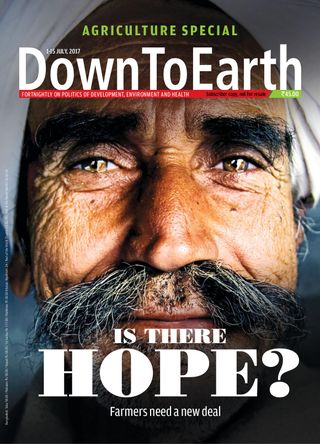

यह कहानी Down To Earth के July 1, 2017 संस्करण से ली गई है।
हजारों चुनिंदा प्रीमियम कहानियों और 10,000 से अधिक पत्रिकाओं और समाचार पत्रों तक पहुंचने के लिए मैगज़्टर गोल्ड की सदस्यता लें।
क्या आप पहले से ही ग्राहक हैं? साइन इन करें
Down To Earth से और कहानियाँ

Down To Earth
THINK TWICE BEFORE FELLING SAL TREES
Many trees considered to be affected by sal borer in the 1990s are still alive today

1 mins
February 16, 2026

Down To Earth
EDGE OF SURVIVAL
Caste divides deny marginalised communities land, resources and essential aid, leaving them more vulnerable to climate disasters
6 mins
February 16, 2026

Down To Earth
A WISH LIST?
Union Budget for 2026-27 conveys the impression of a roll-call of intentions and ambitious proposals, with little detail on their formulation
6 mins
February 16, 2026
Down To Earth
Break down the gender wall
THE RULING National Democratic Alliance (NDA) government has been heavily invested in the goal to make India a developed economy by 2047.
2 mins
February 16, 2026

Down To Earth
MENSTRUAL HEALTH, NOW A FUNDAMENTAL RIGHT
In a landmark judgement, the Supreme Court has recognised menstrual health and hygiene as a fundamental right under Article 21 of the Constitution of India, which guarantees the right to life and dignity.
8 mins
February 16, 2026

Down To Earth
Of devolution and new disasters
The 16th Finance Commission pushes for changes in view of new fiscal and climatic conditions
11 mins
February 16, 2026
Down To Earth
Rising risks of plastics
NEGATIVE IMPACTS on human health due to emissions linked to the plastic lifecycle could double by 2040, according to a study published in The Lancet Planetary Health in January.
1 min
February 16, 2026

Down To Earth
GAP BETWEEN EPIDEMICS NARROWING
A watershed-based and landscape-level approach is needed to address forest degradation
2 mins
February 16, 2026

Down To Earth
WAITING TO STRIKE
Sal heartwood borer is considered the biggest threat to forestry in India, especially to the sal tree, where it lives and breeds.
11 mins
February 16, 2026

Down To Earth
A SPRING DELIGHT
Mustard flowers are not meant only for the eyes. Invite them to your plate once in a while
3 mins
February 16, 2026
Translate
Change font size