कोशिश गोल्ड - मुक्त
The Numbers Behind Climate Change
Down To Earth
|November 01, 2021
The planet can barely afford any more carbon emissions. But we need to continue to emit for our survival and development. What is the carbon budget available to us? More importantly, who should be allowed to emit and how much? An analysis by Sunita Narain and Avantika Goswami

DEATH RACE
Our annual carbon dioxide (CO2) emissions have grown about 70 times since the pre-industrial era, reaching nearly 36.4 gigatonnes (Gt) in 2019. Unless we bring them down to 18.22 Gt by 2030, we are headed for catastrophic climate events
CLIMATE CHANGE is real. We now know that for certain. We are already experiencing doomsday scenarios that climate scientists had projected for the distant future. The UN's top climate science body, Intergovernmental Panel on Climate Change (IPCC), in its latest Sixth Assessment Report (AR6), Climate Change 2021: The Physical Science Basis, only confirms what we already know and see in the world around us: wildfires triggered by extreme heat and moisture loss; devastating floods caused by extreme rain events; and tropical cyclones powered by the changing temperatures between the sea and land surface. The report also clearly says that human activities, for certain, are to be blamed for these climate events. Anthropogenic carbon dioxide (CO 2) and other greenhouse gases (GHGS) have warmed the planet beyond its tolerance level. In May this year, the atmospheric CO 2 level reached 419 parts per million (ppm), as measured by the US’ National Oceanic and Atmospheric Administration’s Mauna Loa Atmospheric Baseline Observatory in Hawaii. This is nearly 45 per cent above IPCC's accepted pre-industrial baseline of 278 ppm in 1750.
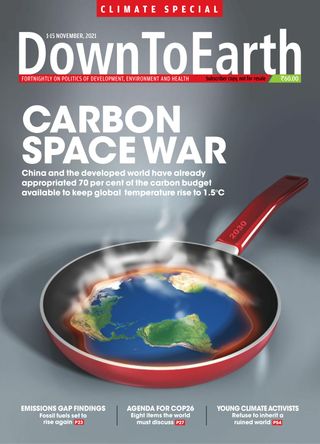

यह कहानी Down To Earth के November 01, 2021 संस्करण से ली गई है।
हजारों चुनिंदा प्रीमियम कहानियों और 10,000 से अधिक पत्रिकाओं और समाचार पत्रों तक पहुंचने के लिए मैगज़्टर गोल्ड की सदस्यता लें।
क्या आप पहले से ही ग्राहक हैं? साइन इन करें
Down To Earth से और कहानियाँ

Down To Earth
THINK TWICE BEFORE FELLING SAL TREES
Many trees considered to be affected by sal borer in the 1990s are still alive today

1 mins
February 16, 2026

Down To Earth
EDGE OF SURVIVAL
Caste divides deny marginalised communities land, resources and essential aid, leaving them more vulnerable to climate disasters
6 mins
February 16, 2026

Down To Earth
A WISH LIST?
Union Budget for 2026-27 conveys the impression of a roll-call of intentions and ambitious proposals, with little detail on their formulation
6 mins
February 16, 2026
Down To Earth
Break down the gender wall
THE RULING National Democratic Alliance (NDA) government has been heavily invested in the goal to make India a developed economy by 2047.
2 mins
February 16, 2026

Down To Earth
MENSTRUAL HEALTH, NOW A FUNDAMENTAL RIGHT
In a landmark judgement, the Supreme Court has recognised menstrual health and hygiene as a fundamental right under Article 21 of the Constitution of India, which guarantees the right to life and dignity.
8 mins
February 16, 2026

Down To Earth
Of devolution and new disasters
The 16th Finance Commission pushes for changes in view of new fiscal and climatic conditions
11 mins
February 16, 2026
Down To Earth
Rising risks of plastics
NEGATIVE IMPACTS on human health due to emissions linked to the plastic lifecycle could double by 2040, according to a study published in The Lancet Planetary Health in January.
1 min
February 16, 2026

Down To Earth
GAP BETWEEN EPIDEMICS NARROWING
A watershed-based and landscape-level approach is needed to address forest degradation
2 mins
February 16, 2026

Down To Earth
WAITING TO STRIKE
Sal heartwood borer is considered the biggest threat to forestry in India, especially to the sal tree, where it lives and breeds.
11 mins
February 16, 2026

Down To Earth
A SPRING DELIGHT
Mustard flowers are not meant only for the eyes. Invite them to your plate once in a while
3 mins
February 16, 2026
Translate
Change font size