
मैगज़्टर गोल्ड के साथ असीमित हो जाओ
10,000 से अधिक पत्रिकाओं, समाचार पत्रों और प्रीमियम कहानियों तक असीमित पहुंच प्राप्त करें सिर्फ
कोशिश गोल्ड - मुक्त
The Gaps In Closing The Ozone Hole
Down To Earth
|September 16, 2019
The cooling industry which first drilled the hole in the ozone layer is now burning the whole planet

The Ozone problem is joined at the hip of the world’s growing obsession for cool-ing. The cooling industry—refrigeration, air-conditioning, and insulation—first burned the hole in the ozone layer and is now heating up the planet. Hydrofluorocarbons (HFCS) and electricity used to run cooling devices are major greenhouse gas (GHG) emitters. To address this, the Montreal Protocol, the only universally adopted treaty, expanded its scope and ambition in 2016 by introducing the Kigali Amendment. It stemmed out of the guilt that its success in removing ozone-depleting chemicals from our cooling devices has filled the atmosphere with highly potent GHGs. So the Kigali Amendment will not just be a fight to protect the ozone layer, but will also be leveraged to fight climate change. But bridging the gap between ozone and climate challenges is not going to be easy. The Kigali Amendment is fiendishly complicated—given its technical and political nuances—but it broadly caps and reduces the use of HFCS in a gradual process.
The agreement recognizes the linkages between the transition in refrigerants and energy efficiency of air-conditioners (ACS). It aims to improve energy efficiency because the world will need more mechanical cooling as the climate gets hotter, electricity generation to keep the ACs running is a critical climate concern. Cooling accounts for 10 percent of all global electricity consumption as per the International Energy Agency.
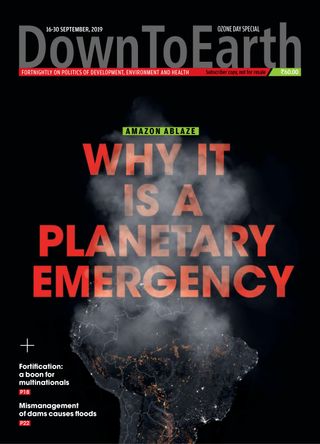

यह कहानी Down To Earth के September 16, 2019 संस्करण से ली गई है।
हजारों चुनिंदा प्रीमियम कहानियों और 10,000 से अधिक पत्रिकाओं और समाचार पत्रों तक पहुंचने के लिए मैगज़्टर गोल्ड की सदस्यता लें।
क्या आप पहले से ही ग्राहक हैं? साइन इन करें
Down To Earth से और कहानियाँ

Down To Earth
THINK TWICE BEFORE FELLING SAL TREES
Many trees considered to be affected by sal borer in the 1990s are still alive today

1 mins
February 16, 2026

Down To Earth
EDGE OF SURVIVAL
Caste divides deny marginalised communities land, resources and essential aid, leaving them more vulnerable to climate disasters
6 mins
February 16, 2026

Down To Earth
A WISH LIST?
Union Budget for 2026-27 conveys the impression of a roll-call of intentions and ambitious proposals, with little detail on their formulation
6 mins
February 16, 2026
Down To Earth
Break down the gender wall
THE RULING National Democratic Alliance (NDA) government has been heavily invested in the goal to make India a developed economy by 2047.
2 mins
February 16, 2026

Down To Earth
MENSTRUAL HEALTH, NOW A FUNDAMENTAL RIGHT
In a landmark judgement, the Supreme Court has recognised menstrual health and hygiene as a fundamental right under Article 21 of the Constitution of India, which guarantees the right to life and dignity.
8 mins
February 16, 2026

Down To Earth
Of devolution and new disasters
The 16th Finance Commission pushes for changes in view of new fiscal and climatic conditions
11 mins
February 16, 2026
Down To Earth
Rising risks of plastics
NEGATIVE IMPACTS on human health due to emissions linked to the plastic lifecycle could double by 2040, according to a study published in The Lancet Planetary Health in January.
1 min
February 16, 2026

Down To Earth
GAP BETWEEN EPIDEMICS NARROWING
A watershed-based and landscape-level approach is needed to address forest degradation
2 mins
February 16, 2026
Down To Earth
WAITING TO STRIKE
Sal heartwood borer is considered the biggest threat to forestry in India, especially to the sal tree, where it lives and breeds.
11 mins
February 16, 2026

Down To Earth
A SPRING DELIGHT
Mustard flowers are not meant only for the eyes. Invite them to your plate once in a while
3 mins
February 16, 2026
Translate
Change font size