कोशिश गोल्ड - मुक्त
SHRINKING WORLD OF CHANGPAS
Down To Earth
|December 16, 2020
The Changpas are trans-Himalayan nomads. For ages, they have roamed the Changthang region of southeastern Ladakh, cut off from the world. Some accounts say they travelled across the Himalayas to arrive here around the 8th century. Located at an altitude of 4,500 metres, life in this arid, vast and rugged plateau is hard. Winters are very long, summers short and vegetation scarce. As a result, the Changpas have led a pastoral life. They rear Changthangi goat, from whose under coat comes the famous pashmina wool. The goats graze on the mountainsides, feeding on seasonal grasses. The weather, however, has changed in the past few decades. The winters and summers are warmer, and there is a perceptive decline in precipitation and snowfall between November and March. This has drastically reduced the size of the grazing grounds and the Changpas now have to shift locations more frequently. RITAYAN MUKHERJEE captures the changing lifestyle of the Changpas

Shear hard work
Changpas are among the world’s primary suppliers of cashmere wool, which comes from the pashmina or Changthangi goat’s undercoat. This undercoat is at its maximum length in winter, and the Changpas shear in early spring ensuring the goats are not harmed. In recent times, say the Changpas, warmer winters have lowered the quality of the animal wool.
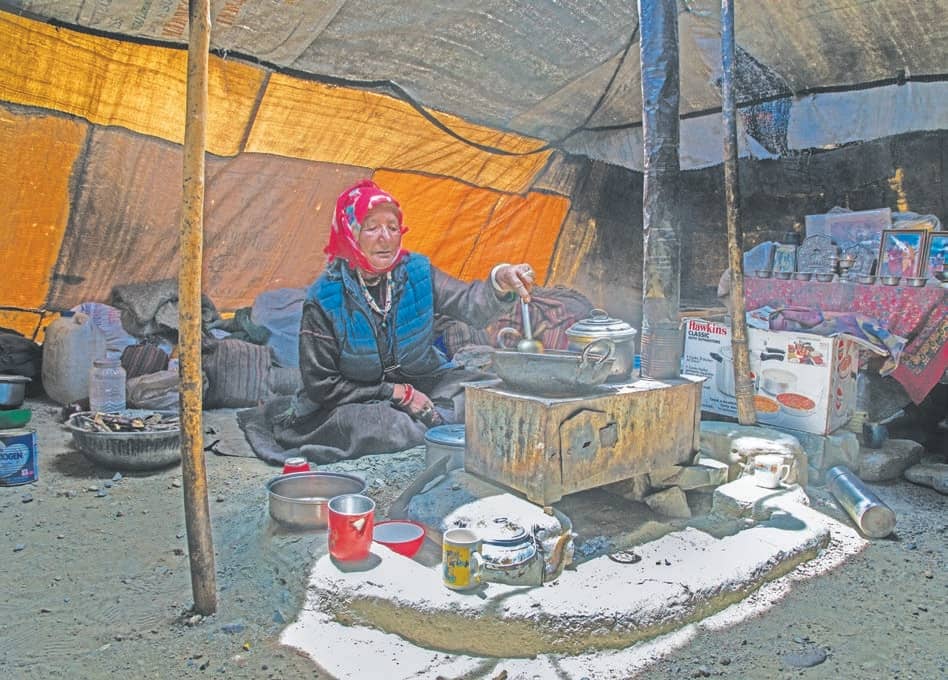
Life in a ‘rebo’

यह कहानी Down To Earth के December 16, 2020 संस्करण से ली गई है।
हजारों चुनिंदा प्रीमियम कहानियों और 10,000 से अधिक पत्रिकाओं और समाचार पत्रों तक पहुंचने के लिए मैगज़्टर गोल्ड की सदस्यता लें।
क्या आप पहले से ही ग्राहक हैं? साइन इन करें
Down To Earth से और कहानियाँ

Down To Earth
THE GREAT PIVOT
China's moves to transition to clean energy offer critical lessons to India

4 mins
March 01, 2026

Down To Earth
COAL V CORRIDOR
A proposal to mine coal along a corridor that links two tiger reserves in central India is a step away from getting final clearance. The move could affect movement and genetic diversity of tiger populations in the region
8 mins
March 01, 2026

Down To Earth
India's challenging AI predicament
Hobbled by lack of innovation and AI skills in its crucial technology sector, India is focusing on a ruinous plan to host data centres
4 mins
March 01, 2026
Down To Earth
China to implement zero tariffs across Africa
CHINA ON February 14 announced that it will implement zero tariffs for imports from all the 53 African nations it has diplomatic relations with, starting from May 1.
1 min
March 01, 2026
Down To Earth
Poverty, sans the threshold
MEASUREMENT OF poverty is a fundamental exercise, needed to direct development programmes.
2 mins
March 01, 2026

Down To Earth
A bridge across forever
For two decades, a Chhattisgarh village remains stuck in a loop of building temporary river crossings to access markets and sell forest produce
4 mins
March 01, 2026
Down To Earth
Liveable cities need a new model
CRY FOR my Delhi. This is my city—my family records many generations who have lived here.
3 mins
March 01, 2026
Down To Earth
Real impacts of the changing seasons
This refers to the article \"1,500 days, and an alarm for new climate\" (1-15 December, 2025).
1 mins
March 01, 2026

Down To Earth
‘It’s a systematic effort by US to dismantle climate policy’
The US, the world's largest historical emitter of greenhouse gases, has overturned its “endangerment finding”, the legal foundation for regulating emissions under the Clean Air Act since 2009.
4 mins
March 01, 2026
Down To Earth
Amazon turned carbon source in 2023 drought
EXTREME DROUGHT and a prolonged heatwave in 2023 pushed parts of the Amazon rainforest from acting as a carbon sink to becoming a carbon source for three months, according to a February 13 study published in the journal AGU Advances of the American Geophysical Union.
1 min
March 01, 2026
Translate
Change font size