
मैगज़्टर गोल्ड के साथ असीमित हो जाओ
10,000 से अधिक पत्रिकाओं, समाचार पत्रों और प्रीमियम कहानियों तक असीमित पहुंच प्राप्त करें सिर्फ
कोशिश गोल्ड - मुक्त
Out Of The Abyss
Down To Earth
|February 01, 2017
The recent surge in earthquakes and the explanation for the formation of the world's largest exposed fault have provided momentum to seismological research. SHREESHAN VENKATESH looks at the latest findings.

THE LAST two months of 2016 proved to be a busy period for seismologists. In November, scientists found out that the abyss under the Pacific Ocean between Indonesia and Papua New Guinea was left behind by a massive earthquake during the last Ice Age and is actually the world’s largest exposed fault. The Banda Detachment Fault is seven kilometres deep, 450 km long and if the bare ocean floor were seen from above, the fault would cover an area of 60,000 sq km. Scientists say that sometime between 10,000 to 30,000 years ago, as the Australian and Pacific tectonic plates grinded against each other, a piece of continental crust the size of Belgium was ripped apart, leaving a huge tear or fault in the surface.
We have known of the existence of the Banda abyss for many years now. But it was not until late last year that scientists were finally able to conclude what formed the Banda abyss, indicating how little we know of the ground beneath our feet.
Since mid-October, a surge in seismic activity, with around 15 temblors measuring more than 6.5 on the Richter scale, has also aroused interest. At least 400 earthquakes of magnitude 5 and above were recorded in December alone, marking an increase of three and a half times the monthly average (see ‘In continuous motion’, p42). The bulk of all quakes occurred along the plate boundaries, especially along the Pacific Ring of Fire. While the surge is within the normal range, it provides seismologists with more seismic observations to chew over and confirms that the Earth’s crust is active and moving.
“There are many things about the inner workings of the Earth and earthquakes themselves that we do not yet understand,” says Vineet Gahalaut, director of the National Centre for Seismology (see ‘A promising start’, p44). It is still an actively developing field with several unknown variables under research.
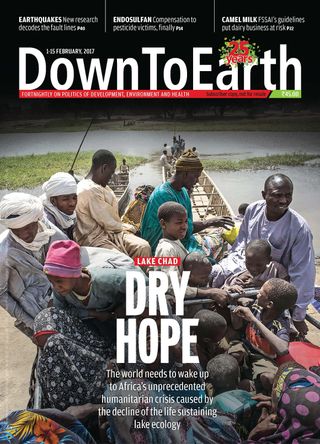

यह कहानी Down To Earth के February 01, 2017 संस्करण से ली गई है।
हजारों चुनिंदा प्रीमियम कहानियों और 10,000 से अधिक पत्रिकाओं और समाचार पत्रों तक पहुंचने के लिए मैगज़्टर गोल्ड की सदस्यता लें।
क्या आप पहले से ही ग्राहक हैं? साइन इन करें
Down To Earth से और कहानियाँ

Down To Earth
THINK TWICE BEFORE FELLING SAL TREES
Many trees considered to be affected by sal borer in the 1990s are still alive today

1 mins
February 16, 2026

Down To Earth
EDGE OF SURVIVAL
Caste divides deny marginalised communities land, resources and essential aid, leaving them more vulnerable to climate disasters
6 mins
February 16, 2026

Down To Earth
A WISH LIST?
Union Budget for 2026-27 conveys the impression of a roll-call of intentions and ambitious proposals, with little detail on their formulation
6 mins
February 16, 2026
Down To Earth
Break down the gender wall
THE RULING National Democratic Alliance (NDA) government has been heavily invested in the goal to make India a developed economy by 2047.
2 mins
February 16, 2026

Down To Earth
MENSTRUAL HEALTH, NOW A FUNDAMENTAL RIGHT
In a landmark judgement, the Supreme Court has recognised menstrual health and hygiene as a fundamental right under Article 21 of the Constitution of India, which guarantees the right to life and dignity.
8 mins
February 16, 2026

Down To Earth
Of devolution and new disasters
The 16th Finance Commission pushes for changes in view of new fiscal and climatic conditions
11 mins
February 16, 2026
Down To Earth
Rising risks of plastics
NEGATIVE IMPACTS on human health due to emissions linked to the plastic lifecycle could double by 2040, according to a study published in The Lancet Planetary Health in January.
1 min
February 16, 2026

Down To Earth
GAP BETWEEN EPIDEMICS NARROWING
A watershed-based and landscape-level approach is needed to address forest degradation
2 mins
February 16, 2026
Down To Earth
WAITING TO STRIKE
Sal heartwood borer is considered the biggest threat to forestry in India, especially to the sal tree, where it lives and breeds.
11 mins
February 16, 2026

Down To Earth
A SPRING DELIGHT
Mustard flowers are not meant only for the eyes. Invite them to your plate once in a while
3 mins
February 16, 2026
Translate
Change font size