कोशिश गोल्ड - मुक्त
FAMILIAL TIES
Down To Earth
|July 16, 2021
A few recently discovered early human fossils further complicate our evolutionary timeline

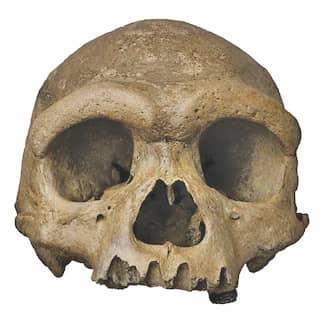
SOME 146,000 years ago, just as Homo sapiens, the modern human, was roaming across Africa, Europe, and Asia, a similar-looking individual walked through forested floodplains of northeastern China. This could be the closest relative of the modern human found so far, say scientists who studied the well-preserved fossilized skull of the 50-year-old individual. The skull is named the Harbin cranium after the city where it was found, while the individual has been tentatively named Homo long or “Dragon Man” after the Long Jiang river in the region. While there is no consensus about the individual’s identity and its relation to the modern human, its arrival adds another layer to evolutionary history and throws up challenges to our understanding of how the modern human came to be.
The Harbin cranium was first found in 1933 by a construction worker, but he did not disclose its discovery. It is in 2018 after his death that his family donated the skull to the Hebei geo University. Since then, scientists led by Qiang Ji from the university, along with Xijuan Ni from the Chinese Academy of Sciences and Chris Stringer from the Natural History Museum, UK, have revealed astonishing details about the Dragon Man. The results were published in three separate research papers in the journal The Innovation on June 25, 2021.


यह कहानी Down To Earth के July 16, 2021 संस्करण से ली गई है।
हजारों चुनिंदा प्रीमियम कहानियों और 10,000 से अधिक पत्रिकाओं और समाचार पत्रों तक पहुंचने के लिए मैगज़्टर गोल्ड की सदस्यता लें।
क्या आप पहले से ही ग्राहक हैं? साइन इन करें
Down To Earth से और कहानियाँ

Down To Earth
THINK TWICE BEFORE FELLING SAL TREES
Many trees considered to be affected by sal borer in the 1990s are still alive today

1 mins
February 16, 2026

Down To Earth
EDGE OF SURVIVAL
Caste divides deny marginalised communities land, resources and essential aid, leaving them more vulnerable to climate disasters
6 mins
February 16, 2026

Down To Earth
A WISH LIST?
Union Budget for 2026-27 conveys the impression of a roll-call of intentions and ambitious proposals, with little detail on their formulation
6 mins
February 16, 2026
Down To Earth
Break down the gender wall
THE RULING National Democratic Alliance (NDA) government has been heavily invested in the goal to make India a developed economy by 2047.
2 mins
February 16, 2026

Down To Earth
MENSTRUAL HEALTH, NOW A FUNDAMENTAL RIGHT
In a landmark judgement, the Supreme Court has recognised menstrual health and hygiene as a fundamental right under Article 21 of the Constitution of India, which guarantees the right to life and dignity.
8 mins
February 16, 2026

Down To Earth
Of devolution and new disasters
The 16th Finance Commission pushes for changes in view of new fiscal and climatic conditions
11 mins
February 16, 2026
Down To Earth
Rising risks of plastics
NEGATIVE IMPACTS on human health due to emissions linked to the plastic lifecycle could double by 2040, according to a study published in The Lancet Planetary Health in January.
1 min
February 16, 2026

Down To Earth
GAP BETWEEN EPIDEMICS NARROWING
A watershed-based and landscape-level approach is needed to address forest degradation
2 mins
February 16, 2026

Down To Earth
WAITING TO STRIKE
Sal heartwood borer is considered the biggest threat to forestry in India, especially to the sal tree, where it lives and breeds.
11 mins
February 16, 2026

Down To Earth
A SPRING DELIGHT
Mustard flowers are not meant only for the eyes. Invite them to your plate once in a while
3 mins
February 16, 2026
Translate
Change font size