
मैगज़्टर गोल्ड के साथ असीमित हो जाओ
10,000 से अधिक पत्रिकाओं, समाचार पत्रों और प्रीमियम कहानियों तक असीमित पहुंच प्राप्त करें सिर्फ
Bitter Medicine
Down To Earth
|May 16, 2017
It is time to treat pharma waste more rigorously. The waste contains active ingredients used in antibiotics and may be contributing to the spread of antimicrobial resistance

SPREAD OVER 380 square kilometres in Himachal Pradesh’s Solan district, the Baddi-Barotiwala-Nalagarh (bbn) industrial area is one of India’s largest pharmaceutical manufacturing hubs. The region hosts around 500 small, medium and large pharma units and accounts for 35 per cent of Asia’s total medicine production. But rapid industrialisation and a lax attitude towards safe disposal and management of pharma waste have raised concerns about the effects of pollution on the environment and health.
The water of the Sirsa river, which flows downstream through Baddi, is black and emanates a foul odour. In Jharmajri village, which has the largest number of pharma units, resident Balvinder Thakur points to an open area where solid waste has been burnt. The burnt waste, which contains medicine wrappers, flows along with wastewater into a dirty canal nearby. “All of this is going to the river,” he says. Pharma manufacturing units are required to send their solid waste to the treatment, storage, and disposal facility (TSDF). But people in the area allege that pharma units sometimes do not comply with these norms. “To cut down on costs, waste is given to scrap dealers who visit plants. They dump the waste in open areas or burn it,” says J S Dukhiya, president, Him Parivesh Environment Protection Society, a nonprofit based in Nalagarh.
Liquid waste from these units is also discharged through pipes and other outlets that open behind the plant or run underground and open into bushy areas. This released wastewater accumulates in or flows through nallahs, canals and rivulets into the Sirsa river. “Effluents are also injected into the ground at night by digging bore wells or released during rains,” says Balkrishna Sharma, another activist.
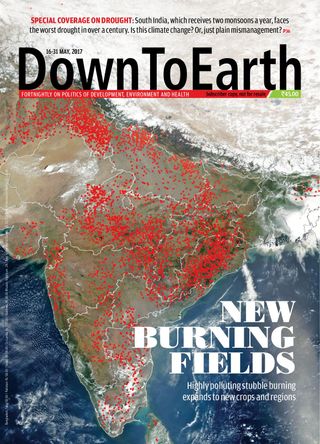

यह कहानी Down To Earth के May 16, 2017 संस्करण से ली गई है।
हजारों चुनिंदा प्रीमियम कहानियों और 10,000 से अधिक पत्रिकाओं और समाचार पत्रों तक पहुंचने के लिए मैगज़्टर गोल्ड की सदस्यता लें।
क्या आप पहले से ही ग्राहक हैं? साइन इन करें
Down To Earth से और कहानियाँ

Down To Earth
KING OF BIRDS
Revered for centuries, western tragopan now needs protection as its forests shrink, human pressures mount

3 mins
December 16, 2025

Down To Earth
WHISKERS ALL AQUIVER
Climate change threatens creatures that have weathered extreme environments for thousands of years
2 mins
December 16, 2025

Down To Earth
GOLDEN SPIRIT
Survival of the shy primate is closely tied to the health of Western Ghats
3 mins
December 16, 2025

Down To Earth
RINGED EYES IN THE CANOPY
Rapid habitat destruction forces arboreal langur to alter habits
2 mins
December 16, 2025

Down To Earth
HANGING BY THE CLIFF
The Himalaya's rarest wild goat is on the brink of local extinction
2 mins
December 16, 2025

Down To Earth
ANGEL OF THE BEAS
Conservation reserves, citizen science, and habitat protection give the Indus River dolphin a fighting chance in India
2 mins
December 16, 2025

Down To Earth
UNDER MOONLIT SCRUB
Survival of this hidden guardian tells us whether our scrublands still breathe
2 mins
December 16, 2025

Down To Earth
SYMBOL OF SILENT VALLEY
Lion-tailed macaque remains vulnerable despite past victories
2 mins
December 16, 2025

Down To Earth
THE APE IN OUR STORIES
India's only non-human ape species is a cultural icon threatened by forest fragmentation
2 mins
December 16, 2025

Down To Earth
SENTINEL OF THE HIGH COLD DESERT
The bird's evocative call may not continue to roll across the cold desert valley for long
3 mins
December 16, 2025
Translate
Change font size