कोशिश गोल्ड - मुक्त
A Blow To Autonomy?
Down To Earth
|June 16, 2017
The landmark Goods and Services Tax, which aims to create a one-tax nation, could reduce local self-governing bodies to mendicancy and lead to centralisation of financial power

AS STATE governments get ready for the roll out of the Goods and Services Tax (gst), which will subsume all indirect taxes imposed by the Centre, states as well as local bodies, Maharashtra has become the first state to ensure that its urban local bodies (ULBS) do not operate in the red under the “one-nation, one-tax” regime. On May 22, while passing the Maharashtra gst Act, 2017, Ratification Bill, the state government amended it to provide adequate compensation and protection to ULBS as gst kicks in from July 1.
ULBS, such as municipalities and municipal corporations, are local self-governments that provide basic community services like healthcare, water supply, educational institutions, housing, transport and waste management. Though they rely heavily on grants-in-aid from the state government to finance their budgets, they are authorised to collect various taxes, such as those levied on property, entertainment, advertisements through hoardings and billboards, and when articles enter the region (Octroi duty or entry tax). These taxes, howsoever meagre they are, ensure the financial autonomy of ULBS to some extent. A study by the Reserve Bank of India shows that municipalities in the country contribute a mere 0.75 per cent to the gdp, compared to 6 per cent in South Africa. ULBS in states like Maharashtra and Gujarat excel in delivering basic services to urban dwellers because they generate huge revenue and depend less on state grants. The Municipal Corporation of Greater Mumbai earns ₹7,000 crore a year from Octroi duty alone.
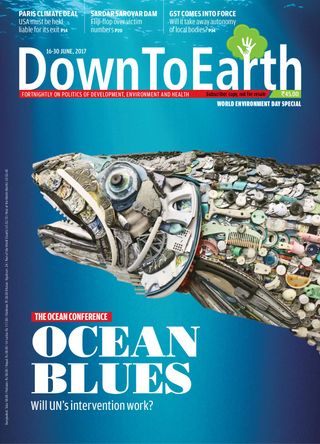

यह कहानी Down To Earth के June 16, 2017 संस्करण से ली गई है।
हजारों चुनिंदा प्रीमियम कहानियों और 10,000 से अधिक पत्रिकाओं और समाचार पत्रों तक पहुंचने के लिए मैगज़्टर गोल्ड की सदस्यता लें।
क्या आप पहले से ही ग्राहक हैं? साइन इन करें
Down To Earth से और कहानियाँ
Down To Earth
THINK TWICE BEFORE FELLING SAL TREES
Many trees considered to be affected by sal borer in the 1990s are still alive today

1 mins
February 16, 2026

Down To Earth
EDGE OF SURVIVAL
Caste divides deny marginalised communities land, resources and essential aid, leaving them more vulnerable to climate disasters
6 mins
February 16, 2026
Down To Earth
A WISH LIST?
Union Budget for 2026-27 conveys the impression of a roll-call of intentions and ambitious proposals, with little detail on their formulation
6 mins
February 16, 2026
Down To Earth
Break down the gender wall
THE RULING National Democratic Alliance (NDA) government has been heavily invested in the goal to make India a developed economy by 2047.
2 mins
February 16, 2026

Down To Earth
MENSTRUAL HEALTH, NOW A FUNDAMENTAL RIGHT
In a landmark judgement, the Supreme Court has recognised menstrual health and hygiene as a fundamental right under Article 21 of the Constitution of India, which guarantees the right to life and dignity.
8 mins
February 16, 2026

Down To Earth
Of devolution and new disasters
The 16th Finance Commission pushes for changes in view of new fiscal and climatic conditions
11 mins
February 16, 2026
Down To Earth
Rising risks of plastics
NEGATIVE IMPACTS on human health due to emissions linked to the plastic lifecycle could double by 2040, according to a study published in The Lancet Planetary Health in January.
1 min
February 16, 2026
Down To Earth
GAP BETWEEN EPIDEMICS NARROWING
A watershed-based and landscape-level approach is needed to address forest degradation
2 mins
February 16, 2026
Down To Earth
WAITING TO STRIKE
Sal heartwood borer is considered the biggest threat to forestry in India, especially to the sal tree, where it lives and breeds.
11 mins
February 16, 2026

Down To Earth
A SPRING DELIGHT
Mustard flowers are not meant only for the eyes. Invite them to your plate once in a while
3 mins
February 16, 2026
Translate
Change font size