कोशिश गोल्ड - मुक्त
1.37 Billion And Not Counting
Down To Earth
|February 01, 2020
India, like the rest of the world, is intensely debating population explosion. But while countries are struggling to keep their numbers at replacement level, India is on the right path towards stabilising population sooner than expected. So what's the discussion all about? KUNDAN PANDEY captures the debate

BE IT a political meeting, a hot TV debate or just a healthy tea-time chat, the topic would most often veer around the population. That was about four decades back. Prime Minister Narendra Modi has brought the debate back to the discussion table after he used the term “population explosion” in his Independence Day speech last year. The term had not been used by any of his predecessors since the country’s disastrous experience of forced family planning during the Emergency period in the 1970s. Since then, population control remains a political pariah. But Modi set the debate on a new trajectory. He equated population control to patriotism. “A small section of society, which keeps its families small, deserves respect. What it is doing is an act of patriotism,” he said.
Of late, politicians have been vocal in pushing the population control debate. It has erupted in a paroxysm of a deep fear of demographic disaster and complete exhaustion of natural resources due to overconsumption. At this age of the sixth mass extinction and the Anthropocene, India is talking about its population, policy and environmental fallout in the same breath.
In July 2019, Rakesh Sinha, Bharatiya Janata Party Member of Parliament in the Rajya Sabha and subscriber to the ideology of the Rashtriya Swayamsevak Sangh, tabled the Population Regulation Bill as a private member bill. The proposed legislation intends to penalize people for having more than two children. Sinha says “population explosion” would irreversibly impact India’s environment and natural resource base, and limit the next generation’s entitlement and progress. The bill proposes that government employees must not produce more than two children, and suggests withdrawal of welfare measures from the poor who have more than two children.
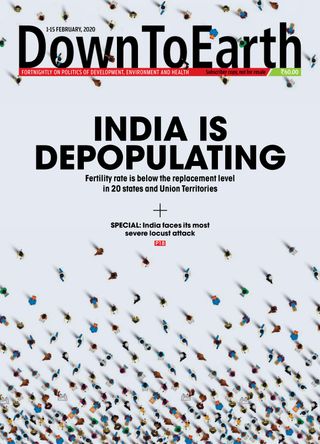

यह कहानी Down To Earth के February 01, 2020 संस्करण से ली गई है।
हजारों चुनिंदा प्रीमियम कहानियों और 10,000 से अधिक पत्रिकाओं और समाचार पत्रों तक पहुंचने के लिए मैगज़्टर गोल्ड की सदस्यता लें।
क्या आप पहले से ही ग्राहक हैं? साइन इन करें
Down To Earth से और कहानियाँ
Down To Earth
Popular distrust
THE WORLD seems to be going through a period of stasis despite facing an unfathomable polycrisis.

2 mins
February 01, 2026

Down To Earth
CONSERVE OR PERISH
Periyar Tiger Reserve has rewritten Indian conservation by turning poachers into protectors and conflict into coexistence
5 mins
February 01, 2026

Down To Earth
'Rivers need to run free'
From Tibet to West Bengal, the Brahmaputra is the pulse of communities and ecosystems along its course. But what are the risks the river faces through human interventions, particularly dams, discusses journalist, author and filmmaker SANJOY HAZARIKA in his new book, River Traveller.
4 mins
February 01, 2026

Down To Earth
India is facing up to its innovation lag
There are signs now that India is acknowledging the superior strides made by China in a frontier technology like Al
4 mins
February 01, 2026

Down To Earth
Competing concerns
What are the repercussions of the EU-Mercosur pact that have made European farmers protest against the free trade agreement?
4 mins
February 01, 2026

Down To Earth
From fryer to flight
Sustainable fuel made from used cooking oil can play a pivotal role in helping India achieve its aviation emission reduction goals. Measures to collect this oil must be revamped
4 mins
February 01, 2026

Down To Earth
ACCESS OPEN
An amendment to India's nodal forest conservation law opens up forests across India to commercial exploitation by the paper industry
6 mins
February 01, 2026
Down To Earth
DRINK FROM TAP CAN BE A REALITY
As cities across India struggle to supply safe piped water, Odisha offers a success story
2 mins
February 01, 2026

Down To Earth
GREAT DRYING
The Earth is hotter than at any point in the past 100,000 years, with 2023-25 becoming the warmest three-year period on record and also breaching the 1.5°C threshold for the first time. One fallout is dwindling freshwater.
22 mins
February 01, 2026

Down To Earth
Green redemption
Restoration of grasslands of Kerala's Pampadum Shola National Park, once dominated by invasive Australian wattles, see a return of streams and native species
1 mins
February 01, 2026
Translate
Change font size