कोशिश गोल्ड - मुक्त
THE NEXT GIANT LEAPS
BBC Focus - Science & Technology
|Summer 2020
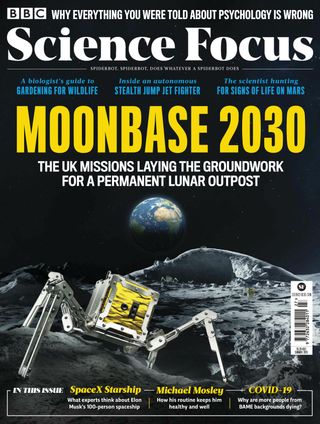
From spider robots to antennas on the Cornish coast, these UK-based projects are laying the groundwork for a permanent station on the Moon. Wallace and Gromit would be proud…

A bout this time next year, a small robotic spider may be taking its first tentative steps on the Moon. It’s not exactly The Spiders From Mars, but the late David Bowie will have played a part in getting it there.
Pavlo Tanasyuk, CEO and founder of the British company Spacebit, remembers once listening to David Bowie’s The Rise And Fall Of Ziggy Stardust And The Spiders From Mars and wondering about one-day building rovers with legs rather than wheels. The idea lay dormant until Tanasyuk was visiting a friend at the Japan Aerospace Agency (JAXA), and mentioned his long-held idea of a spider robot on Mars or the Moon. The friend responded immediately with the Japanese proverb of the asagumo, the morning spider who brings fortune. “That’s when it clicked and I decided that we actually should be doing this rover,” says Tanasyuk.
He incorporated the UK company Spacebar to begin developing the asagumo spider robot. The launch is now scheduled for July 2021, onboard the Peregrine lander that has been developed by the private American company Astrobotic. Peregrine will be flown on a Vulcan Centaur rocket, and if all goes to plan, asagumo will be the UK’s first lunar lander.
Walking on the Moon is tricky because of the regolith, which is the layer of rock fragments and dust that covers the lunar surface. For a walking rover, the dangers are two-fold. First, the legs can sink into this layer, impeding the movement. Second, the dust and fragments can get into the articulated parts of the legs and the motors, causing them to cease up.

यह कहानी BBC Focus - Science & Technology के Summer 2020 संस्करण से ली गई है।
हजारों चुनिंदा प्रीमियम कहानियों और 10,000 से अधिक पत्रिकाओं और समाचार पत्रों तक पहुंचने के लिए मैगज़्टर गोल्ड की सदस्यता लें।
क्या आप पहले से ही ग्राहक हैं? साइन इन करें
BBC Focus - Science & Technology से और कहानियाँ

BBC Science Focus
DOES MY DOG HAVE ADHD?
Officially, Attention-Deficit Hyperactivity Disorder (ADHD) is a human condition. People are diagnosed with it. Dogs are not. Yet many of its core features, including hyperactivity, impulsivity and distractibility, can be found in dogs.

1 min
March 2026

BBC Science Focus
DOES MY BRAIN LIVE A LITTLE IN THE PAST?
Yes, your brain does live a little in the past. It can't help it. The information it receives via your senses is always a little out of date. Whether it's light entering the retinas in your eyes, or sounds vibrating the hairs in your ears, it not only takes time for the data to arrive, but your brain then has to process it.
2 mins
March 2026
BBC Science Focus
ASTRONOMY FOR BEGINNERS
RETURN OF THE EVENING STAR (VENUS)
1 mins
March 2026

BBC Science Focus
CAN YOU STOP YOUR SENSE OF TASTE DULLING AS YOU AGE?
Sometimes I hear people say that food just doesn't taste the same as they get older. It's tempting to blame this on age, but there are other factors at play, too.
1 mins
March 2026
BBC Science Focus
MICROBIOMES OF THE SUPERAGERS
BY STUDYING THE INCREASING NUMBER OF PEOPLE WHO ARE LIVING BEYOND THEIR 100TH BIRTHDAYS, SCIENTISTS ARE DISCOVERING THAT THE SECRET TO REACHING A RIPE OLD AGE IN RUDE HEALTH MIGHT LIE IN OUR GUTS
8 mins
March 2026

BBC Science Focus
HOW BIG WERE MEDIEVAL WAR HORSES?
You might picture knights charging into battle on towering steeds, but medieval horses were typically no bigger than modern-day ponies.
1 min
March 2026

BBC Science Focus
FORCES OF HABIT
Could new research on setting up healthy habits resuscitate those stuttering New Year resolutions?
3 mins
March 2026

BBC Science Focus
5 DANGERS HIDING IN YOUR PROCESSED FOOD
We all know that ultra-processed foods are bad for us, but what ingredients should we particularly try to avoid? And what are they doing to our bodies?
9 mins
March 2026

BBC Science Focus
Mosquitoes are becoming thirstier for human blood
Habitat loss may be pushing mosquitoes towards human hosts with deadly consequences
1 mins
March 2026

BBC Science Focus
HOW CAN I GET OVER MY EX?
Relationship breakups can be brutal, just look at the popularity of songs like 'Someone Like You' by Adele, or all the covers of 'Cry Me a River' by Julie London.
1 mins
March 2026
Translate
Change font size