कोशिश गोल्ड - मुक्त
SHOULD WE BE SIGNALLING OUR EXISTENCE TO ALIEN LIFE?
BBC Focus - Science & Technology
|December 2020
Astrobiologist and extraterrestrial researcher Dr Douglas Vakoch speaks to Sara Rigby about transmitting messages into the cosmos in the hope of finding intelligent extraterrestrial life

METI reverses the process of SETI. SETI, searching for extraterrestrial intelligence, listens for radio or laser signals from space. At METI, we flip it around and instead of listening, we transmit powerful, intentional messages to nearby stars in the hope of eliciting a response.
WHY DO YOU WANT TO SEND OUT A SIGNAL? AND HOW WOULD THAT HELP US FIND ALIEN LIFE?
My big concern is that there are, in fact, a lot of other civilisations out there, but they’re doing exactly what we are. They have these robust SETI programmes and everyone is listening, but no one is saying hello. And so this is our effort to join the galactic conversation.
HAVE MESSAGES OF THIS SORT BEEN SENT BEFORE?
Yeah, there have been sporadic messages sent out. The most famous message was transmitted from what was the world’s largest radio telescope at the time in Arecibo, Puerto Rico. To demonstrate to extraterrestrials, and ourselves, that we could do it, a brief threeminute message was sent out into the Universe.
The message itself was the numbers from 1 to 10 in the binary format, then a description of chemical elements important to life on Earth in terms of their atomic numbers. And there was a description of our DNA, what we look like, how tall we are, how many of us there are on Earth, what our Solar System is like, what the telescope is like. So it was pretty ambitious to cram a lot of information in three minutes.
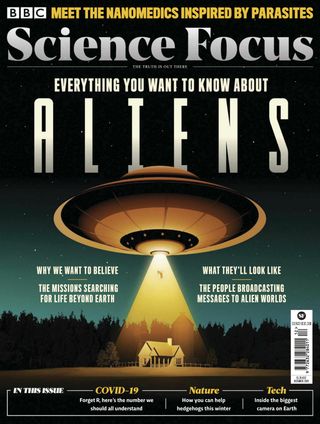

यह कहानी BBC Focus - Science & Technology के December 2020 संस्करण से ली गई है।
हजारों चुनिंदा प्रीमियम कहानियों और 10,000 से अधिक पत्रिकाओं और समाचार पत्रों तक पहुंचने के लिए मैगज़्टर गोल्ड की सदस्यता लें।
क्या आप पहले से ही ग्राहक हैं? साइन इन करें
BBC Focus - Science & Technology से और कहानियाँ

BBC Science Focus
World's biggest cobweb is home to 100,000 spiders
Spiders don't normally create such large colonies, so there's no need to worry about finding one in your basement

1 min
February 2026

BBC Science Focus
A dementia vaccine could be gamechanging – and available already
Getting vaccinated against shingles could protect you from getting dementia, or slow the progression of the disease
1 mins
February 2026

BBC Science Focus
DATA IN SPACE
An unusual spacecraft reached orbit in November 2025, one that might herald the dawn of a new era.
7 mins
February 2026

BBC Science Focus
Climate change is already shrinking your salary
No matter where you live, a new study has found warmer temperatures are picking your pocket
4 mins
February 2026

BBC Science Focus
A MENTAL HEALTH GLOW-UP
Forget fine lines. Could Botox give you an unexpected mental health tweakment?
3 mins
February 2026
BBC Science Focus
Most people with high cholesterol gene don't know they have it
Standard testing struggles to detect the condition
1 mins
February 2026

BBC Science Focus
HOW CAN I BOOST MY IQ?
If you're serious about getting smarter, it's time to ditch the brain-training apps
4 mins
February 2026

BBC Science Focus
Humans are absolutely terrible at reading dogs' emotions
Think you can tell how our furry friends are feeling? Think again
1 mins
February 2026

BBC Science Focus
HOW TO TEACH AI RIGHT FROM WRONG
If we want to get good responses from AI, we may need to see what it does when we ask it to be evil
3 mins
February 2026

BBC Science Focus
What Australia's social media ban could really mean for under-16s
Many people think social media is bad for our kids. Australia is trying to prove it
5 mins
February 2026
Translate
Change font size