कोशिश गोल्ड - मुक्त
The myth of THE FRAGILE HEART
Heartfulness eMagazine
|February 2020
SHAI TUBALI helps us understand the value of keeping the heart open, vulnerable and willing to experience whatever challenges life gives us, without becoming defensive and closing the heart.
-

Your mind cannot tell the difference between “vulnerable” and “breakable.” It thinks it is obvious that if you are vulnerable you are also breakable. Since this sounds logical enough, your mind chooses the strategy of remaining invulnerable as much as possible.
Of course, your mind only wants to protect you, as its main role is to keep you safe in a world full of dangers. It registers moments when you were vulnerable and, as a result, became deeply disappointed, rejected, betrayed, or abandoned. This left you not just with an unbearable pain but also with a profound sense of weakness.
We are all afraid of being weak. It is a survival instinct: we must not show that we are powerless and defenseless in a hostile and overpowering environment. To conceal this weakness, we put on armor, a thick layer of protection with which we defend our vulnerable heart. This is why we become hard and sometimes react quickly to insults or criticism with anger, hatred, and vengefulness, and harbor grudges.
Your mind strives to become so strong and impenetrable that you will never be harmed or feel pain. To achieve this impregnable condition, it surrounds the heart with a protective wall. This wall is not just a metaphor – you could easily sense it in your chest as a thick layer separating you from the environment and protecting your fragile true being. This wall is not necessarily such a bad idea. If you have no coping mechanism for intense emotions and profound disappointments, it is perhaps wise to keep a thick protective layer around your heart. However, in light of our knowledge of the powers of the heart, we should reexamine this strategy: Does it really work? Do we actually feel safer when our hearts are closed?
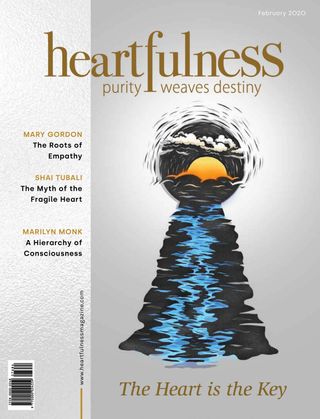

यह कहानी Heartfulness eMagazine के February 2020 संस्करण से ली गई है।
हजारों चुनिंदा प्रीमियम कहानियों और 10,000 से अधिक पत्रिकाओं और समाचार पत्रों तक पहुंचने के लिए मैगज़्टर गोल्ड की सदस्यता लें।
क्या आप पहले से ही ग्राहक हैं? साइन इन करें
Heartfulness eMagazine से और कहानियाँ

Heartfulness eMagazine
A Touch of Heaven
Irish singer and teacher, EILISH BUTLER, combines the mystical chant of Saint Hildegard von Bingen (1098-1176) with the evolutionary path of Uncovering the Voice, satisfying her passion for mystical spirituality and music.

2 mins
November 2025

Heartfulness eMagazine
FROM INNER STILLNESS TO OUTER AGENCY:
How Heartfulness Builds an Internal Locus of Control and Workplace Success
3 mins
November 2025

Heartfulness eMagazine
Virtual Intelligence
Author and cultural commentator CHARLES EISENSTEIN extends last month's argument about virtual substitutes hollowing out reality-this time to Al's imitation of intimacy-and points to what only embodied relationships can restore.
10 mins
November 2025

Heartfulness eMagazine
Grace Is the Creative Spark
Do you sometimes feel that life is blessed and things are unfolding effortlessly, without force or struggle? Some people say it is because of “grace” or “God’s grace.
5 mins
November 2025

Heartfulness eMagazine
Zuri's Guiding Light
A luminous fable from LIAA KUMAR on self-trust, belonging, and inner guidance.
3 mins
November 2025

Heartfulness eMagazine
I AM
In a quiet meditation on desire, stillness, and the witnessing Self, JARNA KHIMANI traces the shift from seeking to being.
3 mins
November 2025

Heartfulness eMagazine
Courage: From Relief to Presence
JASON NUTTING on why relief is temporary-and how courage, rooted in the heart, endures.
3 mins
November 2025

Heartfulness eMagazine
Embracing The Value Within
DR. ROXANNE M. ST. CLAIR on seeing the value in you—and in others—and making it a daily practice.
4 mins
November 2025
Heartfulness eMagazine
Gratitude's Gift
A Creston woman recently recounted her experience in a checkout line.
2 mins
November 2025

Heartfulness eMagazine
HAPPINESS and Gut Health
Q: How does gut health influence mental well-being, and can practices like meditation actively support a healthier digestive system? The gut is often called the second brain because it has over 500 million neurons that constantly talk to the brain through the vagus nerve.
2 mins
November 2025
Translate
Change font size