कोशिश गोल्ड - मुक्त
Devendra Fadnavis - The Man Who Defeated The Marathas
The Caravan
|October 2019
The political intrigues of Devendra Fadnavis.

The historical tug of war for power between Marathas and Brahmins has influenced Maharashtra’s politics since the time of the Maratha empire.
Founded by the Maratha warrior-king Shivaji Bhonsle I, who assumed the title of Chhatrapati, the kingdom reached its peak in the 1750s, when it spanned approximately two and a half million square kilometres—from Thanjavur in Tamil Nadu to present-day Peshawar in Pakistan in the west, and Bengal in the east.
The rapid expansion of the empire in the mid-eighteenth century happened during what is known as the Peshwa era. A few decades after the death of Shivaji, the Peshwas—Brahmin executives of the Maratha Chhatrapati—became more powerful than the Chhatrapati himself. While the Maratha Chhatrapati was reduced to a titular head, the Brahmin Peshwa held the highest administrative office. To keep the kingdom together, the Peshwas granted semi-autonomy to Maratha chieftains such as the Pawars of Dhar, the Scindias of Gwalior and the Bhosales of Nagpur, and the empire became a confederacy. But to this day, the disempowerment of Maratha rulers by Brahmin ministers rankles for the Maratha community.
Perhaps the most striking Brahmin politician from this time was Nana Phadnavis, who rose from the post of a clerk to that of a minister in the Peshwa administration. (“Phadnavis” was a title given to keepers of the Peshwas’ accounts.)
For a large part of the period between the 1760s and his death in 1800, Nana Phadnavis was the most powerful man in the Maratha empire, and was perceived as its de facto ruler. In 1773, the teenaged Peshwa Narayan Rao was murdered by his uncle, Raghunath Rao, who then installed himself as the Peshwa. Phadnavis, along with 11 other ministers from the administration, quickly deposed Raghunath Rao, in what is known as the Baarbhai conspiracy—the conspiracy of the twelve.
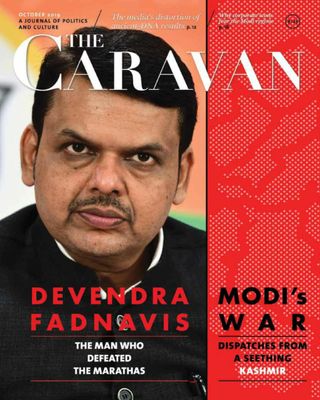

यह कहानी The Caravan के October 2019 संस्करण से ली गई है।
हजारों चुनिंदा प्रीमियम कहानियों और 10,000 से अधिक पत्रिकाओं और समाचार पत्रों तक पहुंचने के लिए मैगज़्टर गोल्ड की सदस्यता लें।
क्या आप पहले से ही ग्राहक हैं? साइन इन करें
The Caravan से और कहानियाँ
The Caravan
ANY RESEMBLANCE TO ACTUAL EVENTS IS NOT COINCIDENTAL
INTERFAITH ROMANCE FICTION IN THE ERA OF LOVE JIHAD

31 mins
December 2025
The Caravan
Manufacturing Legitimacy
How a Washington Post columnist laundered the Sangh's violent history
7 mins
December 2025

The Caravan
DEATH of REPORTAGE
THE DISMANTLING OF OUTLOOK'S LEGACY
32 mins
December 2025

The Caravan
FOG LIGHT
Samayantar's two-and-half-decade fight against the shrinking of Hindi's world
22 mins
December 2025

The Caravan
THE FINE PRINT
ON 19 MARCH 2005, thousands came out on the streets of Udupi, in coastal Karnataka, to protest a gruesome incident that had shaken the region a week earlier.
23 mins
December 2025

The Caravan
CHARACTER BUILDING
The enduring language of Indian streets
5 mins
December 2025
The Caravan
THE CONVENIENT EVASIONS OF RAJDEEP SARDESAI
DRESSED IN A turban and white kurta pyjama, Narendra Modi sat in the passenger seat of a van crossing the Patan district of Gujarat, in September 2012. Next to him sat Rajdeep Sardesai, the founder-editor of the news channel CNN-IBN.
63 mins
December 2025

The Caravan
Ahmed Kamal Junina: “Every class we hold is a defiant refusal to surrender”
A professor in Gaza on teaching during a genocide / Conflict
11 mins
December 2025

The Caravan
Bangla Pride, Urdu Prejudice
The language wars have primed West Bengal for the RSS
8 mins
November 2025

The Caravan
THE INTERVIEW
\"The people are naked before the government but the government is opaque to them\"
16 mins
November 2025
Translate
Change font size