
मैगज़्टर गोल्ड के साथ असीमित हो जाओ
10,000 से अधिक पत्रिकाओं, समाचार पत्रों और प्रीमियम कहानियों तक असीमित पहुंच प्राप्त करें सिर्फ
कोशिश गोल्ड - मुक्त
How Many Stocks Should You Own?
Kiplinger's Personal Finance
|July 2022
With this year's rough ride, you don't need reminding that stocks are volatile.
-

Their prices bounce up and down, sometimes in extreme ways. The U.S. market as a whole has produced average annual returns of about 10% over the past century, but it doesn't go up 10% every year. In roughly one out of four years, it declines-sometimes a lot.
If stocks returned the same amount every year, then, like bonds, they would yield gains of only a few percentage points. High returns are the reward you get for enduring the fear (often the sheer terror) of watching pieces of your nest egg disappear into thin air. People like me tell you to hold on. History shows that markets bounce back. But enduring sickening declines isn't easy.
The best way to smooth the ride is through diversification. I'm not talking here about portfolio diversification-the allocation of your assets to stocks, bonds, cash and maybe more. Portfolio diversification is a necessity but a subject for another day. The topic today is diversification in the part of your portfolio that consists of stocks and stock funds.
The value of diversification seems awfully obvious. Morningstar data in June 2021 showed that about 39% of all U.S. stocks had ever suffered three-month losses of 50% or more, but fewer than 1% of diversified stock funds had incurred losses that severe.
Consider the sad tale of Enron, once a high-flying Houston energy company. When it collapsed in 2001, thousands of investors, including Enron employees whose retirement plans were heavily invested in the stock, suffered huge losses. Enron was the seventh-largest company in the Fortune 500, but in 2000 its market capitalization (price times shares outstanding) represented less than 1% of the value of the S&P 500 index. If you had put $10,000 in an S&P 500 index fund and all the other stocks maintained their prices, then Enron's trip to zero would have cost you just $100.
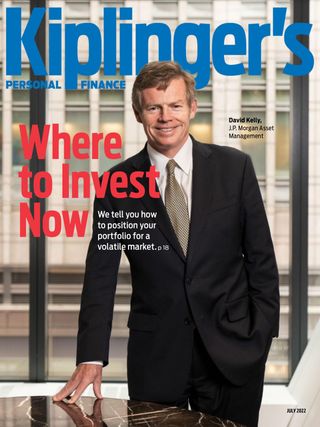

यह कहानी Kiplinger's Personal Finance के July 2022 संस्करण से ली गई है।
हजारों चुनिंदा प्रीमियम कहानियों और 10,000 से अधिक पत्रिकाओं और समाचार पत्रों तक पहुंचने के लिए मैगज़्टर गोल्ड की सदस्यता लें।
क्या आप पहले से ही ग्राहक हैं? साइन इन करें
Kiplinger's Personal Finance से और कहानियाँ

Kiplinger's Personal Finance
NAVIGATING MEDICARE ENROLLMENT
Failing to sign up on time can be a costly mistake.

2 mins
March 2026

Kiplinger's Personal Finance
HOW TO LOWER YOUR TAX BILL
The One Big Beautiful Bill Act brought a host of changes that could affect your 2025 tax return. We'll show you how to make the most of them and get other breaks that reduce what you owe-or maximize your refund.
13 mins
March 2026

Kiplinger's Personal Finance
Trim Your Child-Care Costs
Working parents can take advantage of tax breaks and local assistance programs.
5 mins
March 2026

Kiplinger's Personal Finance
Focus on Income First
EVERY reader knows I am unfazed at the sacrifice of a percentage point or two of share price or net asset value to secure a higher yield or cash distribution. That underscores my reverence for short-term high-yield bonds, packaged car leases and credit card bills, floating-rate corporate bank loans, and the many multisector and flexible exchange-traded and closed-end funds that own these assets or some of each. These investments reliably distribute upward of 5% and sometimes 7%. Add funds or ETFs that write options on stocks or stock indexes to pay out 8% or more, and you might easily overlook how the Federal Reserve has slashed the interest rate it controls to 3.5%—the low since September 2022—with further cuts to follow this year.
2 mins
March 2026

Kiplinger's Personal Finance
Cleaning Up the Paper Clutter
Once you hit retirement, keeping tax returns from decades ago can become unwieldy.
3 mins
March 2026

Kiplinger's Personal Finance
RESOLVE CONFLICTS WITH YOUR ADVISER
Knowing how to deal with a disagreement can improve both your finances and your relationship with your planner.
3 mins
March 2026

Kiplinger's Personal Finance
Longevity Advice for Women
IN recent columns, I have written about longevity literacy and the need for long-term-care planning (see “Living in Retirement,” Dec. 2025 and Feb. 2026). To see how women fit into this picture, I interviewed Maddy Dychtwald, cofounder of AgeWave, a research and consulting firm focused on aging, and author of Ageless Aging: A Woman’s Guide to Increasing Healthspan, Brainspan and Lifespan. Dychtwald interviewed dozens of researchers, scientists and physicians for her book, and these are some of her key takeaways.
2 mins
March 2026
Kiplinger's Personal Finance
MORE TOOLS TO BUILD A BOND LADDER
THE market for exchange-traded funds that help build bond ladders is growing.
1 mins
March 2026

Kiplinger's Personal Finance
MAKE LEARNING A LIFELONG AFFAIR
GOING back to live on a college campus, taking classes, and mixing and mingling with students young enough to be their grandchildren wasn't originally on Anna and Jeffry Young's retirement bingo card. Yet that's their life these days.
12 mins
March 2026

Kiplinger's Personal Finance
GREAT TRIPS FOR SOLO TRAVELERS
Planning a vacation for one? From mountain treks to wellness retreats, you can find a getaway that suits your style—and that builds in some companionship, too.
10 mins
March 2026
Translate
Change font size