
मैगज़्टर गोल्ड के साथ असीमित हो जाओ
10,000 से अधिक पत्रिकाओं, समाचार पत्रों और प्रीमियम कहानियों तक असीमित पहुंच प्राप्त करें सिर्फ
कोशिश गोल्ड - मुक्त
MAGNETITE: A NATURAL HISTORY
Rock&Gem Magazine
|July 2021
An Iron Oxide that Changed the World

Whether they will admit it or not, most placer miners have voiced unkind comments about magnetite. And that’s understandable because magnetite is the primary component of the ubiquitous, heavy, black sands that often clog sluice box riffles. But there’s another side to magnetite that deserves respect, for this iron-oxide mineral has profoundly influenced history, culture, industry, and science.
The best-known variety of magnetite is lodestone. Its natural magnetism has created colorful alchemistic lore; greatly advanced navigation, surveying, and cartography; and inspired landmark breakthroughs in scientific thought. Magnetite made possible the early voice recorders that revolutionized radio broadcasting; today, it is used in many industrial dense-media-separation processes.
And that’s not all. More than a half-billion tons of magnetite ore are currently mined worldwide each year as a source of iron. And geophysicists study magnetite grains in igneous rocks to learn about the ancient Earth’s magnetic fields and tectonic-plate movements.
Magnetite (iron oxide, Fe 3 O4 ) consists by weight of 72.36 percent iron and 27.64 percent oxygen. It crystallizes in the isometric system, usually as octahedrons, occasionally as dodecahedrons, and rarely as cubes. Opaque and with a submetallic-to-metallic luster, magnetite is black to dark-gray in color with an occasional hint of blue iridescence. Brittle and with a subconchoidal-to-uneven fracture, it has a Mohs hardness of 5.5-6.5 and a substantial specific gravity of 5.17.
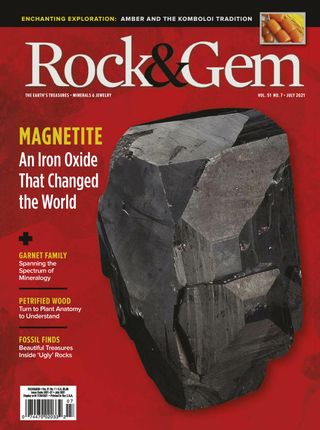

यह कहानी Rock&Gem Magazine के July 2021 संस्करण से ली गई है।
हजारों चुनिंदा प्रीमियम कहानियों और 10,000 से अधिक पत्रिकाओं और समाचार पत्रों तक पहुंचने के लिए मैगज़्टर गोल्ड की सदस्यता लें।
क्या आप पहले से ही ग्राहक हैं? साइन इन करें
Rock&Gem Magazine से और कहानियाँ
Rock&Gem Magazine
A New Amber Locality Fills a Gap
A sandstone quarry in central Ecuador has yielded the first significant deposit of Mesozoic amber from South America.

1 min
January / February 2026
Rock&Gem Magazine
Did "Left-Handed" Fish Leave Water Earlier than Thought?
Fossil evidence suggests that fish (or \"fishapods\") dragged themselves onto land during the middle Devonian Period.
1 min
January / February 2026

Rock&Gem Magazine
"Lab Quakes” Produce Surprising Results
When faults let loose and earthquakes result, the main effect we mortals experience is the violent shaking.
1 min
January / February 2026
Rock&Gem Magazine
This Egg is No Spring Chicken
How to date a dino egg
1 min
January / February 2026
Rock&Gem Magazine
Have we Already Mined the Critical Minerals We Need
Then why are we throwing them away?!
1 min
January / February 2026
Rock&Gem Magazine
One Toxic Worm
A critter that creates & tolerates orpiment!
1 min
January / February 2026
Rock&Gem Magazine
ROCK & GEM FIELD GUIDE: Silver
Silver (Ag) is a native element and one of Earth's most prized precious metals.
2 mins
January / February 2026
Rock&Gem Magazine
DINOSAURS OF THE HELL CREEK MUSEUM
In the Badlands of South Dakota, just outside the small town of Belle Fourche—pronounced “Bell Foosh”—a new attraction has taken shape that every dinosaur enthusiast should see. The Dinosaurs of the Hell Creek Museum is part hands-on exhibit, part science center and part active research lab.
3 mins
January / February 2026
Rock&Gem Magazine
The Lost Twins of Kongsberg
A Silver Story Resurfaced
3 mins
January / February 2026
Rock&Gem Magazine
Switzerland's ICE PALACE
Walk Inside a Glacier at The Top of Europe
7 mins
January / February 2026
Translate
Change font size