कोशिश गोल्ड - मुक्त
Iron's Uncommon Impact Within Gems
Rock&Gem Magazine
|March 2020
In recent On the Rocks columns, I’ve written about the elements and valence electrons.

Readers commented favorably about them, so this column will describe just the active metal element iron and its effects of color in minerals. We are all familiar with the iron minerals hematite, magnetite, siderite, and certainly rust. But we are not as familiar with the role iron plays in the color of gem minerals. Iron gives some of our favorite minerals very attractive colors. Without a trace of this common metal in the molecular structure of many minerals, they would really lack eye appeal.
Take benitoite, for instance. It is a rare and popular blue gemstone found in California. When first found, it was thought to be a blue diamond. It is so beautiful it has been named California’s official state gem.
Benitoite’s chemical composition is barium, titanium, silicate. By themselves, the three elements in benitoite are not the cause of its lovely blue color. We don’t know what color benitoite would be if a trace of iron was not part of its atomic structure.
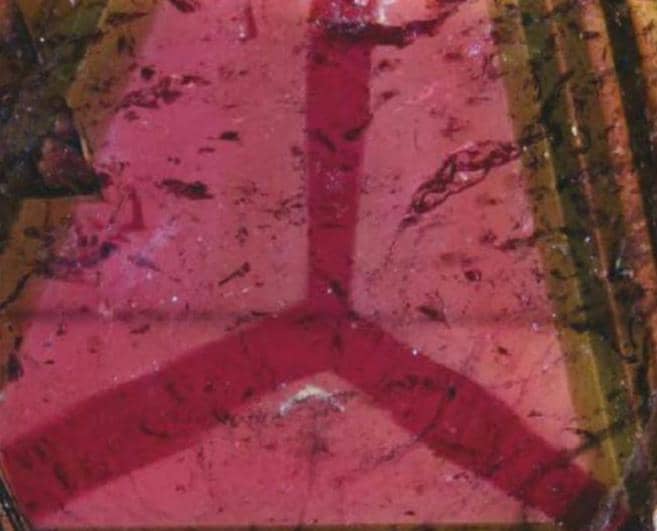
Though iron is necessary for benitoite to have color, iron does not act alone. Iron’s valence electrons combine with titanium, and the silicate’s oxygen, in doing what we call charge transfer, which gives benitoite its blue color. Iron takes in some light energy as it enters the gem. Its two valence electrons use that energy to shift to oxygen, which then shifts electrons to titanium, all of which take light energy, which affects the light emerging from the gem with good blue color. All three of the elements, including iron, are important for this gem to have its blue color.

यह कहानी Rock&Gem Magazine के March 2020 संस्करण से ली गई है।
हजारों चुनिंदा प्रीमियम कहानियों और 10,000 से अधिक पत्रिकाओं और समाचार पत्रों तक पहुंचने के लिए मैगज़्टर गोल्ड की सदस्यता लें।
क्या आप पहले से ही ग्राहक हैं? साइन इन करें
Rock&Gem Magazine से और कहानियाँ
Rock&Gem Magazine
A New Amber Locality Fills a Gap
A sandstone quarry in central Ecuador has yielded the first significant deposit of Mesozoic amber from South America.

1 min
January / February 2026
Rock&Gem Magazine
Did "Left-Handed" Fish Leave Water Earlier than Thought?
Fossil evidence suggests that fish (or \"fishapods\") dragged themselves onto land during the middle Devonian Period.
1 min
January / February 2026

Rock&Gem Magazine
"Lab Quakes” Produce Surprising Results
When faults let loose and earthquakes result, the main effect we mortals experience is the violent shaking.
1 min
January / February 2026
Rock&Gem Magazine
This Egg is No Spring Chicken
How to date a dino egg
1 min
January / February 2026
Rock&Gem Magazine
Have we Already Mined the Critical Minerals We Need
Then why are we throwing them away?!
1 min
January / February 2026
Rock&Gem Magazine
One Toxic Worm
A critter that creates & tolerates orpiment!
1 min
January / February 2026
Rock&Gem Magazine
ROCK & GEM FIELD GUIDE: Silver
Silver (Ag) is a native element and one of Earth's most prized precious metals.
2 mins
January / February 2026
Rock&Gem Magazine
DINOSAURS OF THE HELL CREEK MUSEUM
In the Badlands of South Dakota, just outside the small town of Belle Fourche—pronounced “Bell Foosh”—a new attraction has taken shape that every dinosaur enthusiast should see. The Dinosaurs of the Hell Creek Museum is part hands-on exhibit, part science center and part active research lab.
3 mins
January / February 2026
Rock&Gem Magazine
The Lost Twins of Kongsberg
A Silver Story Resurfaced
3 mins
January / February 2026
Rock&Gem Magazine
Switzerland's ICE PALACE
Walk Inside a Glacier at The Top of Europe
7 mins
January / February 2026
Translate
Change font size