कोशिश गोल्ड - मुक्त
Greed Is Good
The Smart Manager
|May - June 2017
“[Brand desire]…is the passionate feeling for acquisition and experience of a product or service which is driven by a set of connected factors that are intrinsic and also extrinsic.” Nicholas Ind, co-author of Brand Desire: How to Create Consumer Involvement and Inspiration, discusses how more than ‘want’ or ‘need’, ‘desire’ entices consumers to brands. And how brands should cultivate desire to build a stronger connect and engagement.

Which brand do you desire most? It is a question that we have asked people time and again. There are some suggestions that come up fairly consistently, such as Apple, sports brands such as Adidas and Nike, car brands such as Audi and Porsche, and fashion brands such as Prada and Levi’s, and also some unique ones—for example, one person told us about his experience of a patisserie in Lisbon, Portugal. What are as interesting as the choices though are the explanations—linkages back to family and childhood, the sensuality of experience, and the way that brand reflects who you are and who you would like to become. Perhaps not surprisingly, the language people use is often emotional. For some, there is a sense of aspiration but little fantasy for the unattainable. This research led us to wonder whether desire for a brand (not a ‘need’ or a ‘want’ as is often used in marketing, nor ‘love’ which is more enduring) was important and could it be nurtured and managed by brand owners?
To validate our ideas about brand desire, we drew on an attitudinal study of some 8,000 consumers that has been repeated regularly since 2010. This work demonstrates that the value of a brand is built on two pillars: brand pressure which is concerned with awareness of a brand and its availability; and brand desire which is concerned with performance, personality, and emotional connectivity. Not all brands score high on these measures—some are good at pressure but weak in terms of desire and some are niche players (through strategic choice or lack of resources) that are strong on desire but weak on pressure. Leading brands though (what we call ‘desire leaders’) excel at both pressure and desire.
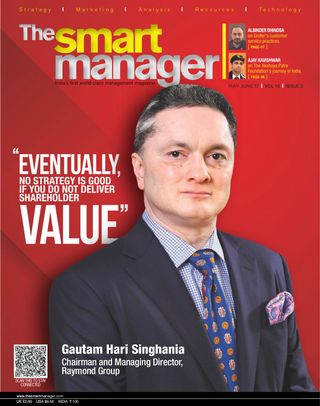

यह कहानी The Smart Manager के May - June 2017 संस्करण से ली गई है।
हजारों चुनिंदा प्रीमियम कहानियों और 10,000 से अधिक पत्रिकाओं और समाचार पत्रों तक पहुंचने के लिए मैगज़्टर गोल्ड की सदस्यता लें।
क्या आप पहले से ही ग्राहक हैं? साइन इन करें
The Smart Manager से और कहानियाँ

The Smart Manager
Building A Quality Culture
A strong company culture defined by its values, beliefs, and behaviors, has a profound impact on its products and services. More so in today’s VUCA world, where to stay relevant and maintain a competitive edge, it is critical for organizations to build a culture that focuses on quality. Suresh Lulla, author of Quality Fables, elucidates through significant examples how creating a culture of quality is imperative to driving success and productivity.

5 mins
July-August 2016

The Smart Manager
Customers For Life
The history of General Motors in India can be traced back to the 1920s, when it became the first automotive company to set up an assembly plant in the country. The relationship since then has not been as fruitful as GM would have hoped. GM’s flagship brand, Chevrolet, was introduced in India to build upon the success of the popular Opel marque. However, success has been fleeting at best—an issue that GM India is determined to rectify. It aims to do so by adopting a two-pronged approach: using customer feedback to influence product development, and delivering a superior sales-to-service experience.
4 mins
July-August 2016

The Smart Manager
The Digital Shift
… technology will radically disrupt HR in the near future. Indeed, it is already changing the way HR works and the role it plays and opening the door to a new type of “digital HR” function.1 The rise of digital and social media is changing the dynamics of HR and creating new ways of hiring, engaging, and retaining employees.
4 mins
July-August 2017

The Smart Manager
The Story Of Telling
“The best brands are built on great stories,”* this remark by Ian Rowden best captures the strategy of diligent brand building. Much more than attractive logos or the products themselves, what builds a brand is how successfully a story is woven around it. Brand marketers have to be good storytellers indeed.
8 mins
July-August 2017

The Smart Manager
Complexity Is Simpler Than You Think
Kay Kendall and Glenn Bodinson, authors of Leading the Malcolm Baldrige Way, shatter myths about excellence models such as Baldrige and EFQM.
6 mins
March/April 2017

The Smart Manager
Proponents of Isolation Never Become Victors
Multilateralism in the political and economic space has always led to frameworks that favor the mighty. WTO was no exception. With agriculture kept out of its purview, it could never become a truly fair and free trading system. China was the only large emerging economy that exploited relative openness in low-cost manufactured goods to take full advantage of the system. Other emerging economies could at best garner minor gains.
1 mins
March/April 2017

The Smart Manager
A History Lesson (From Year One) for Trump and the Brexit Crowd: Isolationism Has Never Worked!
Professor Stephane Garelli on growing isolationism.
3 mins
March/April 2017

The Smart Manager
A Win-Win Game
Business is not a sport where some stakeholder has to lose or fare badly for others to do well. Building an atmosphere of trust and transparency between all stakeholders will help companies retain them even during adverse times.
7 mins
March/April 2017

The Smart Manager
A Sustainable Model
With a total market value of $4.3 trillion and an employment base of at least 1.3 million direct employees and millions of others indirectly employed, platforms have become an important economic force.*Companies today are constantly looking for ways to build platforms—Infosys Ltd announced its plans of monetizing its platforms to make them a $2 billion business by March 2021. But are all platform businesses successful?
9 mins
March/April 2017

The Smart Manager
Custom Made
…three in four consumers said they receive too many emails from brands, and one-fifth said they could not handle the current volume…69 per cent have ‘unfollowed’ brands on social media, closed their accounts or cancelled subscriptions.*In these times, when the market is flooded with products and services, the most efficent way to engage customers is to offer them customized content. To achieve this, brands need to focus on observing the nuances of individual preferences.
5 mins
March/April 2017
Translate
Change font size