कोशिश गोल्ड - मुक्त
Purushartha And Parampara
Swarajya Mag
|August 2017
Only a society entirely constituted by enlightened beings can afford to dispense with smriti. All other societies need both sruti and smriti.

LAST MONTH, WE saw how the individual is both the product and the creator of tradition, though the latter possibilities are often denied to most ordinary people. But just as our genes are previously given to us, our traditions have already left their mark on our minds. This is true also of traditions of discontinuity and rejection. That is why it is possible to argue for a tradition of modernity, which we may characterise as disruptive and contra-distinctive from traditions of affirmation and continuity. Though tradition, in the broader sense of the totality of genetic information, does not exhaust the capacities or possibilities of our physical and mental existence. It provides the base, but not necessarily the limits. Therefore, each individual must reprocess his tradition in the light of his own experiences; some merely pass it on, while others change it, even to the extent of effecting a mutation. Any process of recreation thus involves a rejection of some aspect of the inherited past as it does a reinvention or revitalisation of others. Socially, too, this process happens sometimes smoothly, at other times violently, in a cataclysmic rupture.
In Hindu culture, the relationship between the individual and parampara was regulated by a set of codes or purusharthas—dharma (virtue, ethics), artha (power, profit), kama (desire, pleasure) and moksha (freedom, transcendence), signifying the four-fold expression and general thrust of life itself. In our traditional understanding, they were seen as a unity, in continuum, not fragmented or divided. Thus, there was no dichotomy between moksha and dharma, on the one hand, and artha and kama, on the other. The opposition between the sacred and the secular, spirit and matter, was inadmissible. That is why paramartha (ultimate value) includes, not rejects,
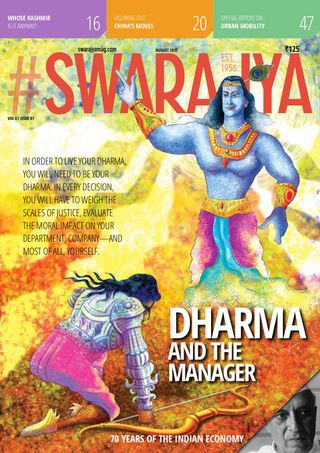

यह कहानी Swarajya Mag के August 2017 संस्करण से ली गई है।
हजारों चुनिंदा प्रीमियम कहानियों और 10,000 से अधिक पत्रिकाओं और समाचार पत्रों तक पहुंचने के लिए मैगज़्टर गोल्ड की सदस्यता लें।
क्या आप पहले से ही ग्राहक हैं? साइन इन करें
Swarajya Mag से और कहानियाँ

Swarajya Mag
Artificial And Natural
Will quantum computers push man up towards his eventual union with the transcendent omniscience that some refer to as Brahman?

6 mins
June 2017
Swarajya Mag
So Much In Common
Between Hindutva And Zionism, There Exist Some Core Similarities That Shape Their Worldview In Profound Ways.
13 mins
June 2017

Swarajya Mag
A Chequered Past
Earlier India had to accommodate the Arab-Islamic opposition to normalisation of relations with Israel, but now it is the other way around.
4 mins
June 2017

Swarajya Mag
Kibbutzim To Capitalism
Israel started with a clear socialistic ideology. How did it then turn itself into a vibrant capitalist economy?
6 mins
June 2017

Swarajya Mag
The 95 Percent Factor
The story of Israel’s agricultural sector is near-miraculous. India can—and should—tweak that model to suit our local conditions.
7 mins
June 2017

Swarajya Mag
Feeble Memories
On the 50th anniversary of the uprising, Naxalbari shrugs off its gory past.
6 mins
June 2017

Swarajya Mag
Back To The Future
ICAR is open to collaborative research with agri-biotech MNCs, says Director-General Trilochan Mohapatra
5 mins
October 2016

Swarajya Mag
Distribute And Win
From space projects to mundane computing tasks, distributed systems are very often better than a single monolithic design.
7 mins
October 2016

Swarajya Mag
Vagina Dentata
Since time immemorial, men have been afraid of the woman’s most private part. The easiest escape is to just blame it on biology.
5 mins
October 2016

Swarajya Mag
The Naked Truth
Josy Joseph takes one through a very flawed India, one that we choose to close our eyes to. But he is also a rather biased author.
4 mins
October 2016
Translate
Change font size