
मैगज़्टर गोल्ड के साथ असीमित हो जाओ
10,000 से अधिक पत्रिकाओं, समाचार पत्रों और प्रीमियम कहानियों तक असीमित पहुंच प्राप्त करें सिर्फ
कोशिश गोल्ड - मुक्त
Insects: Know Your Friends From Your Foes
Farmer's Weekly
|October 11, 2019
Hannelene Badenhorst, a PhD candidate in entomology at the University of the Free State, explains the value of differentiating beneficial insects and other arthropods from harmful ones before resorting to blanket chemical control. Lloyd Phillips reports.

The estimated 2,5 million to 10 million species of insects on the planet have a profound impact, directly and indirectly, on all other creatures and on the environment. This stands to reason; there are an estimated 10 quintillion (or 10 billion billion) individuals, and they represent 80% of all living organisms on earth.
DO YOUR BEST TO MAINTAIN THE DIVERSITY OF POLLINATORS
They are also the most diverse group of organisms.
“Slightly more than one million insect species have actually been named, and only a small proportion of them have been properly studied,” says Hannelene Badenhorst, a PhD candidate in entomology at the University of the Free State.
“They are responsible for pollinating about 85% of the world’s flowering plants.
“Non-insect arthropods, such as spiders, also have a significant environmental role. Some aid in predating on pests and by promoting the decomposition of organic matter, while others are pests themselves.”
(Insects comprise 90% of all arthropod species.)
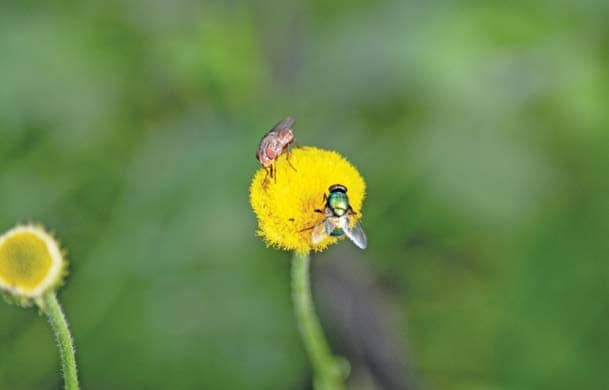
Although insects are the main consumers of plants, including crops, fewer than 1% of the known insect species are considered pests by humans, explains Badenhorst. Of these, only a few hundred species have proved to be constantly problematic. All the other insects and arthropods are beneficial to humans and the environment, providing a diverse range of key ecosystem services between them.
One of these, she points out, is plant pollination. While bees make the largest contribution to pollination and rightfully deserve to be protected, it is also critical to maintain the diversity of other insect pollinators, as many plant species have co-evolved with them and can only be pollinated by specific groups of pollinators.

यह कहानी Farmer's Weekly के October 11, 2019 संस्करण से ली गई है।
हजारों चुनिंदा प्रीमियम कहानियों और 10,000 से अधिक पत्रिकाओं और समाचार पत्रों तक पहुंचने के लिए मैगज़्टर गोल्ड की सदस्यता लें।
क्या आप पहले से ही ग्राहक हैं? साइन इन करें
Farmer's Weekly से और कहानियाँ
Farmer's Weekly
Cash flow budgets: keeping farmers in control of liquidity, risk, and their survival
Profit doesn't guarantee a farm's survival - cash does. Cobus du Plessis explains why cash flow budgets are one of the most important yet underused financial tools on South African farms.

5 mins
February 27 - March 06, 2026

Farmer's Weekly
The toast of the Navy
The incredible story of the World War II-era Great Dane dog Nuisance being enlisted in the Royal Navy is well documented. Graham Jooste shared some entertaining anecdotes involving the canine shipmate.
6 mins
February 27 - March 06, 2026
Farmer's Weekly
Healthier soils deter destructive locusts
Locust swarms remain a serious global threat, capable of devastating crops, livelihoods and local economies across vast regions.
1 min
February 27 - March 06, 2026
Farmer's Weekly
Wheat crisis dominates Grain SA regional meetings
As the ongoing wheat crisis continues to erode producers' margins, emotions ran high at Grain SA's regional meeting in Moorreesburg in the Western Cape.
2 mins
February 27 - March 06, 2026

Farmer's Weekly
A FARMER'S EXPERIENCE
Street Wallet has been a game-changer for Mario Athanasopoulos, hydroponic production consultant and owner of Green City Farms.
1 mins
February 27 - March 06, 2026
Farmer's Weekly
Kesieberg Merino Stud Production Sale
The Kesieberg Merino Stud Production Sale was held on the farm Leeuwfontein on 4 February on behalf of Willie and Herman Henning.
1 min
February 27 - March 06, 2026
Farmer's Weekly
Not cheaper, just different: what you should know about farming in Mozambique
Although Mozambique is often viewed as a cheaper, easier farming location than South Africa, cost comparisons tell a more complex story. But while cross-border production presents real challenges, it also offers opportunities for complementary trade, diversification and regional food security, particularly when it comes to subtropical crops such as bananas.
10 mins
February 27 - March 06, 2026

Farmer's Weekly
The all-rounder anchoring South Africa's beef value chain
Louis Steyl, CEO of the Bonsmara Cattle Breeders' Society of South Africa, spoke to Octavia Avesca Spandiel about how the versatile Bonsmara breed anchors the country's beef value chain, delivering balanced performance, reproductive and feed efficiency, and carcass traits across extensive and intensive systems.
6 mins
February 27 - March 06, 2026

Farmer's Weekly
THE HITCHING POST
I'm a 60-year-old white woman who loves camping, animals, the outdoors, and watching sport.
2 mins
February 27 - March 06, 2026
Farmer's Weekly
Foot-and-mouth disease in pigs
Recently, the radio news mentioned an outbreak of foot-and-mouth disease (FMD) in pigs in South Africa.
2 mins
February 27 - March 06, 2026
Translate
Change font size