कोशिश गोल्ड - मुक्त
Vacuum Technology In The Chemical Industry
Chemical Engineering World
|August 2018
For many economic sectors, the chemical industry is an indispensable supplier of raw materials. The automotive industry, mechanical engineering, plastics, foodstuff, glass, or building materials industries, for example, are all reliant on substances that are produced by the chemical industry. Plastics or synthetic resins, which are used as the basis for coatings or foams, play by far the most important role. These are employed in a countless number of end products that we use daily. Vacuum technology is crucial for a large part of these applications in the chemical industry.
-

Polycondensation is a chain reaction of small molecule compounds, or monomers. The functional groups of the monomers involved generally react by losing water and becoming long-chain molecules, or polymers. Accordingly, only monomers with at least two functional groups can create chains or networks. The product that is formed at the end of the poly condensation depends on the number and types of functional groups of the reacting monomer. During this process, vacuum technology is used in order to prevent unwanted byproducts of poly condensation. In polymer chemistry, poly condensation is one of the most important processes. It is used to produce plastics such as polyethylene terephthalate (PET), polyethylene or poly carbonate in large quantities. Adhesives are also produced with poly condensation as well as brake pads for automobiles.
Vacuum conditions in the medium vacuum range between 1 and 10 mbar are an essential part of the poly condensation process, especially in the production of high quality plastics. Together with temperature, vacuum technology steers the complete poly condensation process and significantly affects the resulting end product. Even the smallest fluctuations in pressure during the reaction can lead to damage of the end product or even render it unusable. The thermal load is reduced by vacuum during the process, especially with temperature sensitive materials. Without vacuum, the production of certain plastics would not be possible; they would burn.
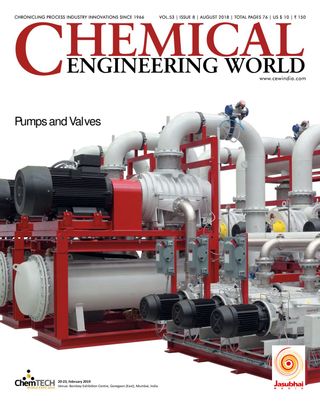

यह कहानी Chemical Engineering World के August 2018 संस्करण से ली गई है।
हजारों चुनिंदा प्रीमियम कहानियों और 10,000 से अधिक पत्रिकाओं और समाचार पत्रों तक पहुंचने के लिए मैगज़्टर गोल्ड की सदस्यता लें।
क्या आप पहले से ही ग्राहक हैं? साइन इन करें
Chemical Engineering World से और कहानियाँ
Chemical Engineering World
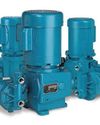
Sizing and Selecting the proper Metering Pump
In process application, large amounts of chemicals are used during daily operations and the volumes of chemicals are large and very precise, with exact amounts delivered according to strict injection schedules. Thus the pressures - from very high to very low – for injecting the chemicals should be governed precisely. Metering pumps have—whether mechanically, hydraulically or electronically actuated—raised to the fore as a technology of first choice for the injection of chemicals in processing and agricultural applications, but within the realm of metering pumps there are many different styles and modes of operation. The article explains the different metering-pump technologies and illustrates how the user should select the proper size and style depending on the injection application for which the pump will be tasked.

8 mins
August 2016
Chemical Engineering World
How Two Petrochemical Plants Improved Level And Flow Measurement
How Two Petrochemical Plants Improved Level And Flow Measurement
2 mins
May 2018

Chemical Engineering World
Just The Right Dose Of Intelligence
Nothing herein shall constitute an offer to sell, or a solicitation of an offer to buy. The ACOPOStrak product is not available for sale into the United States of America until September 2018.
1 mins
May 2018

Chemical Engineering World
Hunting For Hazards
Leaving no stone unturned, no nook or corner unchecked, till we identify all hazards that threaten our installation or personnel or public
3 mins
May 2018
Chemical Engineering World
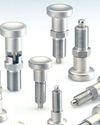
Indexing Plungers For Ultimate Demands In Terms Of Corrosion Resistance, Hygiene And Material Quality
Indexing Plungers For Ultimate Demands In Terms Of Corrosion Resistance, Hygiene And Material Quality
1 min
May 2018

Chemical Engineering World
ABB to Invest 100 Million in Global Innovation & Training Campus
ABB makes largest organic investment in industrial automation at home of B&R in Austria One year after announcing its acquisition of B&R (Bernecker + Rainer Industrie-Elektronik GmbH), ABB is to invest €100 million in Austria to build a state-of-the-art innovation and training campus at the home of B&R in Eggelsberg, Upper Austria. It is the largest organic investment in industrial automation in ABB’s more than 130-year history and lays the foundation for around 1,000 new high-tech jobs in Austria.
3 mins
April 2018

Chemical Engineering World
Secure & Seamless Communication With Powerlink & OPC UA
An OPC UA companion specification is now available for POWERLINK according to a joint announcement by the OPC Foundation and the Ethernet POWERLINK Standardization Group (EPSG). The companion specification describes how payload data is exchanged between POWERLINK and any OPC UA platform. The result is integrated communication from the sensor to the cloud – without any interfaces whatsoever.​​​​​​​
1 min
April 2018

Chemical Engineering World
B&R Expands Gilgenberg Site
Automation specialist invests in production, office space and logistics.
1 mins
March 2018

Chemical Engineering World
Unmatched Efficiency With High-Speed Diverters
B&R presents flexible transport system at Hannover Messe.
1 mins
March 2018

Chemical Engineering World
Digitalization Is Not An Option, But A Must
B&R India explores IIoT topics at 4th annual Innovation Day.
2 mins
March 2018
Translate
Change font size