
Passez à l'illimité avec Magzter GOLD
Obtenez un accès illimité à plus de 9 000 magazines, journaux et articles Premium pour seulement
TEAC UD-701N - STREAMING PREAMP, D/A CONVERTER
Stereophile
|December 2024
In Gramophone Dreams #88, I described the sound of TEAC's VRDS-701T CD transport as "dense and precise in a way I had never previously heard from digital." I went on to explain, "by dense, I mean there was a tangible corporeality effected by seemingly infinite quantities of small, tightly packed molecules of musical information."

What I noticed most during the review period was the extraordinary volume of data the 701T was vacuuming off those pits and lands and turning into music. As I have gotten to know it better, what I've noticed most is how the 701T sorts and delivers all that data in a manner that makes every DAC I pair it with sound more corporal and dynamic.
As I wrote that review, I wondered how the 701T would perform partnered with its matching UD-701N converter/streamer/preamplifier and how the TEAC flagship DAC's sound character would compare to flagship DACs from HoloAudio, Denafrips, and dCS.
Now I know. These are my impressions.
 Description
 The TEAC UD-701N ($4299.99) is the heart of a trio of matching 700-series components that includes the VRDS-701T CD transport and the smart-looking AP-701 power amplifier. The UD-701N isn't just a DAC; it's also a fully balanced, two-input (RCA + XLR) line-level preamplifier and a two-output headphone amplifier (4-pin XLR and 1/4" jack).
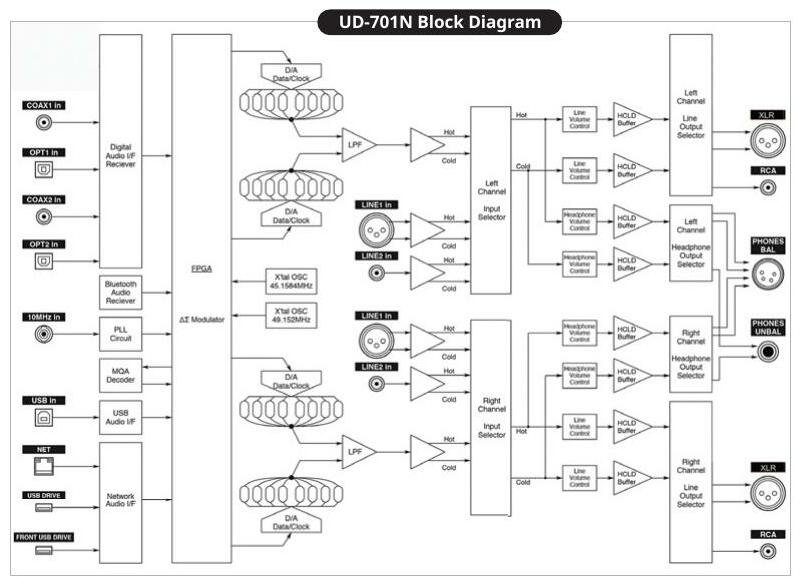
The DAC part of the UD-701N isn't just another chip DAC. TEAC explains: "Instead of using a generic DAC [integrated circuit], we incorporated a custom-developed TEAC AΣ (Delta Sigma) discrete DAC comprised of discrete circuitry that uses FPGA"-field-programmable gate array "incorporating our original algorithms." See the block diagram below.
"DSD signals are transmitted as is, while PCM signals are transmitted after passing through a AΣ modulator and conversion to either 1-bit or multibit signals, according to the end user's choosing." Multibit is the default. "With the TEAC AΣ discrete DAC, playback of 22.5MHz DSD and 384kHz/32-bit PCM is possible."
Up-conversion can be used with all digital inputs and comes in three powers: 2*, 4*, or 8×Fs. Users can also set the AΣ sampling frequency: 128×, 256×, or 512×Fs.

Cette histoire est tirée de l'édition December 2024 de Stereophile.
Abonnez-vous à Magzter GOLD pour accéder à des milliers d'histoires premium sélectionnées et à plus de 9 000 magazines et journaux.
Déjà abonné ? Se connecter
PLUS D'HISTOIRES DE Stereophile

Stereophile
Buzz Me In
If you like 1970s rock music, particularly hard rock music, something you love was recorded or mixed in a Record Plant studio.

3 mins
January 2026

Stereophile
NuPrime MCX-800AD
IMMERSIVE AUDIO PROCESSOR
11 mins
January 2026
Stereophile
Shanachie Records
The term 'sales' is an anachronism. Today, it's about streaming and ancillary income.\"
3 mins
January 2026
Stereophile
Advance Paris X-CD9
CD PLAYER
11 mins
January 2026
Stereophile
T+A Symphonia for phono; a new NAD M10
Out of the box, the T+A Symphonia streaming integrated amplifier Rogier van Bakel reviewed in the November 2025 issue¹ has two pairs of single-ended analog line inputs.
20 mins
January 2026

Stereophile
Why the Music We Love Feels Different Now
There's a scene in the 2002 movie The Pianist in which Adrien Brody's character, the Polish-Jewish pianist Władysław Szpilman, is hiding in the ruins of a Warsaw villa.
3 mins
January 2026
Stereophile
A tale of two Walters
Acommon theme in this space in Stereophile is the need to reach new audiences and generate broader interest in the hi-fi hobby.
3 mins
January 2026
Stereophile
Eversolo Play CD Edition
ALL-IN-ONE STREAMING PLAYER
12 mins
January 2026

Stereophile
Timeless flights
How many adventurous rock’n’roll bands forged in the late-’60s/early-’70s would have been left by the wayside—or relegated to languish in perpetual cutout-bin purgatory—had it not been for the wide-open programming M.O. of stereo-loving FM radio stations? The Moody Blues could very easily have been one of those sidelined, notched-cover footnotes, but they altered their gameplan when guitarist/vocalist Justin Hayward and bassist/vocalist John Lodge joined the fold a few years after the chart success of “Go Now” in 1964.¹
3 mins
January 2026

Stereophile
You still believe in me
One of my foundational memories of becoming an audiophile was waiting to listen to a pair of speakers at Sound by Singer in Manhattan.
12 mins
January 2026
Listen
Translate
Change font size