
Passez à l'illimité avec Magzter GOLD
Obtenez un accès illimité à plus de 9 000 magazines, journaux et articles Premium pour seulement
Essayer OR - Gratuit
The Evolution of The Modern Workspaces
PCQuest
|September 2022
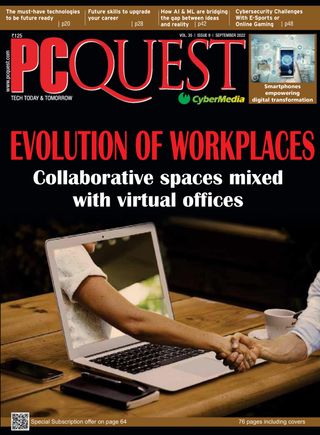
With an increase in flexible working, employees now have the freedom to work from anywhere. Technology and social interactions have already changed our work life and work roles. As the workforce is evolving, the future looks fascinating that would consist collaborative spaces mixed with virtual offices

Over the years, workplace characteristics have changed drastically. The pandemic pushed us to sit at one place, and today technology started to prevail and influence the way we work. The workplace of the present looks completely different from what it was just a few decades ago—or even a few years ago. With the rise of collaboration and the continuing evolution, it’s fascinating to think about all the transformations that have happened and the future. We spoke to Ankur Goel, Managing Director, Poly India & SAARC, to understand the evolution of the workspaces and strategies to implement the hybrid work environment.
▾ Evolution of work and workspaces
Undoubtedly, we have seen a massive shift in the way we work over the last two years. In the initial days of the pandemic, organisations were forced to move to a work from-home setup. Were organisations ready for it? The answer is no.
However, as we progressed and employers and employees started getting a bit more accustomed to remote working, companies started realising that we can be productive, no matter our work location, provided we have the right tools and technologies.Today, the location and the devices from which we work have become irrelevant, and work is no longer a place we go to, but it is what we do.
I definitely believe that hybrid working is the future. The physical office is not going to go away anytime soon, especially for sectors like manufacturing and banking, but it will take on a new form. At the same time, remote working will also continue in some form as companies have realised the benefits of working remotely,like better work-life balance for employees and lesser operational costs for employers.

Cette histoire est tirée de l'édition September 2022 de PCQuest.
Abonnez-vous à Magzter GOLD pour accéder à des milliers d'histoires premium sélectionnées et à plus de 9 000 magazines et journaux.
Déjà abonné ? Se connecter
PLUS D'HISTOIRES DE PCQuest
PCQuest
When Software Drives the Machine Need for Enterprise-Grade Software
Cars used to fail because of broken parts.Now they fail because of broken code. As vehicles become rolling computers, enterprise-grade software, ruthless testing, and fail-safe architecture decide one thing: whether a car keeps moving safely at 100 km/h

2 mins
March 2026

PCQuest
AI on the ground Practical use cases of AI in large enterprise operations
AI isn't a side project anymore, it's the quiet operator inside global giants. It reads invoices, senses machine fatigue, tailors every customer moment, flags risk in real time, and feeds leaders sharper instincts. Scale just got smarter
3 mins
March 2026

PCQuest
From AI experiments in 2025 to enterprise scale in 2026: Why data foundations will decide the winners
Everyone's betting big on Al, but most are burning cash instead of building value. The hidden culprit? Dirty data, clunky processes, and missing context. What if fixing your foundation, not your algorithms, was the real AI game-changer?
4 mins
March 2026
PCQuest
How automation at the periphery is accelerating digital transformation
Digital transformation is not tearing down the core anymore. It is happening at the edges. With AI and automation layered onto existing systems, companies are cutting costs, boosting productivity by up to 40%, and scaling smarter without risking operational chaos
2 mins
March 2026

PCQuest
When AI moves from chips to racks
AI performance is no longer just about faster chips. It is about how racks, power, networking, and orchestration work together. As agentic AI grows, infrastructure must become predictable, open, and built for scale from day one
4 mins
March 2026

PCQuest
Designing enterprise AI systems that stay fair
In 2026, bias is no longer treated as a communications issue or a public relations headache.
6 mins
March 2026

PCQuest
HALO smart sensor
What if bathrooms, locker rooms, and isolated spaces could become safer without adding cameras?
2 mins
March 2026

PCQuest
Building enterprise AI that doesn't discriminate
Bias in enterprise AI is not a side issue. It starts in data pipelines, training systems, product design, and engineering workflows. As AI scales, fairness, transparency, and accessibility are becoming core software requirements
4 mins
March 2026
PCQuest
Bias travels faster than code
Bias in enterprise AI is not a surface issue. It enters through data, features, model training, APIs, and UI logic, then spreads across the stack. The technical response is shifting from audits to architecture, observability, and deployment controls
6 mins
March 2026

PCQuest
How hospitals can use AI without risking patient data
With the fast pace of adoption of Artificial Intelligence (AI) and digital health systems in Indian hospitals, issues related to the security of patient data are also increasing at an equal rate.
2 mins
March 2026
Translate
Change font size