
Passez à l'illimité avec Magzter GOLD
Obtenez un accès illimité à plus de 9 000 magazines, journaux et articles Premium pour seulement
Essayer OR - Gratuit
Speaking code, thinking human
PCQuest
|October 2025
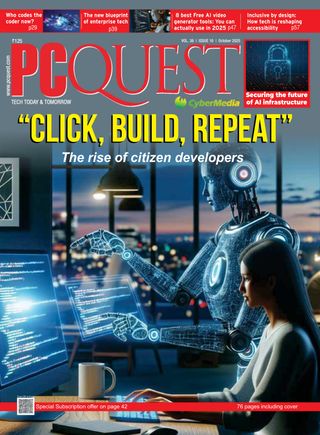
Natural language, Al copilots, and low-code tools are reshaping the developer stack. As abstraction layers rise, developers move from syntax to strategy, building smarter systems that feel more human, flexible, and future-proof

It’s not often that someone describes the future of development in terms as relatable as voice conversations and park picnics but that’s exactly what Nathaniel Okenwa, Developer Evangelist, Twilio, does. With a career rooted in building things that connect people, he now spends his time exploring how AI, low-code, and natural language interfaces are flipping the traditional developer stack. In this interview-turned-narrative, he unpacks the evolution of developer tooling, platform architectures, and trust frameworks, all while painting a picture of a future where developers are less focused on syntax and more focused on solving meaningful, human-centric problems.
AI: Not Just a Tool, But a Teammate
Coding used to be a solo mission. Lines of syntax, logic trees, and endless semicolons. But today, developers are wielding copilots, AI-driven tools that do more than autocomplete. They help prototype faster, test sooner, and shift mental bandwidth toward creative problem-solving. It’s no longer about just making things work. It’s about making things matter.
The integration of AI isn’t just happening on the surface. It’s permeating every layer of the development stack, helping engineers debug code, streamline UI flows, and enhance backend logic in ways that traditional tools couldn't. This transformation has redefined efficiency. It’s not just about writing more code; it’s about writing better outcomes.
From Walled Gardens to Builder Parks
In a world obsessed with vendor lock-in, platform sprawl, and proprietary silos, many companies choose to fence in their users. But there’s another model: the open, builder-first ecosystem. That’s the one Twilio is betting on.

Cette histoire est tirée de l'édition October 2025 de PCQuest.
Abonnez-vous à Magzter GOLD pour accéder à des milliers d'histoires premium sélectionnées et à plus de 9 000 magazines et journaux.
Déjà abonné ? Se connecter
PLUS D'HISTOIRES DE PCQuest

PCQuest
AI on the ground Practical use cases of AI in large enterprise operations
AI isn't a side project anymore, it's the quiet operator inside global giants. It reads invoices, senses machine fatigue, tailors every customer moment, flags risk in real time, and feeds leaders sharper instincts. Scale just got smarter

3 mins
March 2026

PCQuest
From AI experiments in 2025 to enterprise scale in 2026: Why data foundations will decide the winners
Everyone's betting big on Al, but most are burning cash instead of building value. The hidden culprit? Dirty data, clunky processes, and missing context. What if fixing your foundation, not your algorithms, was the real AI game-changer?
4 mins
March 2026

PCQuest
How automation at the periphery is accelerating digital transformation
Digital transformation is not tearing down the core anymore. It is happening at the edges. With AI and automation layered onto existing systems, companies are cutting costs, boosting productivity by up to 40%, and scaling smarter without risking operational chaos
2 mins
March 2026

PCQuest
When AI moves from chips to racks
AI performance is no longer just about faster chips. It is about how racks, power, networking, and orchestration work together. As agentic AI grows, infrastructure must become predictable, open, and built for scale from day one
4 mins
March 2026

PCQuest
Designing enterprise AI systems that stay fair
In 2026, bias is no longer treated as a communications issue or a public relations headache.
6 mins
March 2026

PCQuest
HALO smart sensor
What if bathrooms, locker rooms, and isolated spaces could become safer without adding cameras?
2 mins
March 2026

PCQuest
Building enterprise AI that doesn't discriminate
Bias in enterprise AI is not a side issue. It starts in data pipelines, training systems, product design, and engineering workflows. As AI scales, fairness, transparency, and accessibility are becoming core software requirements
4 mins
March 2026

PCQuest
Bias travels faster than code
Bias in enterprise AI is not a surface issue. It enters through data, features, model training, APIs, and UI logic, then spreads across the stack. The technical response is shifting from audits to architecture, observability, and deployment controls
6 mins
March 2026

PCQuest
How hospitals can use AI without risking patient data
With the fast pace of adoption of Artificial Intelligence (AI) and digital health systems in Indian hospitals, issues related to the security of patient data are also increasing at an equal rate.
2 mins
March 2026

PCQuest
DeFi in 2026: The rise of liquidity, privacy and decentralized exchanges
DeFi's teenage years are over. Liquidity now behaves like infrastructure, privacy is baked in with zero-knowledge math, and DEXS hum like borderless trading engines. What once felt scrappy now resembles parallel financial system-without gatekeepers
3 mins
March 2026
Listen
Translate
Change font size