
Passez à l'illimité avec Magzter GOLD
Obtenez un accès illimité à plus de 9 000 magazines, journaux et articles Premium pour seulement
Essayer OR - Gratuit
No-code, no limits
PCQuest
|October 2025
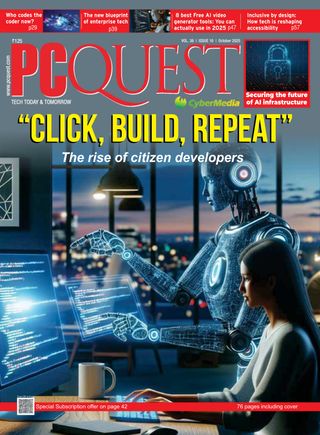
No-code isn't killing code, it's rewriting the rules. From AI- driven workflows to syntax-free security, the future of software is modular, visual, and lightning-fast. In this new era, the smartest minds won't just build, they'll orchestrate

Let's cut through the noise: no-code is no longer the playground of hobbyists or side-hustlers.
It's not just about moving fast. It's about moving differently. The software world is facing an architecture-level disruption. And it's not coming from traditional development frameworks or open-source libraries. It's coming from visual builders, templates, and Al that can generate code from prompts.
Not convinced? Take a closer look. The shift isn't just aesthetic, it's structural.
From code to context
For decades, building apps meant writing code. Carefully. Painstakingly. One line at a time. Then no-code platforms entered the scene and flipped the process. Developers or even non-developers could now drag and drop functionality instead of wrangling syntax.
Now, Al has joined the party, adding a whole new abstraction layer. Just type a natural language prompt and, boom, Al generates entire blocks of code. But here's where things get murky.
That Al-generated code? It's fast but flat. It's functional, yes, but rarely modular. You get chunks of logic, not layers of architecture. You get results, but not reusability.
The emerging challenge is this: can Al-created software match the discipline and design of handcrafted code?
The answer, for now, leans toward no. But that's not the real story. Because while Al rushes to catch up with clean architectures, no-code platforms are quietly offering structured, visual, and repeatable models—without needing syntax at all.
From automation toy to orchestration engine
The real surprise? No-code has grown up.
What started as a tool for simple forms and automations is now running core business processes. Billing systems. Customer engagement pipelines. Scheduling engines. All orchestrated, visually.

Cette histoire est tirée de l'édition October 2025 de PCQuest.
Abonnez-vous à Magzter GOLD pour accéder à des milliers d'histoires premium sélectionnées et à plus de 9 000 magazines et journaux.
Déjà abonné ? Se connecter
PLUS D'HISTOIRES DE PCQuest

PCQuest
AI on the ground Practical use cases of AI in large enterprise operations
AI isn't a side project anymore, it's the quiet operator inside global giants. It reads invoices, senses machine fatigue, tailors every customer moment, flags risk in real time, and feeds leaders sharper instincts. Scale just got smarter

3 mins
March 2026

PCQuest
From AI experiments in 2025 to enterprise scale in 2026: Why data foundations will decide the winners
Everyone's betting big on Al, but most are burning cash instead of building value. The hidden culprit? Dirty data, clunky processes, and missing context. What if fixing your foundation, not your algorithms, was the real AI game-changer?
4 mins
March 2026

PCQuest
How automation at the periphery is accelerating digital transformation
Digital transformation is not tearing down the core anymore. It is happening at the edges. With AI and automation layered onto existing systems, companies are cutting costs, boosting productivity by up to 40%, and scaling smarter without risking operational chaos
2 mins
March 2026

PCQuest
When AI moves from chips to racks
AI performance is no longer just about faster chips. It is about how racks, power, networking, and orchestration work together. As agentic AI grows, infrastructure must become predictable, open, and built for scale from day one
4 mins
March 2026

PCQuest
Designing enterprise AI systems that stay fair
In 2026, bias is no longer treated as a communications issue or a public relations headache.
6 mins
March 2026

PCQuest
HALO smart sensor
What if bathrooms, locker rooms, and isolated spaces could become safer without adding cameras?
2 mins
March 2026

PCQuest
Building enterprise AI that doesn't discriminate
Bias in enterprise AI is not a side issue. It starts in data pipelines, training systems, product design, and engineering workflows. As AI scales, fairness, transparency, and accessibility are becoming core software requirements
4 mins
March 2026

PCQuest
Bias travels faster than code
Bias in enterprise AI is not a surface issue. It enters through data, features, model training, APIs, and UI logic, then spreads across the stack. The technical response is shifting from audits to architecture, observability, and deployment controls
6 mins
March 2026

PCQuest
How hospitals can use AI without risking patient data
With the fast pace of adoption of Artificial Intelligence (AI) and digital health systems in Indian hospitals, issues related to the security of patient data are also increasing at an equal rate.
2 mins
March 2026

PCQuest
DeFi in 2026: The rise of liquidity, privacy and decentralized exchanges
DeFi's teenage years are over. Liquidity now behaves like infrastructure, privacy is baked in with zero-knowledge math, and DEXS hum like borderless trading engines. What once felt scrappy now resembles parallel financial system-without gatekeepers
3 mins
March 2026
Listen
Translate
Change font size