
Passez à l'illimité avec Magzter GOLD
Obtenez un accès illimité à plus de 9 000 magazines, journaux et articles Premium pour seulement
Essayer OR - Gratuit
Modelling the IPL as a Graph System
Open Source For You
|March 2026
Performance analyses of cricketers and teams playing in the Indian Premier League (IPL) can benefit immensely from a graph model. Here's how...
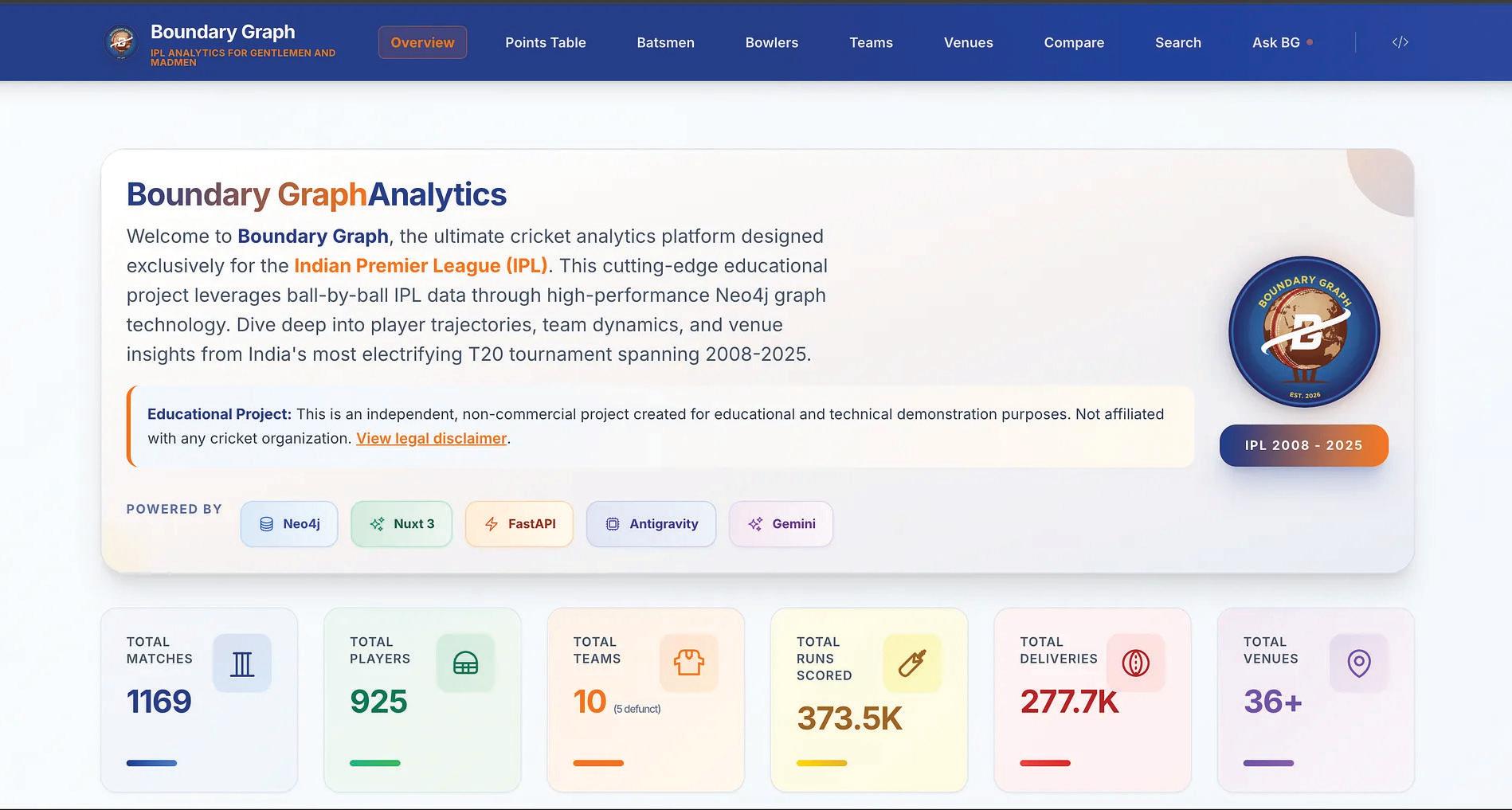
Cricket analytics in the IPL (Indian Premier League) has traditionally evolved around summarisation. Batting averages, strike rates, economy numbers, and points tables provide convenient abstractions, but they compress a highly relational sport into static outcomes. Every performance in the IPL is shaped by a web of dependencies: the opposition, the batting order, the venue, team composition, and even the strategic intent of a particular season.
What often gets lost is continuity. Players move franchises, roles change, venues behave differently across years, and teams reinvent themselves every auction cycle. These are not isolated events. They are transitions, and transitions are fundamentally relational.
A graph model embraces this reality by making relationships explicit rather than inferred.
Why graph thinking fits the IPL
The IPL is not a dataset that sits still. Squads change annually, impact players alter match dynamics, and franchises experiment with long-term versus short-term strategies. Asking meaningful questions across seasons quickly becomes cumbersome in tabular systems because relationships must be reconstructed repeatedly.
Graph thinking allows analysis to begin from connections rather than records. It becomes possible to traverse how a player's career arcs across teams, how team cores evolve, or how venue conditions interact with playing styles.
This shift enables questions such as:
- How does a player's performance change when moving between franchises with different team cores?
- Which teams maintain structural stability across seasons despite roster churn?
- How strongly do venues influence specific player archetypes over time? These are difficult to express cleanly without a relationship-native model.
Structuring the IPL as a graph
The graph is built around stable entities that rarely change identity:

Cette histoire est tirée de l'édition March 2026 de Open Source For You.
Abonnez-vous à Magzter GOLD pour accéder à des milliers d'histoires premium sélectionnées et à plus de 9 000 magazines et journaux.
Déjà abonné ? Se connecter
PLUS D'HISTOIRES DE Open Source For You

Open Source For You
Pixxel and Sarvam join forces to build India's first orbital AI data centre
Pixxel and Sarvam have announced a strategic partnership to develop India's first orbital data centre satellite, positioning the mission as a stepping stone towards sovereign and potentially open AI infrastructure.

1 mins
June 2026
Open Source For You
Niantic Spatial open sources SPZ 4
Niantic Spatial has released SPZ 4, the latest version of its open source file format for 3D Gaussian splats, positioning it as foundational infrastructure for scalable XR, robotics, web, and creative 3D workflows.
1 min
June 2026
Open Source For You
FSFE slams NHS England's reported move to privatise open source code
The Free Software Foundation Europe (FSFE) has warned that NHS England's reported plan to switch most public source-code repositories to 'private' threatens open source principles and weakens cybersecurity transparency.
1 min
June 2026
Open Source For You
Fine-tuning AI models for empathy may undermine accuracy, warn researchers
A study by the Oxford Internet Institute, published in Nature, has found that AI models fine-tuned for warmer, more empathetic responses are 60% more likely to generate incorrect answers than their base versions-raising fresh concerns for the open-weight ecosystem.
1 min
June 2026
Open Source For You
Claude Mythos effect forces Indian banks to employ continuous cybersecurity models
Indian banks are moving decisively from periodic compliance cycles to continuous cybersecurity models, with a sharp focus on real-time vulnerability detection, continuous remediation tracking, and exposure monitoring across ‘crown jewel’ systems.
1 min
June 2026
Open Source For You
Kaltura open sources machine-readable AI skills
Kaltura has open sourced a suite of AI agent skills-structured, production-tested knowledge modules designed for AI coding agents such as Claude Code, OpenAI Codex, GitHub Copilot, and Cursor.
1 min
June 2026

Open Source For You
Pinterest turns to open source AI to cut costs by 90%
Pinterest is positioning open source AI as a core driver of cost-efficient scalability, adopting a model-agnostic strategy that blends proprietary systems with closed models alongside open source models.
1 min
June 2026
Open Source For You
Tether backs local AI tools with new grants
Tether has launched a new grants initiative aimed at developers building open source wallets, payment, decentralised infrastructure, and local-first AI tools on its open technology stack.
1 min
June 2026
Open Source For You
Menlo open sources humanoid robotics development
Menlo Research has introduced the Asimov v1 humanoid robot as an open source humanoid platform designed for builders, researchers and robotics developers, positioning humanoid robotics away from closed proprietary systems and towards reproducible engineering platforms.
1 min
June 2026
Open Source For You
Google uncovers first AI-assisted zero-day exploit
Google has warned that cybercriminals and state-backed threat actors are rapidly operationalising generative AI to develop exploits, automate malware campaigns, and scale cyberattacks targeting open source infrastructure and AI ecosystems.
1 min
June 2026
Listen
Translate
Change font size