
Passez à l'illimité avec Magzter GOLD
Obtenez un accès illimité à plus de 9 000 magazines, journaux et articles Premium pour seulement
Essayer OR - Gratuit
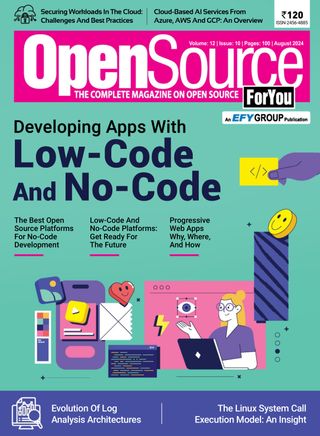
Low-Code and No-Code Platforms: Get Ready for the Future
Open Source For You
|August 2024
Software development has received a boost with the emergence of low-code/no-code (LCNC) platforms that allow even those not initiated in coding to create applications in quick time. We take a look at some of the best LCNC platforms in the open source domain.

With skilled software developers in short supply, enterprises are turning to artificial intelligence (AI) and lowcode/no-code (LCNC) platforms to get their work done quickly while reducing development costs. Lowcode software development uses a platform that requires minimal coding to create software. Low-code platforms are suitable for rapid application development and automating business processes. No-code software development provides an interface with drag-and-drop functionality to develop applications from various templates and components of pre-programmed software. This helps to create an application without coding. Nocode platforms are suitable for small businesses and offer quick solutions.
Gartner predicts that by 2026, developers outside formal IT departments will account for at least 80% of the user base for low-code development tools, up from 60% in 2021. According to IDC, sales of nocode platforms will grow at an annual rate of 13.9% through 2026, with that of low-code platforms growing at 14.1% over the same period.
A market research study published by P&S Intelligence states that the global low-code market will witness a 31.1% CAGR between 2020 and 2030 to reach US$ 187 billion by 2030.
Key characteristics of LCNC platforms LCNC platforms enable developers to quickly build applications by leveraging a library of pre-built components, such as user interfaces, databases, and APIs. Check Figure 1 for the key characteristics of these platforms.
Some of the most common characteristics are:
Accelerated application development and a drag-and-drop interface, which allows creation of applications by using flow charts and other diagrams. These platforms democratise development as there is no need of experience and training to build effective custom apps.
Reusable code functionality, which saves time as users don’t need to re-create core components.

Cette histoire est tirée de l'édition August 2024 de Open Source For You.
Abonnez-vous à Magzter GOLD pour accéder à des milliers d'histoires premium sélectionnées et à plus de 9 000 magazines et journaux.
Déjà abonné ? Se connecter
PLUS D'HISTOIRES DE Open Source For You

Open Source For You
Sending IoT Sensor Data to Public or Private Servers
This IoT system shows a simple and effective way to send sensor data using an ESP8266 microchip.

3 mins
March 2026

Open Source For You
Popular FOSS Tools for LLM Observability, Monitoring and Evaluation
This overview of popular tools for monitoring large language models also sheds light on how LLM-as-a-judge enhances their performance.
2 mins
March 2026
Open Source For You
Data Deduplication Done the Right Way
Deduplication helps to save space on Linux-based storage systems. Choose the right platform and check whether it meets your goals.
6 mins
March 2026

Open Source For You
The Relevance of Rubber Duck Debugging in the Age of AI
Discover why rubber duck debugging is a powerful process today. There's also a step-by-step guide on how to use it in the age of artificial intelligence.
4 mins
March 2026

Open Source For You
GitHub weighs turning off pull requests as AĬ slop floods projects
GitHub has formally acknowledged that AI-generated 'slop' is overwhelming open source projects, forcing maintainers to sift through poor pull requests (PRS), abandoned submissions and guideline violations - and is now considering restricting or even disabling pull requests, the core mechanism of open collaboration.
1 min
March 2026

Open Source For You
Global banks are deploying Ethereum's Layer-2 stack
Banks are standardising on Ethereum's open source stack as production financial infrastructure, shifting from experimental pilots and proprietary blockchains to live Layer-2 networks for tokenised deposits, interbank payments, and cross-border settlement.
1 min
March 2026

Open Source For You
OpenClaw's creator joins OpenAl
In a move that reinforces its commitment to open development rather than acquisition, OpenAI has brought Peter Steinberger, founder of OpenClaw, into the company while placing the popular AI agent under a foundation structure to ensure it remains open source.
1 min
March 2026
Open Source For You
LibreOffice 26.2 comes with native Markdown support
LibreOffice 26.2 has been released by The Document Foundation, strengthening its position as a fully free and open source office suite for Windows, macOS, and Linux, with support for more than 120 languages.
1 min
March 2026

Open Source For You
Indian government mandates labelling of Al-generated content and quicker deletion of illegal deepfakes
India has introduced sweeping AI content rules that immediately place pressure on social platforms and open source AI ecosystems to label, trace and rapidly remove AI Open ource synthetic media at scale.
1 min
March 2026
Open Source For You
I2C and I3C: How Modern Devices Communicate
I3C and I2C are both two-wire communication protocols that help exchange data between multiple devices. While I3C preserves the simplicity of I2C, it introduces new features suited for today's sensor-rich devices.
8 mins
March 2026
Listen
Translate
Change font size