Essayer OR - Gratuit
WHY THE MIDDLE MATTERS
Cycling Weekly
|October 16, 2025
The mantra of polarised training is 'go easy or go hard - never in between'. But what if that's all wrong? Rob Kemp meets the coach who says the middle is where the magic happens
For more than two decades, polarised training has dominated endurance sports. The model - popularised by physiologist Stephen Seiler - demands that athletes spend about 80% of their training at low intensity, and 20% at very high intensity. Anything in the middle, the theory goes, is no man's land: too hard to recover from, too easy to stimulate real adaptations. It's a simple, compelling message - especially in an era obsessed with data purity and perfect zone distribution. But what if everything we thought we knew about how to divvy up our effort across the week was wrong?
Steve Neal, a Canadian coach with 37 years in endurance sport, doesn't believe in a single “one-size-fits-all” model. Instead, he adapts training to the season and the athlete's specific needs - sometimes pyramidal, sometimes polarised. The key, Neal says, is selecting the right method to move fitness in the desired direction. While pyramidal training often emphasises coaches, he doesn't take training software outputs at face value. "I think software does a great job of the higher-intensity training zones, but I still prefer to use lactate testing to dial in the training below threshold."
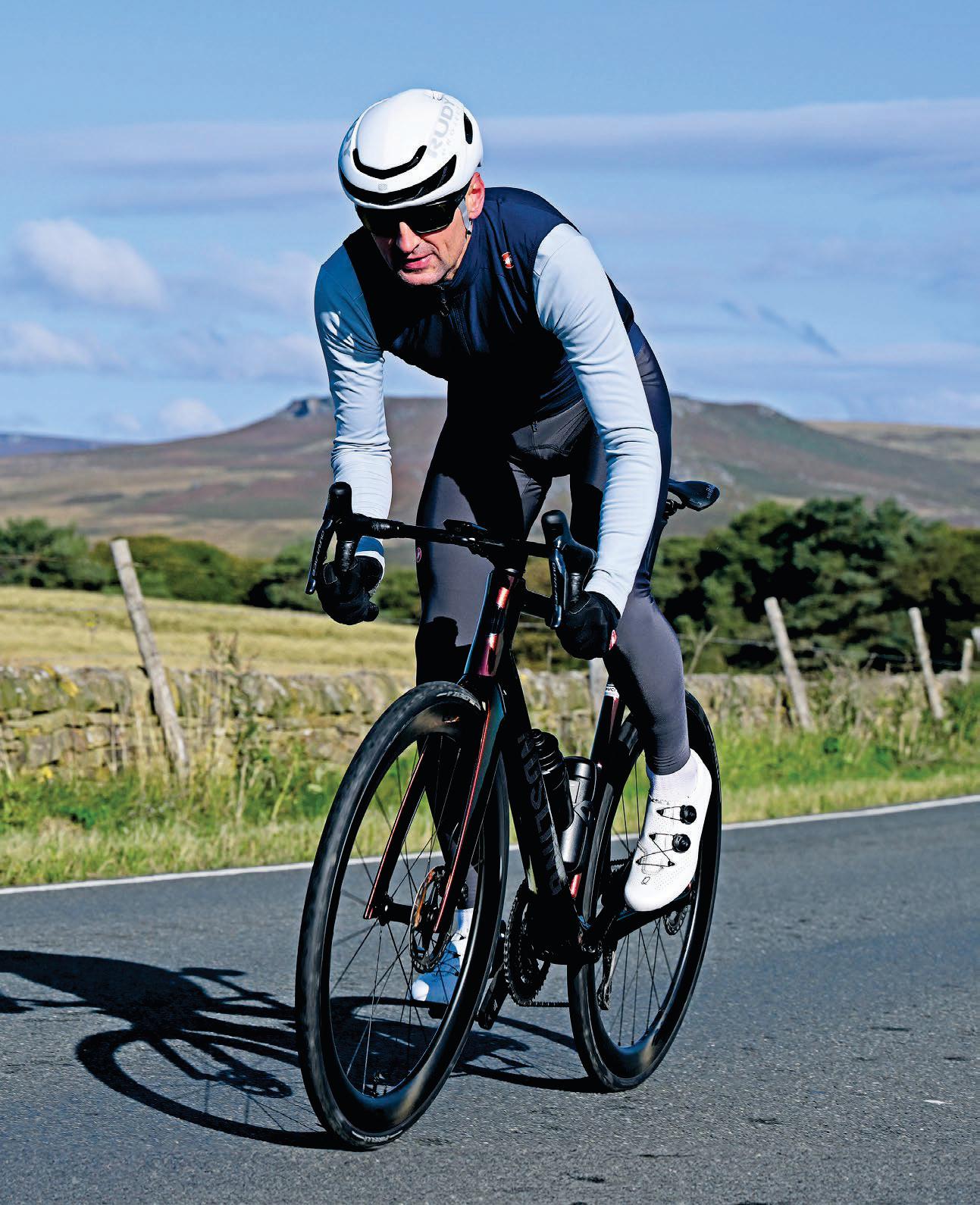 At the heart of Neal's philosophy - and his success in raising the performance of elite riders across varied disciplines - is pyramidal training. He has found that this approach especially suits athletes aged over 40, who make up 95% of his coaching clients.
At its core, pyramidal training means plenty of easy endurance work, a solid dose of tempo or "middle" intensity, and just a small amount of hard effort at threshold or VO2max. Picture a pyramid: a wide aerobic base that narrows as intensity rises, with that middle zone getting real attention.
Unlike more strictly polarised models, pyramidal training doesn't avoid the "grey zone" - it makes smart use of it.

Cette histoire est tirée de l'édition October 16, 2025 de Cycling Weekly.
Abonnez-vous à Magzter GOLD pour accéder à des milliers d'histoires premium sélectionnées et à plus de 9 000 magazines et journaux.
Déjà abonné ? Se connecter
PLUS D'HISTOIRES DE Cycling Weekly

Cycling Weekly
THE ULTRA-PROCESSED PARADOX
The gels and bars that fuel our long rides fall into the increasingly vilified 'ultra-processed' category. But are they really a risk to our health?

7 mins
January 08, 2026

Cycling Weekly
MID-TWENTIES ALCYON RACE
The defining performance brand of the early 20th century
1 mins
January 08, 2026

Cycling Weekly
GARMIN EDGE 850
The head unit specialist is back - and its latest release is bristling with new features
2 mins
January 08, 2026

Cycling Weekly
WHITESIDE & OLDHAM WIN U23 TITLES
Scotland hosts final National Trophy Series
5 mins
January 08, 2026

Cycling Weekly
"Most of the nuisance, and the risk, is from something that's already illegal"
Cycling speed limits are preaching to the converted
3 mins
January 08, 2026

Cycling Weekly
Joe Montgomery, Cannondale pioneer
Visionary American bike maker who challenged bike industry orthodoxy in the 1980s and beyond
2 mins
January 08, 2026

Cycling Weekly
Lukas Pöstlberger's Rose Backroad FF
Graffiti-adorned gravel bike with white bar tape - what's not to like?
2 mins
January 08, 2026

Cycling Weekly
INTERMITTENT FASTING
Can cyclists benefit from time-restricted eating?
3 mins
January 08, 2026
Cycling Weekly
PFEIFFER GEORGI FROM CALPE TO CHRISTMAS
Today's article comes to you fresh off the tarmac at Bristol Airport, as I landed back into the darkness and drizzle of the UK after our first training camp of the winter in Calpe.
1 min
January 08, 2026

Cycling Weekly
Could MVDP upset Tadej Pogačar's plans for 2026?
In a five day race, yes. Absolutely not in a 21-day race.
1 min
January 08, 2026
Listen
Translate
Change font size