Essayer OR - Gratuit
Sight Savers
Scientific American
|November 2025
Diabetic retinopathy is a leading cause of blindness. The right treatment, started early, can preserve vision
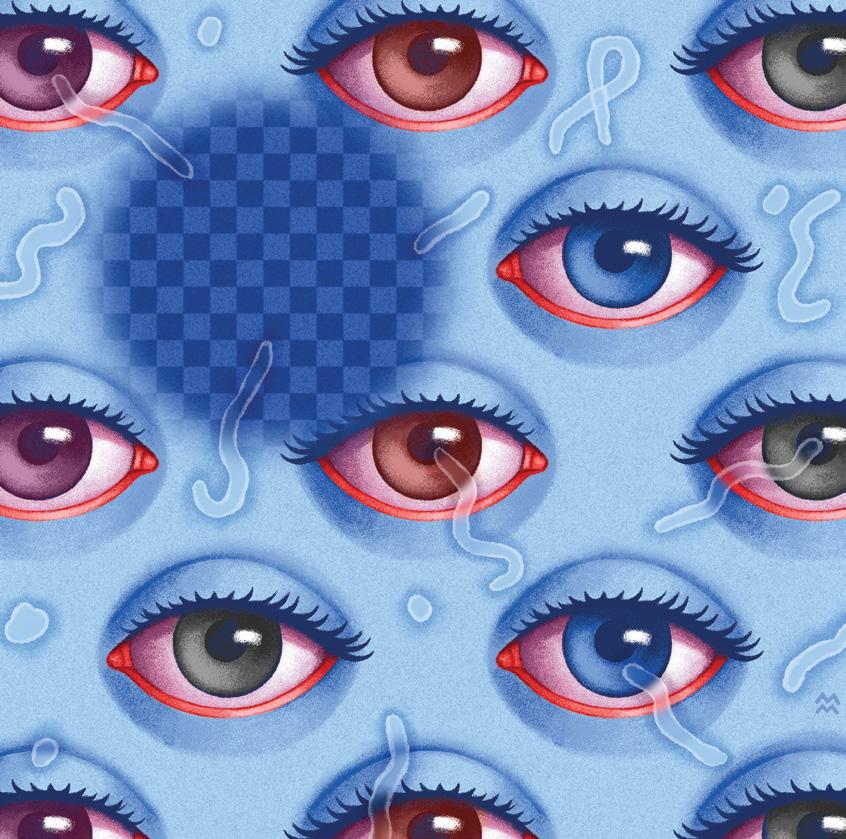
STERLING GLASS had many health problems as a child—swollen feet, night sweats, nausea and vomiting, unquenchable thirst, and fatigue that often left him too exhausted to go to school. The problems didn’t seem connected. Neither Glass nor his parents asked a doctor whether there was an underlying cause until he was 19, when he couldn’t get out of bed and wasn’t able to eat for five days because he felt so sick. That’s when doctors told the family that Glass had type 1 diabetes.
By that point, 30 years ago, Glass’s blood glucose levels had spiked to 600 milligrams per deciliter—six times higher than normal. “The doctor was blown away,” says Glass, who now is 49 and lives in Asheboro, N.C. “He was like, ‘I don’t know how you’re still alive. There’s no telling how long your sugar has been running that high.’”
Today Glass is blind. Years of uncontrolled blood glucose can cause serious damage to organs throughout the body. The eyes are frequent sites of injury. In the retina, the light-detecting tissue in the eye, excess glucose can harm tiny blood vessels and make them leak. The damage cuts off sight. Over time more than half of people with diabetes develop diabetic retinopathy, which can lead to vision loss and blindness. The condition affects nearly 10 million people in the U.S. and 100 million around the world. It is the leading cause of blindness in working-age people.

Cette histoire est tirée de l'édition November 2025 de Scientific American.
Abonnez-vous à Magzter GOLD pour accéder à des milliers d'histoires premium sélectionnées et à plus de 9 000 magazines et journaux.
Déjà abonné ? Se connecter
PLUS D'HISTOIRES DE Scientific American
Scientific American
Sailing the Sun
By designing vertical panels that move in a gale, two Swedish inventors are unlocking a solar future for the windswept north

9 mins
March 2026
Scientific American
Covered in Bees
Ancient bees burrowed deep into discarded mammal jawbones
2 mins
March 2026
Scientific American
Fire Starters
Ancient humans were making fire 350,000 years earlier than thought
3 mins
March 2026
Scientific American
Relativity Revealed
Physicists have observed a bizarre prediction of special relativity for the first time
8 mins
March 2026
Scientific American
Everything You Wanted to Know about Polyamory (but Were Afraid to Ask
The practice is not a faddish excuse to sleep around, research shows. And it has deep roots in American culture
14 mins
March 2026
Scientific American
Let the Rivers Run
An investigation into the rights of nature
4 mins
March 2026
Scientific American
Hidden Proof
\"Effective zero knowledge\" beats long-standing cryptographic impossibilities
2 mins
March 2026
Scientific American
The Universe's Weirdest Optical Illusions
Sometimes the farther away an object is, the bigger it seems to be
4 mins
March 2026
Scientific American
Earthquake Life
Yellowstone quakes spark bursts of microbial growth underground
2 mins
March 2026
Scientific American
Living in the COPILOT SOCIETY
The promise and peril of artificial intelligence everywhere
2 mins
March 2026
Listen
Translate
Change font size