Essayer OR - Gratuit
People Watching
Scientific American
|October 2025
Our social voyeurism may have deep evolutionary roots
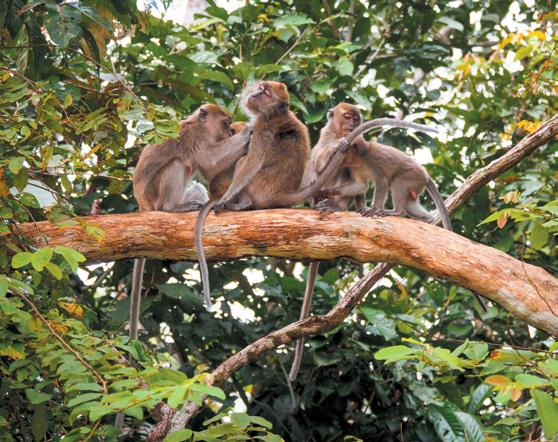
THE HUMAN FASCINATION with watching others—whether through reality TV, Instagram stories or overheard drama—is often dismissed as nosiness. But new research suggests this impulse may be a social survival tool dating back millions of years.
To explore the origins of social curiosity, Laura Lewis, a comparative and developmental psychologist at the University of California, Santa Barbara, and her colleagues studied how human children between four and six years old from San Francisco’s Bay Area and adult chimpanzees responded to certain videos showing members of their respective species. The results, published in the Proceedings of the Royal Society B, show that both groups preferred watching social interactions over scenes involving solitary individuals—even forgoing small rewards to see the former.

Cette histoire est tirée de l'édition October 2025 de Scientific American.
Abonnez-vous à Magzter GOLD pour accéder à des milliers d'histoires premium sélectionnées et à plus de 9 000 magazines et journaux.
Déjà abonné ? Se connecter
PLUS D'HISTOIRES DE Scientific American

Scientific American
Sailing the Sun
By designing vertical panels that move in a gale, two Swedish inventors are unlocking a solar future for the windswept north

9 mins
March 2026
Scientific American
Covered in Bees
Ancient bees burrowed deep into discarded mammal jawbones
2 mins
March 2026
Scientific American
Fire Starters
Ancient humans were making fire 350,000 years earlier than thought
3 mins
March 2026
Scientific American
Relativity Revealed
Physicists have observed a bizarre prediction of special relativity for the first time
8 mins
March 2026

Scientific American
Everything You Wanted to Know about Polyamory (but Were Afraid to Ask
The practice is not a faddish excuse to sleep around, research shows. And it has deep roots in American culture
14 mins
March 2026
Scientific American
Let the Rivers Run
An investigation into the rights of nature
4 mins
March 2026

Scientific American
Hidden Proof
\"Effective zero knowledge\" beats long-standing cryptographic impossibilities
2 mins
March 2026
Scientific American
The Universe's Weirdest Optical Illusions
Sometimes the farther away an object is, the bigger it seems to be
4 mins
March 2026
Scientific American
Earthquake Life
Yellowstone quakes spark bursts of microbial growth underground
2 mins
March 2026

Scientific American
Living in the COPILOT SOCIETY
The promise and peril of artificial intelligence everywhere
2 mins
March 2026
Listen
Translate
Change font size