Essayer OR - Gratuit
The mythos of ancient India's scientific excellence
Down To Earth
|March 01, 2025
Policymakers are obsessed by a fuddled idea of resurrecting a glorious civilisational past, and even IITs have fallen in line
-
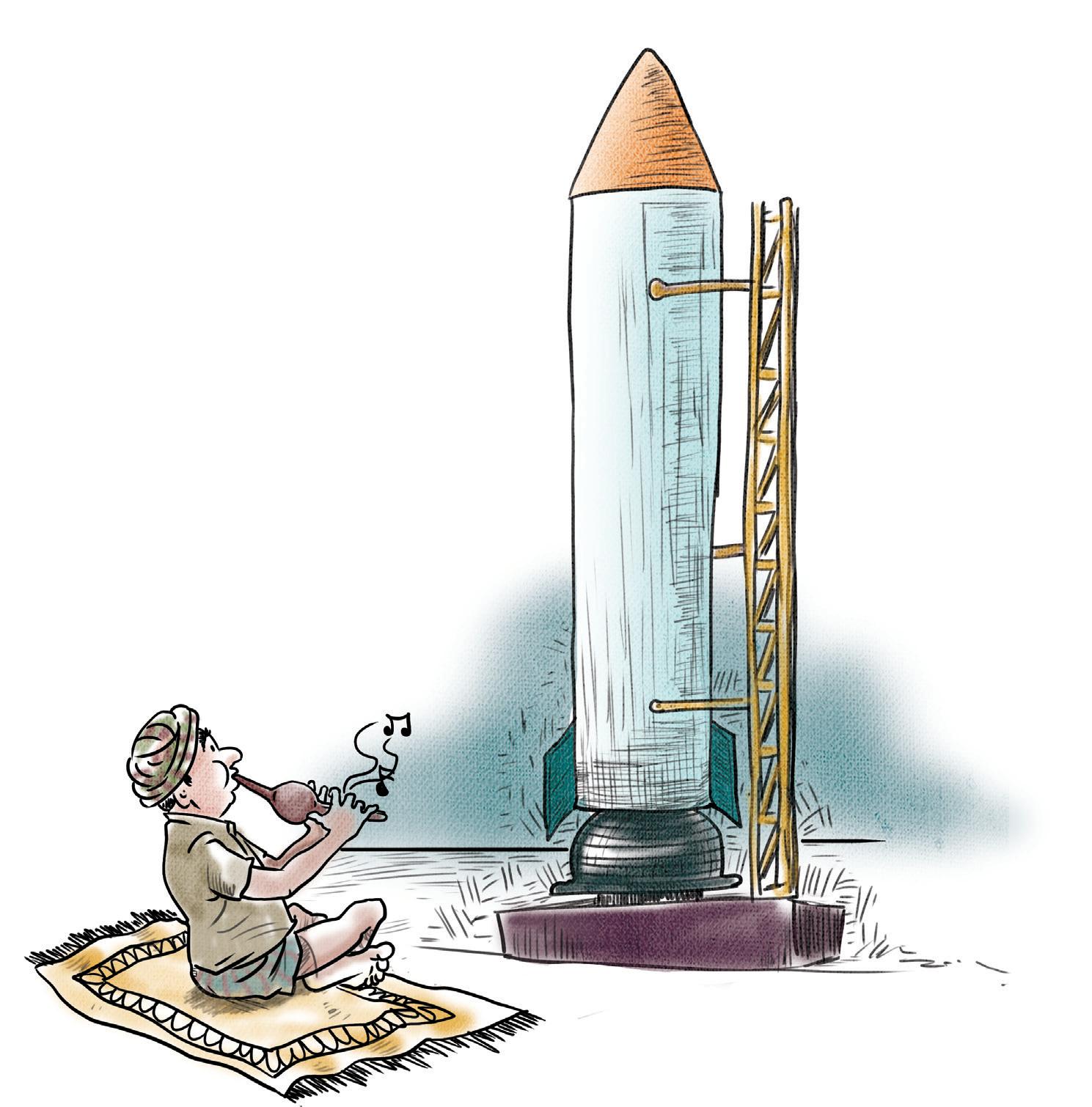
A FEW days ago, a leading newspaper carried an opinion piece on patents, which championed a baffling proposition: that patents in India should be registered in Sanskrit, too, apart from English and Hindi as is the current practice. The writer claimed this would preserve and protect India’s technological advancements while reaffirming its cultural heritage. Waxing enthusiastic about its role in history, he wrote that complex knowledge systems were codified in Sanskrit with clarity and brevity, because its “unique feature of interpretability allowed a single phrase to hold multiple meanings”. This is a fallacious and facile understanding of a complex process. Patent and other claims on intellectual property rights require precise and detailed descriptions today; a phrase and sometimes even a word, if misplaced or omitted, can lead to damaging lawsuits and stall operations of companies. The misconceptions—and there are many—could be forgiven if the writer were a layperson. What can one say when the author is a visiting professor at the India Institute of Technology (IIT),
Delhi? Does Sanskrit have the vocabulary and symbols for complex chemical reactions that, for instance, would be needed to explain a new drug formulation? Or the language to describe a new molecule? Or the string theory? I would not know since I am not one of the 24,821 Indians who are listed as Sanskrit speakers (as per the 2011 Census). This, apparently, works out to 0.002 per cent of the Indian population. That is an irrelevant detail. If the Lok Sabha Speaker can ram through a proposal to have simultaneous Sanskrit translation of parliamentary proceedings despite members objecting to it as a waste of taxpayer money, why should an IIT professor not call for patent filings in Sanskrit? One of the charming reasons the academic offers is this:
“Picture a courtroom debate over whether a Sanskrit

Cette histoire est tirée de l'édition March 01, 2025 de Down To Earth.
Abonnez-vous à Magzter GOLD pour accéder à des milliers d'histoires premium sélectionnées et à plus de 9 000 magazines et journaux.
Déjà abonné ? Se connecter
PLUS D'HISTOIRES DE Down To Earth

Down To Earth
GREAT NICOBAR DILEMMA
In the fragile ecosystem of Nicobar, strategic development must align with constitutional commitment to protect environment, indigenous dignity

3 mins
March 16, 2026
Down To Earth
CATCH BY THE ROOTS
Sabai grass could be a game-changer for the marginalised economies of West Bengal's dry uplands. All it needs is an efficient market strategy
4 mins
March 16, 2026

Down To Earth
POWERING TRANSITION
India's renewable ambitions are rising rapidly, with half of its installed power capacity now coming from non-fossil sources. Yet the gap between capacity and generation remains wide. The experiences of two pioneering states, Karnataka and Tamil Nadu, which together generate over a fifth of the country's renewable energy, offer crucial lessons for accelerating the transition, reports PUJA DAS from Bengaluru, Chennai, Mumbai and New Delhi
16 mins
March 16, 2026

Down To Earth
At core of survival
Water scarcity defines life in a village inside Sariska Tiger Reserve's critical habitat, as debates over its relocation drag on
5 mins
March 16, 2026

Down To Earth
What's on your plate
An upcoming digital tool can help people learn about the origin of their meals and make climate-positive food choices
2 mins
March 16, 2026

Down To Earth
'Bad environment can never be good economics'
The Supreme Court of India and even the high courts were once very active and took a proactive role in protecting the environment; unfortunately, that is no longer true
4 mins
March 16, 2026
Down To Earth
Things fall apart
IN THE past year, the world has counted more missiles and bombs than hours.
2 mins
March 16, 2026

Down To Earth
Universities in crisis, innovation is stifled
Political control and skewed policies have led to unrest in academia, stifling creativity and meaningful research
4 mins
March 16, 2026

Down To Earth
SPARK IN THE GAME
The Reserve Bank of India's restored recognition of Default Loss Guarantees re-enables credit flow into last-mile electric mobility
3 mins
March 16, 2026

Down To Earth
Ushering in new eras
An appraisal of the state of biodiversity conservation, pollution reduction and climate adaptation regimes in India
3 mins
March 16, 2026
Listen
Translate
Change font size