
Passez à l'illimité avec Magzter GOLD
Obtenez un accès illimité à plus de 9 000 magazines, journaux et articles Premium pour seulement
Essayer OR - Gratuit
FADING REEFS
Down To Earth
|November 01, 2025
Warm-water corals are the first major ecosystem to collapse in a rapidly warming planet. Scientists are racing to save them using cutting-edge technologies, from preserving spawn to breeding hardier varieties, but admit their efforts may fall short unless global temperature rises are limited to below 1.5°C.
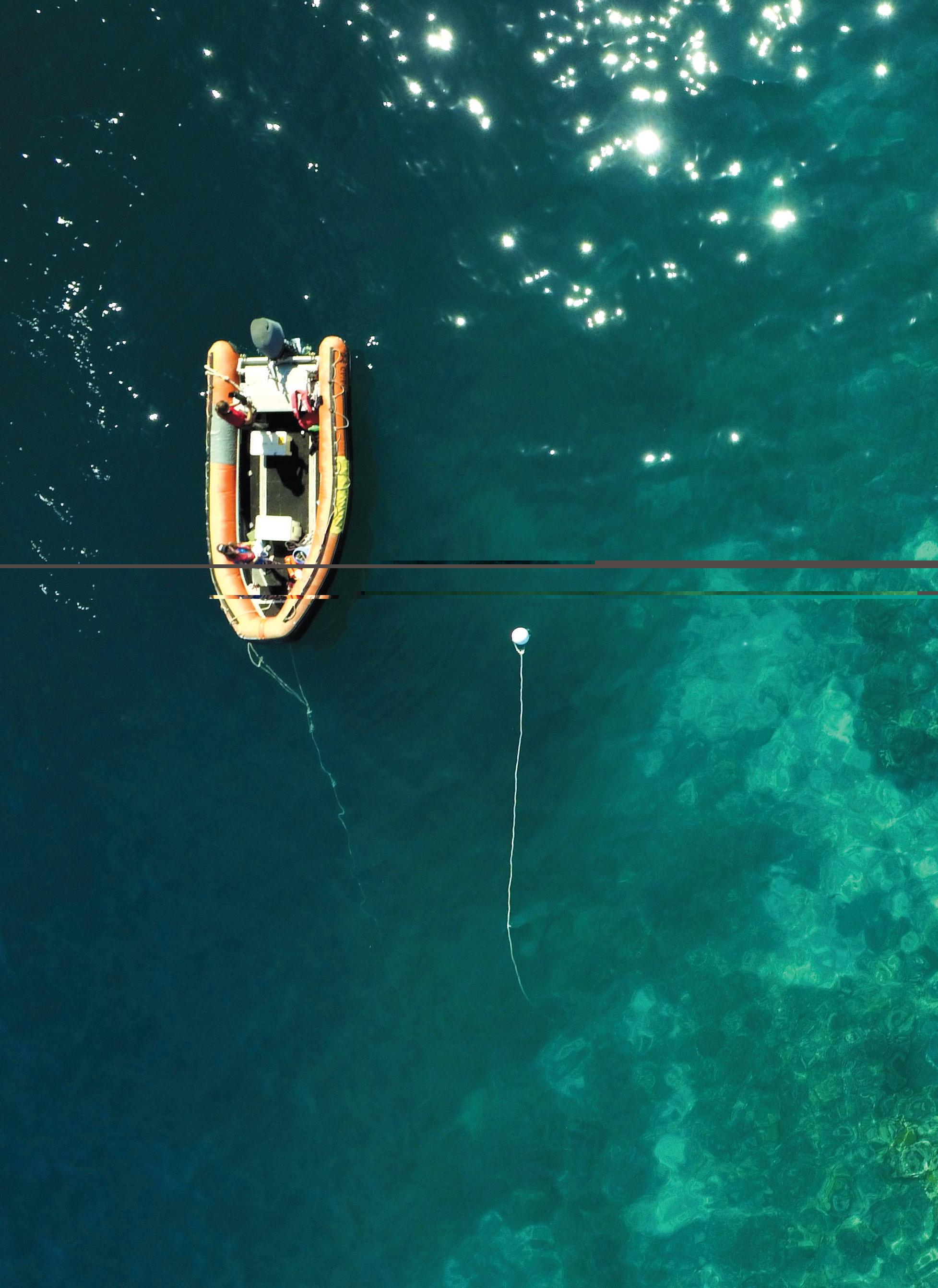
THE EARTH has reached its first catastrophic tipping point, with widespread bleaching and death of coral reefs.
Surging global temperatures have pushed these sensitive yet vital ecosystems towards irreversible decline, warns the “Global Tipping Points Report 2025”. Prepared by 160 scientists from 23 countries, the report states that warm-water coral reefs, or shallow coral reefs in tropical and subtropical regions, are crossing their thermal tipping point and undergoing unprecedented die-off. This collapse threatens the livelihoods of nearly one billion people who depend on reefs for food, income and coastal protection. The report was released ahead of the 30th UN climate summit (COP30), where countries are expected to set out their goals for bringing down emissions over the next decade.
The report also warns that the world is “on the brink” of reaching other tipping points, including the dieback of the Amazon rainforests and Eurasian boreal forests, collapse of major ocean currents such as the Atlantic Meridional Overturning Circulation (AMOC) and the sub-polar gyre (SPG) and melting of ice sheets, including land permafrost and mountain glaciers (see ‘Escalated risks’, p38). “We're in a new climate reality,” says Tim Lenton, founding director at Global Systems Institute at the University of Exeter, UK, who led the report. “We have crossed a tipping point in the climate system, and we're now sure we're going to carry on through 1.5°C of global warming above the prior industrial level, and that’s going to put us in the danger zone for crossing more climate tipping points.”
According to the Intergovernmental Panel on Climate Change (IPCC), tipping points are “critical thresholds” that, when exceeded, can lead to significant changes in the state of the system. This change, which is often irreversible, is propelled by self-perpetuating feedback loops, even if what was driving the change in the system stops.

Cette histoire est tirée de l'édition November 01, 2025 de Down To Earth.
Abonnez-vous à Magzter GOLD pour accéder à des milliers d'histoires premium sélectionnées et à plus de 9 000 magazines et journaux.
Déjà abonné ? Se connecter
PLUS D'HISTOIRES DE Down To Earth

Down To Earth
GREAT NICOBAR DILEMMA
In the fragile ecosystem of Nicobar, strategic development must align with constitutional commitment to protect environment, indigenous dignity

3 mins
March 16, 2026
Down To Earth
CATCH BY THE ROOTS
Sabai grass could be a game-changer for the marginalised economies of West Bengal's dry uplands. All it needs is an efficient market strategy
4 mins
March 16, 2026

Down To Earth
POWERING TRANSITION
India's renewable ambitions are rising rapidly, with half of its installed power capacity now coming from non-fossil sources. Yet the gap between capacity and generation remains wide. The experiences of two pioneering states, Karnataka and Tamil Nadu, which together generate over a fifth of the country's renewable energy, offer crucial lessons for accelerating the transition, reports PUJA DAS from Bengaluru, Chennai, Mumbai and New Delhi
16 mins
March 16, 2026

Down To Earth
At core of survival
Water scarcity defines life in a village inside Sariska Tiger Reserve's critical habitat, as debates over its relocation drag on
5 mins
March 16, 2026

Down To Earth
What's on your plate
An upcoming digital tool can help people learn about the origin of their meals and make climate-positive food choices
2 mins
March 16, 2026

Down To Earth
'Bad environment can never be good economics'
The Supreme Court of India and even the high courts were once very active and took a proactive role in protecting the environment; unfortunately, that is no longer true
4 mins
March 16, 2026
Down To Earth
Things fall apart
IN THE past year, the world has counted more missiles and bombs than hours.
2 mins
March 16, 2026

Down To Earth
Universities in crisis, innovation is stifled
Political control and skewed policies have led to unrest in academia, stifling creativity and meaningful research
4 mins
March 16, 2026

Down To Earth
SPARK IN THE GAME
The Reserve Bank of India's restored recognition of Default Loss Guarantees re-enables credit flow into last-mile electric mobility
3 mins
March 16, 2026

Down To Earth
Ushering in new eras
An appraisal of the state of biodiversity conservation, pollution reduction and climate adaptation regimes in India
3 mins
March 16, 2026
Listen
Translate
Change font size