
Passez à l'illimité avec Magzter GOLD
Obtenez un accès illimité à plus de 9 000 magazines, journaux et articles Premium pour seulement
Essayer OR - Gratuit
Atomic juncture
Down To Earth
|January 16, 2026
A new comprehensive law opens up the nuclear sector to private players, while diluting disaster liability and safety provisions
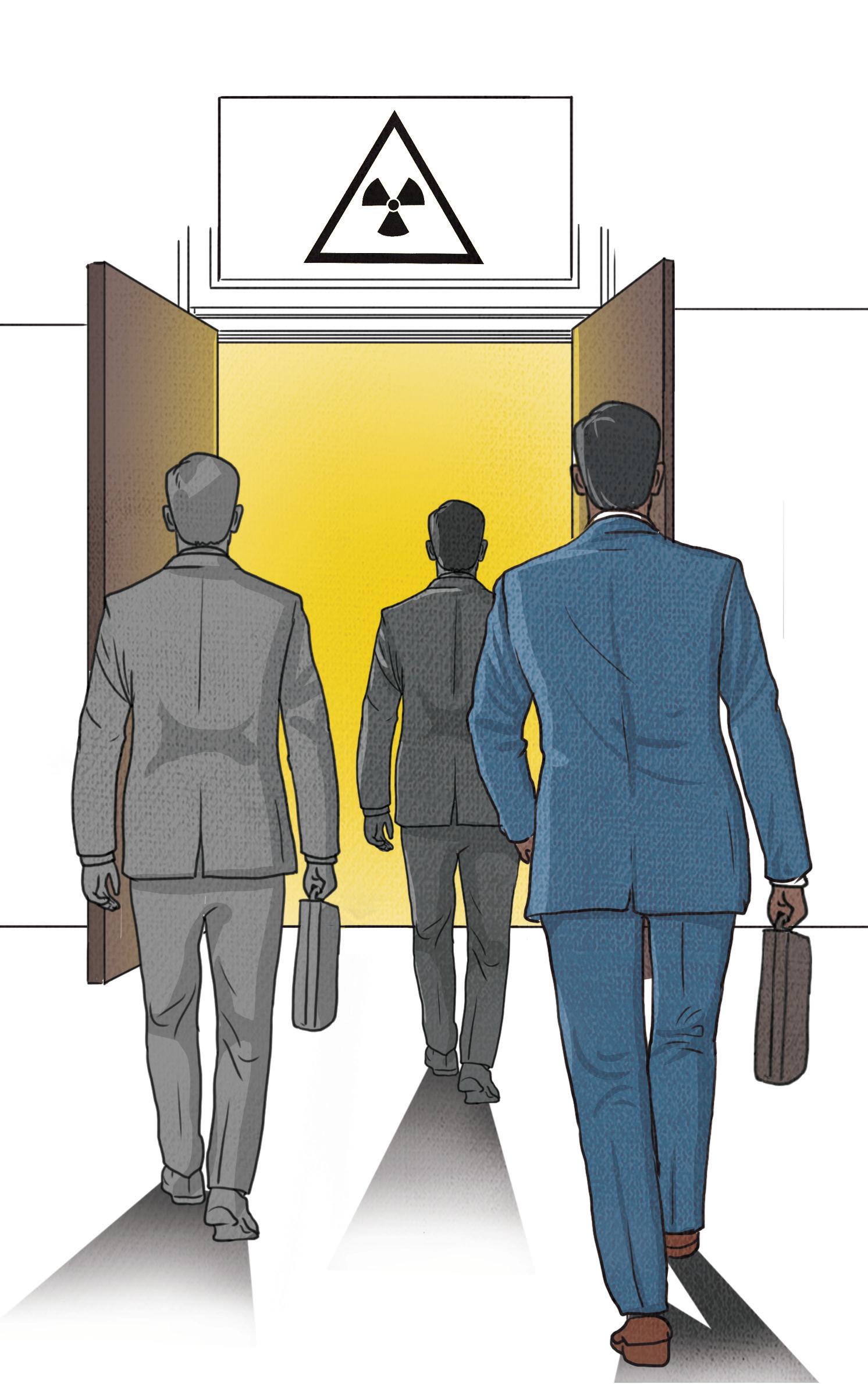
IN THE first week of January came a slew of media reports stating that the National Thermal Power Corporation (NTPC) Limited, a state-owned company, has inked agreements with foreign firms to explore collaborations for nuclear power projects in India. These include Russia's Rosatom, France's Électricité de France SA (EDF) and the US' Clean Core Thorium Energy. Reports of the deals in such quick succession can be attributed to the Sustainable Harnessing and Advancement of Nuclear Energy for Transforming India Act, 2025, or SHANTI Act, passed by the Parliament in December.
The legislation repeals the Atomic Energy Act, 1962 and the Civil Liability for Nuclear Damage Act, 2010, ending the state's monopoly over nuclear power generation and opening the sector to private and foreign participation for uranium mining, reactor construction, operation, equipment manufacturing and other aspects of the nuclear fuel cycle, subject to licensing and regulatory oversight.
Union Minister of State (Independent Charge) for Science and Technology Jitendra Singh termed the Act as a historic reform that will “unlock nuclear potential for peaceful, clean, and sustainable energy while maintaining uncompromising standards of safety, sovereignty, and public interest.” The Act furthers the Centre’s intent to enhance nuclear power in the energy mix, as a cleaner power source. It is aligned with the Nuclear Energy Mission, announced in the Union budget for 2025-26, which targets 100 gigawatts (GW) of installed nuclear capacity by 2047.
Nuclear power has so far been the preserve of public sector entities like the Nuclear Power Corporation of India Ltd (NPCIL). The Act will allow foreign direct investments up to 49 per cent, with private players able to forge partnerships, joint ventures and play manufacturing roles. NPCIL will retain operational control over sensitive aspects in the fuel cycle.

Cette histoire est tirée de l'édition January 16, 2026 de Down To Earth.
Abonnez-vous à Magzter GOLD pour accéder à des milliers d'histoires premium sélectionnées et à plus de 9 000 magazines et journaux.
Déjà abonné ? Se connecter
PLUS D'HISTOIRES DE Down To Earth

Down To Earth
GREAT NICOBAR DILEMMA
In the fragile ecosystem of Nicobar, strategic development must align with constitutional commitment to protect environment, indigenous dignity

3 mins
March 16, 2026
Down To Earth
CATCH BY THE ROOTS
Sabai grass could be a game-changer for the marginalised economies of West Bengal's dry uplands. All it needs is an efficient market strategy
4 mins
March 16, 2026

Down To Earth
POWERING TRANSITION
India's renewable ambitions are rising rapidly, with half of its installed power capacity now coming from non-fossil sources. Yet the gap between capacity and generation remains wide. The experiences of two pioneering states, Karnataka and Tamil Nadu, which together generate over a fifth of the country's renewable energy, offer crucial lessons for accelerating the transition, reports PUJA DAS from Bengaluru, Chennai, Mumbai and New Delhi
16 mins
March 16, 2026

Down To Earth
At core of survival
Water scarcity defines life in a village inside Sariska Tiger Reserve's critical habitat, as debates over its relocation drag on
5 mins
March 16, 2026

Down To Earth
What's on your plate
An upcoming digital tool can help people learn about the origin of their meals and make climate-positive food choices
2 mins
March 16, 2026

Down To Earth
'Bad environment can never be good economics'
The Supreme Court of India and even the high courts were once very active and took a proactive role in protecting the environment; unfortunately, that is no longer true
4 mins
March 16, 2026
Down To Earth
Things fall apart
IN THE past year, the world has counted more missiles and bombs than hours.
2 mins
March 16, 2026

Down To Earth
Universities in crisis, innovation is stifled
Political control and skewed policies have led to unrest in academia, stifling creativity and meaningful research
4 mins
March 16, 2026

Down To Earth
SPARK IN THE GAME
The Reserve Bank of India's restored recognition of Default Loss Guarantees re-enables credit flow into last-mile electric mobility
3 mins
March 16, 2026

Down To Earth
Ushering in new eras
An appraisal of the state of biodiversity conservation, pollution reduction and climate adaptation regimes in India
3 mins
March 16, 2026
Listen
Translate
Change font size