
Passez à l'illimité avec Magzter GOLD
Obtenez un accès illimité à plus de 9 000 magazines, journaux et articles Premium pour seulement
Essayer OR - Gratuit
GOING ROGUE
BBC Science Focus
|April 2024
Some planets are stuck following the same orbital paths their entire lives. Others break free to wander alone through the vast, empty darkness of interstellar space and there's a lot more of them than you might think

Imagine a world where the sun never rises. A planet that doesn't even have a sun. A place with no pastel-painting-sunsets and no dawn choruses, just a constant veil of faint stars twinkling in a perpetual, indelible inky night.
This unfamiliar scenario would be the reality for any life calling a starless planet home, such as one that's somehow become untethered from its star, rendering it free to wander through the Universe.
When we think about planets, we usually picture the eight worlds of our Solar System silently orbiting the central star that's pulling on invisible gravitational strings to keep them close. Yet in recent years astronomers have uncovered an increasingly large population of a very different kind of planet. Worlds that no longer orbit a star at all, worlds that wander the void between stars. Free-floating, rogue planets.
"They are planets that originally orbited a star, but then something happened and they were kicked out," says Dr Alexander Scholz, an astronomer from the University of St Andrews, who studies these strange, orphaned worlds.
Early in their lives, solar systems are particularly chaotic places. Two sibling planets could gravitationally duel for supremacy, flinging the losing planet out of the system entirely. A planet's trajectory could also be set onto a similar exit route simply by interacting with the disc of material that it formed from in the first place.
Or perhaps the planet's banishment came later. A passing star could wrench a planet out of place, or the death of the planet's star could tip the delicate gravitational balance and destabilise that planet.
Computer simulations have shown that somewhere in the region of 20 to 30 per cent of gas planets could get ejected from their home solar systems to end their lives wandering free. "There are likely to be billions of rogue planets in the Milky Way," says Scholz. There may even be trillions.
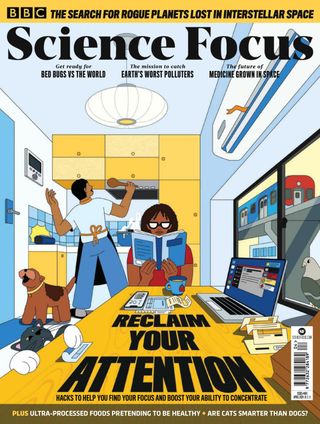

Cette histoire est tirée de l'édition April 2024 de BBC Science Focus.
Abonnez-vous à Magzter GOLD pour accéder à des milliers d'histoires premium sélectionnées et à plus de 9 000 magazines et journaux.
Déjà abonné ? Se connecter
PLUS D'HISTOIRES DE BBC Science Focus
BBC Science Focus
World's biggest cobweb is home to 100,000 spiders
Spiders don't normally create such large colonies, so there's no need to worry about finding one in your basement

1 min
February 2026

BBC Science Focus
A dementia vaccine could be gamechanging – and available already
Getting vaccinated against shingles could protect you from getting dementia, or slow the progression of the disease
1 mins
February 2026
BBC Science Focus
DATA IN SPACE
An unusual spacecraft reached orbit in November 2025, one that might herald the dawn of a new era.
7 mins
February 2026

BBC Science Focus
Climate change is already shrinking your salary
No matter where you live, a new study has found warmer temperatures are picking your pocket
4 mins
February 2026

BBC Science Focus
A MENTAL HEALTH GLOW-UP
Forget fine lines. Could Botox give you an unexpected mental health tweakment?
3 mins
February 2026
BBC Science Focus
Most people with high cholesterol gene don't know they have it
Standard testing struggles to detect the condition
1 mins
February 2026
BBC Science Focus
HOW CAN I BOOST MY IQ?
If you're serious about getting smarter, it's time to ditch the brain-training apps
4 mins
February 2026
BBC Science Focus
Humans are absolutely terrible at reading dogs' emotions
Think you can tell how our furry friends are feeling? Think again
1 mins
February 2026

BBC Science Focus
HOW TO TEACH AI RIGHT FROM WRONG
If we want to get good responses from AI, we may need to see what it does when we ask it to be evil
3 mins
February 2026
BBC Science Focus
What Australia's social media ban could really mean for under-16s
Many people think social media is bad for our kids. Australia is trying to prove it
5 mins
February 2026
Listen
Translate
Change font size