
Passez à l'illimité avec Magzter GOLD
Obtenez un accès illimité à plus de 9 000 magazines, journaux et articles Premium pour seulement
Essayer OR - Gratuit
BED BUGS VS THE WORLD
BBC Science Focus
|April 2024
When bloodthirsty bed bugs made headlines for infesting Paris Fashion Week in 2023, it shone a spotlight on a problem that's been making experts itch for decades: the arms race going on between bed bugs and humans. Now, with the 2024 Summer Olympics fast approaching, the stakes are higher than ever

Bed bugs have been around longer than humans. When researchers used bed bug DNA to get an idea of when they first evolved, they found that the ancestors of today's bed bugs were already tiny but successful predators over 115 million years ago, during the reign of the dinosaurs.
What they were preying on back then, we don't know, possibly ancient birds. What we do know is that when the first bats appeared, bed bugs were present. A few enterprising individuals crawled into the caves where bats slept to enjoy a hearty meal. From there, several species of bed bugs evolved to feed on their blood, according to the research of Prof Klaus Reinhardt, an evolutionary biologist at University of Tübingen, Germany.
As early humans took shelter in those same caves, bed bugs suddenly found they had a larger, juicier mammal to feed on. Somewhere between 900,000 and 100,000 years ago (Reinhardt reckons 245,000 years ago) bed bugs added humans to their roster of victims - a unique move for a parasite, which usually thrive by being highly specialised to one type of host.
The oldest recorded proof of bed bugs that mingled with humans are the 11,000-year-old bugs archaeologists found in caves in North America. There are also fossilised tracks left by bed bug ancestors in ancient Egyptian workers' living quarters from 3,550 years ago, as well as Greek comedy texts from 423 BCE with characters saying "What a torture the bugs will this day put me to." Today there are about 100 species of bed bugs, all part of the insect family, known as Cimicidae.
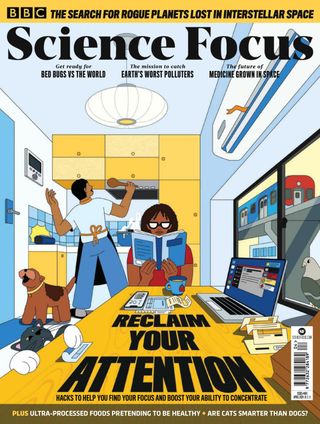

Cette histoire est tirée de l'édition April 2024 de BBC Science Focus.
Abonnez-vous à Magzter GOLD pour accéder à des milliers d'histoires premium sélectionnées et à plus de 9 000 magazines et journaux.
Déjà abonné ? Se connecter
PLUS D'HISTOIRES DE BBC Science Focus
BBC Science Focus
World's biggest cobweb is home to 100,000 spiders
Spiders don't normally create such large colonies, so there's no need to worry about finding one in your basement

1 min
February 2026

BBC Science Focus
A dementia vaccine could be gamechanging – and available already
Getting vaccinated against shingles could protect you from getting dementia, or slow the progression of the disease
1 mins
February 2026

BBC Science Focus
DATA IN SPACE
An unusual spacecraft reached orbit in November 2025, one that might herald the dawn of a new era.
7 mins
February 2026
BBC Science Focus
Climate change is already shrinking your salary
No matter where you live, a new study has found warmer temperatures are picking your pocket
4 mins
February 2026

BBC Science Focus
A MENTAL HEALTH GLOW-UP
Forget fine lines. Could Botox give you an unexpected mental health tweakment?
3 mins
February 2026
BBC Science Focus
Most people with high cholesterol gene don't know they have it
Standard testing struggles to detect the condition
1 mins
February 2026

BBC Science Focus
HOW CAN I BOOST MY IQ?
If you're serious about getting smarter, it's time to ditch the brain-training apps
4 mins
February 2026

BBC Science Focus
Humans are absolutely terrible at reading dogs' emotions
Think you can tell how our furry friends are feeling? Think again
1 mins
February 2026

BBC Science Focus
HOW TO TEACH AI RIGHT FROM WRONG
If we want to get good responses from AI, we may need to see what it does when we ask it to be evil
3 mins
February 2026

BBC Science Focus
What Australia's social media ban could really mean for under-16s
Many people think social media is bad for our kids. Australia is trying to prove it
5 mins
February 2026
Listen
Translate
Change font size