
Passez à l'illimité avec Magzter GOLD
Obtenez un accès illimité à plus de 9 000 magazines, journaux et articles Premium pour seulement
Common Misconceptions About Addiction
Heartfulness eMagazine
|September 2022
DR. PARI DESHMUKH is a board certified psychiatrist, a certified psychotherapist, and a meditation trainer in both Heartfulness and Mindfulness. He is also an elected fellow of the American Psychiatric Association and the Society of Addiction Medicine. He has a special interest in the common ground of science and spirituality, and their implications on the betterment of our mental health. Here he addresses some basic aspects of addiction, including common misconceptions.

What is addiction?
Addiction is a treatable, chronic medical disease, a complex interaction among brain circuits, genetics, the environment, and an individual's life experiences. Many think that addiction is not treatable and is some form of moral defect or character defect, which is not true. It's just like high blood pressure or diabetes. Chronic means long-term; it can be a very long time including over a lifetime, but it is treatable.
The brain is involved in pushing the addiction, and there are certain brain circuits that are more involved. One of them is the reward pathway.
There is also the component of genetics; if our family members have addiction disorders, our chances of addiction are more. Even if their addiction was in some other form, we may still be predisposed to it.
Then there is interaction with the environment. What kind of stimulus, rewards, and punishments is the environment giving us, and how is it guiding our behavior? That has a tremendous impact on our addiction.
Then there are individual life experiences. How has our life been shaped so far?
So, brain circuits, genetics, individual life experiences, and environment are the ingredients that come together to form a long-term medical disease, which is treatable. Research shows that treating addiction is equally as successful as treating other chronic disorders, like diabetes.
What are the different types of addictions that exist?
There are mostly two types: substance addiction and process addiction.
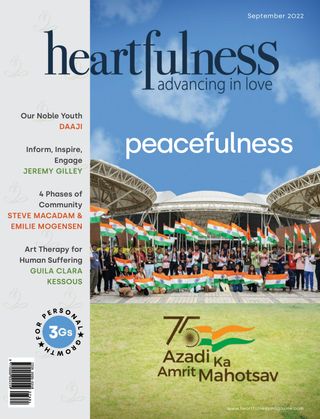

Cette histoire est tirée de l'édition September 2022 de Heartfulness eMagazine.
Abonnez-vous à Magzter GOLD pour accéder à des milliers d'histoires premium sélectionnées et à plus de 9 000 magazines et journaux.
Déjà abonné ? Se connecter
PLUS D'HISTOIRES DE Heartfulness eMagazine

Heartfulness eMagazine
A Touch of Heaven
Irish singer and teacher, EILISH BUTLER, combines the mystical chant of Saint Hildegard von Bingen (1098-1176) with the evolutionary path of Uncovering the Voice, satisfying her passion for mystical spirituality and music.

2 mins
November 2025

Heartfulness eMagazine
FROM INNER STILLNESS TO OUTER AGENCY:
How Heartfulness Builds an Internal Locus of Control and Workplace Success
3 mins
November 2025

Heartfulness eMagazine
Virtual Intelligence
Author and cultural commentator CHARLES EISENSTEIN extends last month's argument about virtual substitutes hollowing out reality-this time to Al's imitation of intimacy-and points to what only embodied relationships can restore.
10 mins
November 2025

Heartfulness eMagazine
Grace Is the Creative Spark
Do you sometimes feel that life is blessed and things are unfolding effortlessly, without force or struggle? Some people say it is because of “grace” or “God’s grace.
5 mins
November 2025
Heartfulness eMagazine
Zuri's Guiding Light
A luminous fable from LIAA KUMAR on self-trust, belonging, and inner guidance.
3 mins
November 2025

Heartfulness eMagazine
I AM
In a quiet meditation on desire, stillness, and the witnessing Self, JARNA KHIMANI traces the shift from seeking to being.
3 mins
November 2025

Heartfulness eMagazine
Courage: From Relief to Presence
JASON NUTTING on why relief is temporary-and how courage, rooted in the heart, endures.
3 mins
November 2025

Heartfulness eMagazine
Embracing The Value Within
DR. ROXANNE M. ST. CLAIR on seeing the value in you—and in others—and making it a daily practice.
4 mins
November 2025
Heartfulness eMagazine
Gratitude's Gift
A Creston woman recently recounted her experience in a checkout line.
2 mins
November 2025

Heartfulness eMagazine
HAPPINESS and Gut Health
Q: How does gut health influence mental well-being, and can practices like meditation actively support a healthier digestive system? The gut is often called the second brain because it has over 500 million neurons that constantly talk to the brain through the vagus nerve.
2 mins
November 2025
Translate
Change font size