
Passez à l'illimité avec Magzter GOLD
Obtenez un accès illimité à plus de 9 000 magazines, journaux et articles Premium pour seulement
Essayer OR - Gratuit
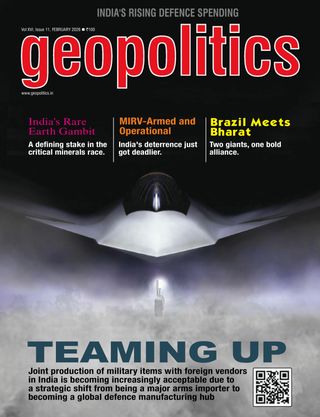
SHOULD INDIA BET ITS SIXTH-GEN FIGHTER FUTURE ON EUROPE?
Geopolitics
|February 2026
AMIT GUPTA argues why joining either the Franco-German Future Combat Air System (FCAS) or the British-Japan-Italy Global Combat Air Programme (GCAP) would make sense, given the future needs of the Indian Air Force (IAF)
-

The recent free trade agreement with the European Union (EU) has significant ramifications for defence cooperation. The major powers like France, Britain, and Germany, as well as smaller countries like Spain, Poland, and Czechia, all have arms industries willing to collaborate on weapons systems ranging from fighter aircraft to rifles and pistols. For India, this is an opportune moment to collaborate on the production of weapons, particularly a sixth-generation fighter.
The IAF's doctrine discusses establishing air superiority over the battle space, and its success requires a sufficient number of combat squadrons.
The IAF is sanctioned to have 42 combat squadrons (over 800 aircraft), but its leadership has proposed building the force up to 60 squadrons (which is around 1200 aircraft). The desire for 1200 odd aircraft is not an empire-building enterprise by the air force, but a recognition of what will be needed in the future to counter the military
The challenge of a two-front threat posed by Pakistan and China.
Everyone in India talks of the two-front aerial threat, be it the media, politicians, or military personnel, but little has been done to tackle it successfully. Because of cost and other considerations, the government reduced the original Rafale deal from 126 aircraft to 36, and Chinese analysts correctly pointed out that these few aircraft would not make a difference along the long India-China border.

Cette histoire est tirée de l'édition February 2026 de Geopolitics.
Abonnez-vous à Magzter GOLD pour accéder à des milliers d'histoires premium sélectionnées et à plus de 9 000 magazines et journaux.
Déjà abonné ? Se connecter
PLUS D'HISTOIRES DE Geopolitics

Geopolitics
Navy Advances Amphibious Carrier Evaluation
The Indian Navy has begun technical evaluations for its proposed Landing Helicopter Dock warship programme, widely viewed as a step toward developing a compact, drone-enabled aircraft-carrier capability.

1 min
May 2026

Geopolitics
Indigenous Engine Materials Near Completion
MIDHANI has reportedly completed nearly half of the specialised alloy development work required for India's proposed 120kN engine intended for the Advanced Medium Combat Aircraft programme, with around 80 per cent of the materials already certified.
1 mins
May 2026

Geopolitics
Sheshnag Swarms Transform Battlefield Dynamics
Bengaluru-based NewSpace Ben Hechnologies is preparing to Research Sheshnag-20 swarming loitering munition system for trials with the Indian Army following successful developmental testing.
1 min
May 2026
Geopolitics
MPATGM Nears Production Clearance Milestone
India's indigenous Man-Portable Anti-Tank Guided Missile programme has moved closer to final production approval following successful moving-target trials.
1 min
May 2026
Geopolitics
India Accelerates Future Combat Drones
India is accelerating the development of multiple manned-unmanned teaming programmes under the Combat Air Teaming System initiative as the country prepares for the next generation of network-centric aerial warfare.
1 min
May 2026
Geopolitics
THE IRON RENAISSANCE
India is committing ₹57,000 crore to overhaul its ageing Soviet-era tank fleet into a digital warfighting force. The transformation comes as China's Type 15 tanks loom on Himalayan ridgelines and Ukraine's battlefield lessons echo worldwide. The country's engineers are reimagining the very concept of the tank for a new era of combat. A Special Report
8 mins
May 2026

Geopolitics
THE ALGORITHMIC BATTLEFIELD IS THE FUTURE
As India is confronted with a critical strategic question of whether to prioritise indigenous development or to rely on foreign Artificial Intelligence technologies to guarantee sovereignty and security, JOSEPH P CHACKO analyses indigenous capabilities and the dependence versus self-reliance debate, as well as Al implementations in surveillance, threat detection, and decision support systems within the Indian defence framework.
14 mins
May 2026
Geopolitics
Rafale Partnership Structure Faces Overhaul
India is reportedly examining a major restructuring of the Dassault Reliance Aerospace Limited (DRAL) venture, with discussions underway regarding the induction of a new private-sector partner to strengthen Rafale-related manufacturing and maintenance operations in the country.
1 mins
May 2026

Geopolitics
INDIA'S DEFENCE VISION-2047: CLARITY BEFORE CAPABILITY
While the outlined roadmap for the Indian defence forces to emerge as the best in the world by the time the country celebrates 100 years of independence is timely, argues that one should not rush into creating theatre commands before becoming self-reliant in defence manufacturing.
6 mins
May 2026

Geopolitics
Indigenous Blast Capabilities Expand Rapidly
Sagar Defence Engineering has secured an explosives manufacturing licence, marking a major milestone in the company's expansion into indigenous defence production and reinforcing India's broader push towards strategic self-reliance in military technologies.
1 min
May 2026
Listen
Translate
Change font size