Essayer OR - Gratuit
FORGING AN IMPENETRABLE SKY SHIELD
Geopolitics
|September 2025
The Sudarshan Chakra represents the beginning of India's air defence evolution. As threats continue evolving, the system must adapt and expand to maintain effectiveness through continuous technology development, regular system updates, and periodic capability assessments
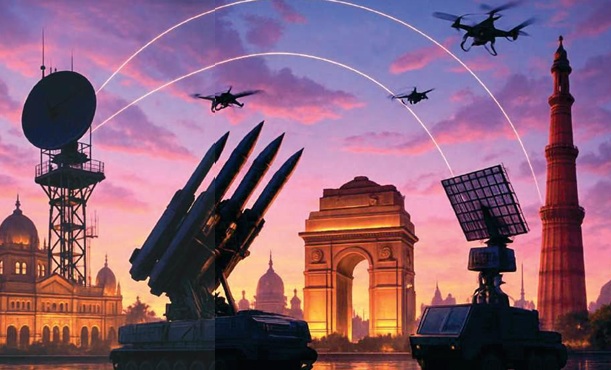
When Prime Minister Narendra Modi announced Mission Sudarshan Chakra in his Independence Day address, he unveiled India's most ambitious defence undertaking since independence—a multilayered air defence system designed to transform the nation into an impregnable fortress against aerial threats. Named after Lord Vishnu's divine discus weapon, this shield promises to protect India's 1.4 billion citizens and critical infrastructure from an increasingly complex array of modern threats.
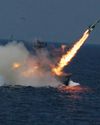
The Sudarshan Chakra represents more than just another defence acquisition. It embodies India's vision of becoming a truly self-reliant military power, capable of defending itself without depending on foreign systems. The recent successful test of the Integrated Air Defence Weapon System (IADWS) off Odisha's coast has provided the first glimpse of this ambitious vision becoming reality.
The Strategic Imperative Behind the Shield
India's strategic environment has fundamentally transformed over the past decade. Today's battlefield features hypersonic missiles that can strike with minimal warning, stealth aircraft designed to evade detection, swarms of autonomous drones, and cruise missiles that can navigate terrain to avoid radar.
The 2025 Operation Sindoor demonstrated these evolving threats firsthand. Pakistan's deployment of drone swarms alongside conventional missiles revealed how adversaries are adapting asymmetric tactics to overwhelm traditional defences. Meanwhile, China's rapid military modernisation has introduced hypersonic glide vehicles and advanced cruise missiles that can bypass conventional air defence systems entirely.
Chief of Defence Staff General Anil Chauhan described modern warfare as a continuum of "five C's"—competition, crisis, confrontation, conflict, and combat. In this new paradigm, the lines between war and peace have blurred, making comprehensive air defence existentially critical.


Cette histoire est tirée de l'édition September 2025 de Geopolitics.
Abonnez-vous à Magzter GOLD pour accéder à des milliers d'histoires premium sélectionnées et à plus de 9 000 magazines et journaux.
Déjà abonné ? Se connecter
PLUS D'HISTOIRES DE Geopolitics
Geopolitics
Navy Flags Critical Engine Dependency Gap
Despite significant advances in indigenous warship construction, India's continued reliance on foreign marine propulsion systems remains a critical vulnerability in its defence framework.

1 mins
April 2026

Geopolitics
GTRE Advances Engine Testing With Su-30
India's aero-engine development programme is set to accelerate as GTRE proceeds to convert two Su-30 MKI fighters into dedicated flying testbeds, enabling real-time validation of indigenous propulsion technologies.
1 mins
April 2026
Geopolitics
Indigenous Anti-Tank Missile Nears Production Clearance
India's indigenous man-portable anti-tank guided missile is approaching final clearance for mass production following successful validation trials against moving targets.
1 min
April 2026
Geopolitics
A RE-LOOK AT INDIAN MILITARY LOGISTICS & THEATRE COMMANDS
JOSEPH P CHACKO explains why logistics systems must be integrated to be capable of seamlessly supporting modern warfare operations, which necessitate rapid, coordinated responses across multiple domains
14 mins
April 2026
Geopolitics
Defence Spending Drives Acquisition Surge
India's defence modernisation programme has entered a phase of rapid implementation, with FY 2025-26 seeing full utilisation of capital expenditure and a clear focus on addressing critical capability gaps across the armed forces.
3 mins
April 2026

Geopolitics
K9 Vajra Hits mega Indigenisation
India's India's flagship tracked artillery programme has reached a crucial turning point, with the K9 Vajra-T now achieving over 82 per cent indigenous content at the work package level, marking a fundamental shift in domestic defence manufacturing capability.
1 min
April 2026

Geopolitics
NUCLEAR SHARKS OF STEEL!
India’s third Arihant-class submarine, INS Aridhaman, was commissioned into the Indian Navy on April 3, 2026, at Visakhapatnam by Defence Minister Rajnath Singh.
2 mins
April 2026

Geopolitics
Army Eyes Tank-Launched Drone Strikes
The Indian Army is advancing a new concept to equip its main battle tanks with indigenous loitering munitions that can be deployed directly from existing 81mm smoke grenade launchers.
1 min
April 2026

Geopolitics
THE ANATOMY OF A POLARISED FRONTIER
West Bengal has changed from a longtime “Red Bastion” to one of the most hotly contested states in Indian politics.
2 mins
April 2026

Geopolitics
Navy Advances Drone-Ready Amphibious Carriers
India's next-generation amphibious warfare programme has entered a crucial -phase as the Navy advances its evaluation of four large-deck platforms designed to revolutionise expeditionary operations.
1 mins
April 2026
Listen
Translate
Change font size