
Passez à l'illimité avec Magzter GOLD
Obtenez un accès illimité à plus de 9 000 magazines, journaux et articles Premium pour seulement
Essayer OR - Gratuit
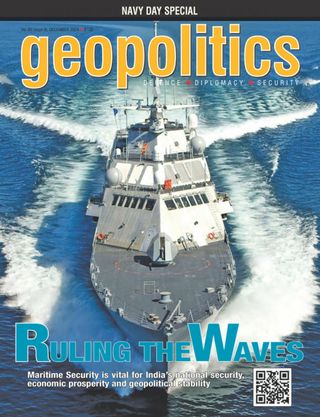
ENHANCING INDIAN NAVAL AVIATION
Geopolitics
|December 2024
JYOTI SINGH reports how a powerful Indian naval air arm will prove to be the biggest seabased conventional level deterrence, both for the tactical and strategic battlefields

The last three-quarters of the 20th century were transformational times for naval warfare as traditional maritime strike capabilities of nations were further boosted with offensive air power. The Second World War witnessed massive aerial bombing operations being launched by allied and axis nations from their respective naval platforms and remote bases. The concept of aircraft-carrier ships and carrier-borne strike aircraft took concrete shape during the war which permanently changed the way wars are fought over longer ranges in the strategic level battlefield. With the beginning of cold war between the two superpowers in 1945, the world was largely divided into two camps, with both the military blocs deploying large numbers of aircraft carrier ships and warships armed with supersonic turbofan-powered strike aircraft, helicopters and cruise missiles, away from home bases. The advent of nuclear-powered aircraft carriers further augmented the ranges of nations' offensive capabilities as the combat assets could be mobilised tens of thousands of kilometres away into the high seas near hostile territories, thus increasing the strike envelope.
Significance of a carrier-borne fleet
Surrounded by an unstable Pakistan on one side and an expansionist China on the other flank, there was a growing need for India to defend the peninsula from hostile naval action. The country's first ever aircraft carrier INS Vikrant (R11), a Majestic-class ship, was bought off the shelf from the Britishers in 1957 and commissioned into service with the Indian Navy in 1961. The ship carried a 'White Tigers' squadron consisting of Hawker Sea Hawk fighter jets, a 'Cobras' squadron of Breguet 1050 Alize antisubmarine warfare aircraft, and two helicopter squadrons: 'Angels' and 'Harpoons' consisting of Aerospatiale Alouette-III (HAL Chetak) and Westland Sea King choppers respectively.

Cette histoire est tirée de l'édition December 2024 de Geopolitics.
Abonnez-vous à Magzter GOLD pour accéder à des milliers d'histoires premium sélectionnées et à plus de 9 000 magazines et journaux.
Déjà abonné ? Se connecter
PLUS D'HISTOIRES DE Geopolitics
Geopolitics
Navy Flags Critical Engine Dependency Gap
Despite significant advances in indigenous warship construction, India's continued reliance on foreign marine propulsion systems remains a critical vulnerability in its defence framework.

1 mins
April 2026
Geopolitics
GTRE Advances Engine Testing With Su-30
India's aero-engine development programme is set to accelerate as GTRE proceeds to convert two Su-30 MKI fighters into dedicated flying testbeds, enabling real-time validation of indigenous propulsion technologies.
1 mins
April 2026
Geopolitics
Indigenous Anti-Tank Missile Nears Production Clearance
India's indigenous man-portable anti-tank guided missile is approaching final clearance for mass production following successful validation trials against moving targets.
1 min
April 2026
Geopolitics
A RE-LOOK AT INDIAN MILITARY LOGISTICS & THEATRE COMMANDS
JOSEPH P CHACKO explains why logistics systems must be integrated to be capable of seamlessly supporting modern warfare operations, which necessitate rapid, coordinated responses across multiple domains
14 mins
April 2026
Geopolitics
Defence Spending Drives Acquisition Surge
India's defence modernisation programme has entered a phase of rapid implementation, with FY 2025-26 seeing full utilisation of capital expenditure and a clear focus on addressing critical capability gaps across the armed forces.
3 mins
April 2026

Geopolitics
K9 Vajra Hits mega Indigenisation
India's India's flagship tracked artillery programme has reached a crucial turning point, with the K9 Vajra-T now achieving over 82 per cent indigenous content at the work package level, marking a fundamental shift in domestic defence manufacturing capability.
1 min
April 2026
Geopolitics
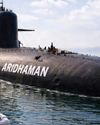
NUCLEAR SHARKS OF STEEL!
India’s third Arihant-class submarine, INS Aridhaman, was commissioned into the Indian Navy on April 3, 2026, at Visakhapatnam by Defence Minister Rajnath Singh.
2 mins
April 2026
Geopolitics
Army Eyes Tank-Launched Drone Strikes
The Indian Army is advancing a new concept to equip its main battle tanks with indigenous loitering munitions that can be deployed directly from existing 81mm smoke grenade launchers.
1 min
April 2026

Geopolitics
THE ANATOMY OF A POLARISED FRONTIER
West Bengal has changed from a longtime “Red Bastion” to one of the most hotly contested states in Indian politics.
2 mins
April 2026
Geopolitics
Navy Advances Drone-Ready Amphibious Carriers
India's next-generation amphibious warfare programme has entered a crucial -phase as the Navy advances its evaluation of four large-deck platforms designed to revolutionise expeditionary operations.
1 mins
April 2026
Listen
Translate
Change font size