
Passez à l'illimité avec Magzter GOLD
Obtenez un accès illimité à plus de 9 000 magazines, journaux et articles Premium pour seulement
Essayer OR - Gratuit
Understanding perinatal RELATIONAL DISTRESS
ParentsWorld India
|December 2025
From post-partum depression to relationship woes – the importance of mental health after giving birth
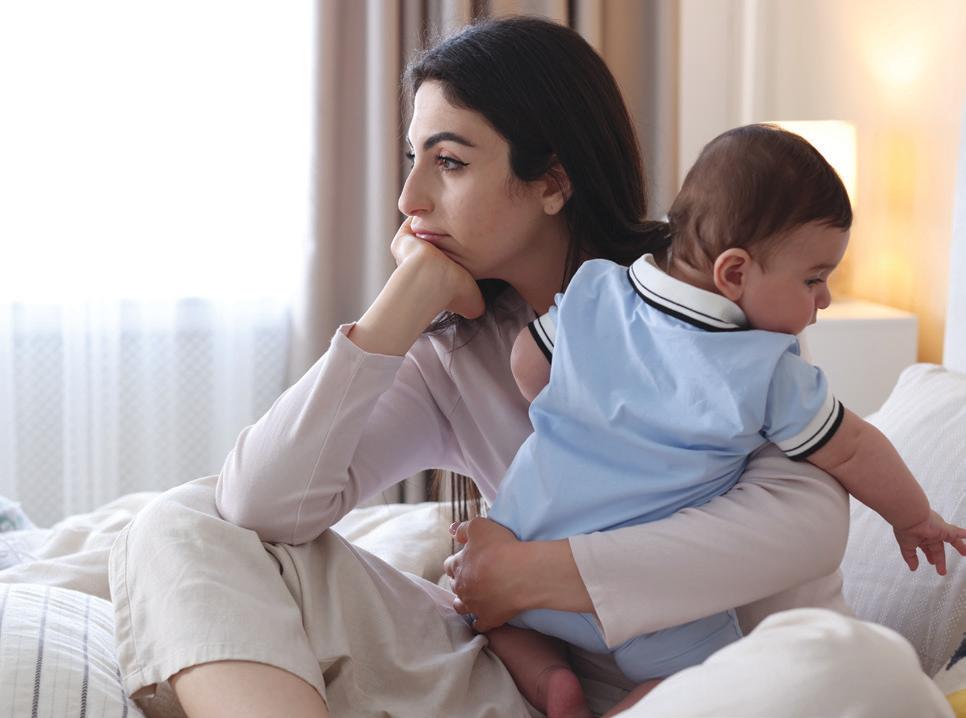
Post-partum depression” has been discussed as an identifiable, measurable, treatable disorder for 50 years. Thresholds, scales, prevalence rates: everything seems clear, even reassuring.
But this binary model — it’s either depression or not depression — obscures a more subtle reality: new parenthood is disruptive, makes us vulnerable and places us all on a spectrum of distress.
The notion of postpartum depression was established in 1968, primarily because it responded to dual academic and medical requirements: to lend scientific legitimacy to the suffering of new mothers and to provide a clear and specific diagnostic framework for a particular period of life.
At the time, emphasis was placed on the atypical nature of this depression, which resembled an anxiety disorder. Its specificity was considered to be solely related to its symptoms, and the challenge lay more in its detection than management.
Minimizing lived experiences
Furthermore, this specific characterization made it possible to distinguish postnatal depression from the “baby blues” (sometimes called “chemical depression”) that occur in the form of brief depressive episodes linked to biological factors, particularly postpartum hormonal changes.
Since then, the debate has been confined to psychiatric classifications and screening tools. But that’s reduced a lived experience to a simple diagnostic category.
In a recent article published in the journal Neuropsychiatrie de l'enfance et de l'adolescence, we proposed, together with child psychiatrist Romain Dugravier, talking about perinatal relational distress rather than postpartum depression.
Far from being unanimously accepted within the scientific community, our approach, which questions diagnoses and labels, attempts to view adjustments to parenthood beyond the sole prism of individual disorders.
A crisis of maturity

Cette histoire est tirée de l'édition December 2025 de ParentsWorld India.
Abonnez-vous à Magzter GOLD pour accéder à des milliers d'histoires premium sélectionnées et à plus de 9 000 magazines et journaux.
Déjà abonné ? Se connecter
PLUS D'HISTOIRES DE ParentsWorld India

ParentsWorld India
Making weekends SPECIAL FOR CHILDREN
PW invited parents of Johnson Grammar School ICSE, Kuntloor, Hyderabad to share how they make weekends meaningful for their children

2 mins
February 2026

ParentsWorld India
Silent signs of children's EMOTIONAL DISTRESS
For parents, recognising the signs of emotional distress early – and learning to respond with understanding rather than alarm – is critical to ensuring children's emotional wellbeing
2 mins
February 2026

ParentsWorld India
Navigating the parent and adult child RELATIONSHIP
How to navigate the evolving parent-child relationship as children become adults
4 mins
February 2026
ParentsWorld India
Climate change could raise child stunting cases in South Asia
Hot and humid conditions driven by climate change could increase cases of child stunting in South Asia by over three million by 2050, says a study conducted by the University of California, Santa Barbara, USA (UCSB).
1 min
February 2026

ParentsWorld India
Home FIRST AID GUIDE
I am aware that the parent of a toddler needs to know about first aid. But I'm just not prepared. Please advise.— Lipika Hashim, Mumbai
5 mins
February 2026

ParentsWorld India
Boosting children's IMMUNE SYSTEM
PW invited parents of Sadhbhavana World School, Kozhikode to share how they boost their children's immune systems
2 mins
February 2026
ParentsWorld India
One in three adolescents use alcohol or tobacco
One in three adolescents in India is at risk of developing health issues due to alcohol or tobacco usage, says a recent research study conducted by Bengaluru's St. John's Medical College, Christ University, and Kasturba Medical College, Manipal.
1 min
February 2026

ParentsWorld India
Sustained demand for hospitality PROFESSIONALS
The demand for trained hotel and hospitality management personnel is unabated, offering youth attractive career opportunities, sizeable pay packages and conducive conditions
3 mins
February 2026
ParentsWorld India
80-85 percent of patients don't receive timely psychiatric care
Four in five Indians suffering psychiatric disorders don't receive timely or adequate treatment, leaving millions without professional care, indicate estimates of the Indian Psychiatric Society (IPS).
1 min
February 2026

ParentsWorld India
My child is introverted. HELP!
My 14-year old son is an introvert and uncomfortable in large groups. Please suggest some ways to develop his social skills.
2 mins
February 2026
Listen
Translate
Change font size