
Passez à l'illimité avec Magzter GOLD
Obtenez un accès illimité à plus de 9 000 magazines, journaux et articles Premium pour seulement
Essayer OR - Gratuit
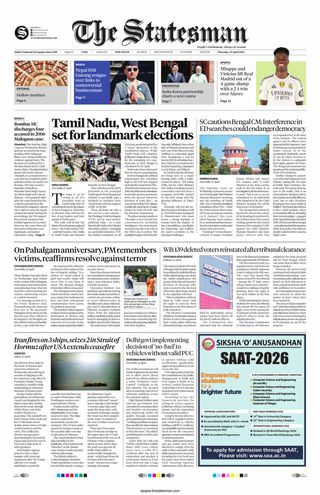
West Bengal's real poll battle: Not on streets, but over who gets to vote
The Statesman Delhi
|April 23, 2026
Armoured vehicles rumble along rural roads and Central Armed Police forces patrol through bazaars.
Checkpoints dot the highways, where cars and buses are stopped and searched for cash or liquor meant to influence voters.A day before Bengal heads for a crucial election, and the unprecedented deployment by the Election Commission of India is supposed to curb possible political clashes and “vote buying.”
However, the "war zone movie set" scenario, belies the fact that the real battle for Bengal's ballot box may not be unfolding on these roads at all. It is being fought, more quietly but no less consequentially, in tribunals tasked with determining who has the right to vote in the forthcoming elections, and by implication who is an Indian.
Some 91 lakh people had their names removed from voter rolls, through an exercise called the Special Intensive Revision (SIR) of electoral rolls. Out of these 91 lakh, some 27 lakh had their names struck off after being placed under adjudication by an Artificial Intelligence generated filter which felt their entry had "logical discrepancies".
Deletions based on "logical discrepancy" could be on as flimsy a ground as why a son's surname is spelled differently from his father’s, such as Rai and Ray, Chattopadhyay (Sanskriticised surname for Brahmins from the Chattal region) and Chatterjee (Anglicised version of Chattopadhyay).
For Bengali Muslims, most of whom have no fixed surname, this has meant whole villages have been left out of the voter list.
The deletions have impacted minorities, women and the poor the most say researchers working with the data officially available.
The border districts of Malda, Murshidabad, North and South 24-Parganas, with huge Muslim and Dalit populations have been hit the hardest, with the number of deleted names ranging from 2.2 lakh (South 24-Parganas) to 4.6 lakh (Murshidabad).
However, the "privileged class" too have been hit by the role purification drive, often inexplicably.

Cette histoire est tirée de l'édition April 23, 2026 de The Statesman Delhi.
Abonnez-vous à Magzter GOLD pour accéder à des milliers d'histoires premium sélectionnées et à plus de 9 000 magazines et journaux.
Déjà abonné ? Se connecter
PLUS D'HISTOIRES DE The Statesman Delhi
The Statesman Delhi
Global AI spending expected to surge 47 pct to $2.59 tn in 2026
Worldwide spending on artificial intelligence is projected to jump 47 percent year-on-year to $2.59 trillion in 2026, driven largely by rising investments in AI infrastructure and AI-optimised servers as enterprises and cloud providers accelerate adoption of generative AI and agentic workflows, a report said on Tuesday.

1 min
May 20, 2026
The Statesman Delhi
As hostage crisis continues in Manipur, CM sends peace teams
With an aim to resolve the hostage crisis, the Manipur government has sent two different teams comprising of Church leaders to conduct talks with Naga and Kuki groups.
1 mins
May 20, 2026
The Statesman Delhi
SC upholds citizens' right to live free from fear of stray dog attacks
Linking the issue of the stray dog menace to the right to life under Article 21 of the Constitution, the Supreme Court on Tuesday held that citizens have the right to live with dignity and move freely in public spaces without fear of dog bites and violent attacks.
2 mins
May 20, 2026
The Statesman Delhi
UPI drives 85.5 per cent of India’s payment volumes, debit card usage falls: RBI report
India’s digital payments ecosystem is increasingly being driven by small-ticket everyday transactions, with Unified Payments Interface (UPI) accounting for 85.5 per cent of total payment volumes during the second half of 2025, according to the latest Payments System Report released by the Reserve Bank of India.
2 mins
May 20, 2026
The Statesman Delhi
Indian Railways approves two key rail infrastructure projects worth over ₹1,950 cr
Indian Railways has approved two major rail infrastructure projects, the Kiul-Jhajha 3rd Line Project in Bihar and the Arakkonam-Chengalpattu Doubling Project in Tamil Nadu, with a combined investment of over Rs 1,950 crore aimed at enhancing network capacity, improving operational efficiency and strengthening passenger as well as freight movement across key corridors.
1 mins
May 20, 2026
The Statesman Delhi
Petrol, diesel prices hiked again; fuel rates up by 90 paise per litre
Petrol and diesel prices were hiked again on Tuesday, with fuel rates rising by around 90 paise per litre across the country.
1 min
May 20, 2026
The Statesman Delhi
IPL 2026: KKR brace for must-win contest against Mumbai Indians
With their IPL 2026 playoff hopes hanging by the slimmest of threads, three-time champions Kolkata Knight Riders face a must-win situation when they host already-eliminated Mumbai Indians at the Eden Gardens here on Wednesday.
2 mins
May 20, 2026
The Statesman Delhi
Clean energy, offshore wind among five key agreements signed by India, Norway
As India and Norway deepen bilateral engagement during the visit of PM Narendra Modi to Norway, the Council of Scientific and Industrial Research (CSIR), Department of Scientific and Industrial Research (DSIR), GoI signed a series of important agreements with leading Norwegian research, academic and industrial organisations in Oslo on Monday to strengthen cooperation in science, technology, innovation and sustainable development.
1 min
May 20, 2026
The Statesman Delhi
Stock market ends lower, IT index spikes over 3 per cent
The Indian stock market on Tuesday ended lower after a volatile trading session amid select consumption stocks and heavyweight counters.
1 min
May 20, 2026
The Statesman Delhi
Turkey-Pakistan axis
Turkey’s support has given Pakistan something it has always struggled to build on its own and that is an international narrative reach. Over the last several years, Turkey under Recep Tayyip Erdogan has invested heavily in building global media influence. Kashmir, Islamophobia, Muslim identity politics, political Islam projecting the Caliphate and anti-India narratives gradually became regular themes within this ecosystem. Pakistan's military establishment quickly understood the value of this partnership
5 mins
May 20, 2026
Listen
Translate
Change font size