
Passez à l'illimité avec Magzter GOLD
Obtenez un accès illimité à plus de 9 000 magazines, journaux et articles Premium pour seulement
Essayer OR - Gratuit
UNITED THEY FEEL
The Guardian Weekly
|October 20, 2023
WHY DID SO MANY OF THE HUGE STREET PROTESTS OF THE 2010S LEAD TO THE OPPOSITE OF WHAT THEY ASKED FOR?

IN THE DECADE FROM 2010 TO 2020, humanity witnessed an explosion of mass protests that seemed to herald profound changes. These protests started in Tunisia and erupted across the Arab world, before huge demonstrations also rocked countries like Turkey, Ukraine and Hong Kong. By the end of the decade, protests were roiling Sudan, Iraq, Algeria, Australia, France, Indonesia, much of Latin America, India, Lebanon and Haiti. During these 10 years, more people took part in street demonstrations than at any other point in history.
Many of these protests were experienced as a euphoric victory by their participants and met with optimism in the international press. But years later, after most foreign reporters have gone, we can now see how the uprisings preceded - if not necessarily caused - outcomes that were very different from the goals of the protesters. Nowhere did things turn out as planned. In many cases, things got much worse.
Take Brazil. On 13 June 2013, I was standing on a street in São Paulo reporting on a growing protest movement, when the military police, without warning, began shooting at the crowd. Teargas, shock bombs, maybe rubber bullets - it was hard to know in the moment. I found refuge in the entrance of a residential building. It took me a few moments to regain my senses and realise where I was, after I had confirmed I could still breathe with some regularity.
The police crackdown led to an explosion of sympathy for the demonstrations, which had been organised by the Movimento Passe Livre (MPL), a small group of leftists and anarchists demanding cheaper public transport. Millions of people took to the streets across Brazil, shaking the political system to its core. New demonstrators brought new demands - better schools and healthcare, less corruption and police violence - into the mass movement.
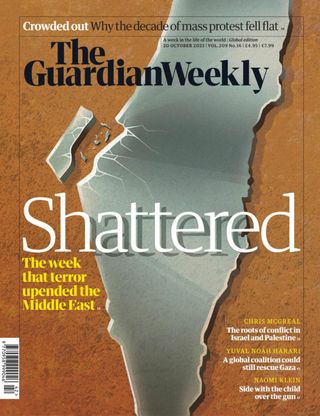

Cette histoire est tirée de l'édition October 20, 2023 de The Guardian Weekly.
Abonnez-vous à Magzter GOLD pour accéder à des milliers d'histoires premium sélectionnées et à plus de 9 000 magazines et journaux.
Déjà abonné ? Se connecter
PLUS D'HISTOIRES DE The Guardian Weekly
The Guardian Weekly
A bold attempt to convince sceptics that neuroscience has proved Freud was right
Vladimir Nabokov notoriously dismissed the \"vulgar, shabby, and fundamentally medieval world\" of the ideas of Sigmund Freud, whom he called.

3 mins
January 23, 2026
The Guardian Weekly
A fascinating and wideranging account of the good-and the bad-of the new obesity drugs
Few aspects of being human have generated judgment, scorn and conmore demnation than a person's size, shape and weight - particularly if you are female.
1 mins
January 23, 2026

The Guardian Weekly
Can Cuba survive?
Disillusioned with the revolution after 68 years of US sanctions and a shattered economy, one in four Cubans have left the country in the past four years. Now it seems the Trump administration has the regime in its sights and its future is unclear
11 mins
January 23, 2026

The Guardian Weekly
Are our bodies really full of microplastics?
Doubts over whether plastic particles have infiltrated human tissue have grown, with one high-profile study called a 'joke'
5 mins
January 23, 2026

The Guardian Weekly
The team reinventing abortion advice for TikTok age
What do a purple cartoon cat and abortion have in common? Nothing - and that is the point, say the women behind Jacarandas, a Colombian abortion helpline.
3 mins
January 23, 2026

The Guardian Weekly
Talk of The town
Michael Sheen on building a new Welsh National Theatre company, as its first show reimagines an American classic in his homeland
7 mins
January 23, 2026

The Guardian Weekly
Parallel lives
Piet Mondrian found fame with his grid-like paintings. But a reappraisal of little-known British artist Marlow Moss repositions her influence on his work
4 mins
January 23, 2026

The Guardian Weekly
Melting ice brings geopolitical jostling for Arctic assets
Lying between the US and Russia, Greenland has become a critical frontline as global heating opens up the Arctic.
2 mins
January 23, 2026

The Guardian Weekly
Every cent you take?
Sting and his former bandmates have been in court over a royalties dispute-the latest chapter in the song's fractious story
3 mins
January 23, 2026

The Guardian Weekly
Shah's son stakes his claim to lead the country
Reza Pahlavi, the son of Iran’s former pro-western monarch, has predicted the country’s Islamic regime will fall and claimed he is “uniquely” placed to head a successor government.
2 mins
January 23, 2026
Translate
Change font size