Essayer OR - Gratuit
Fly me to the moon...
Hindustan Times Ranchi
|November 23, 2025
It wasn't easy, bringing the stars indoors. The world's first planetarium opened 100 years ago, in Germany. It used the grainy imagery of the time, but elicited gasps nonetheless. Today, planetariums invite viewers to zoom through galaxies, tour clouds of asteroids, view meteors as they approach. And, a new future looms: explorations of tech, biology, even the human body - on domes so large and crystal-clear, they're helping astrophysicists learn about space
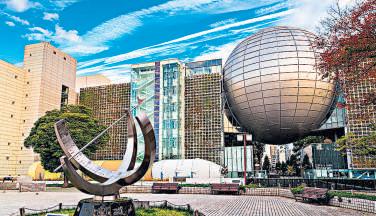
It's 1925, and a small crowd has stepped into a pitch-black dome and heard the doors close behind them.
As they struggle to adjust to the darkness, the roof seems to disappear. An expanse of star-studded sky appears above them.
There are no models of ringed globes in this planetarium. No pinholes in the walls, with light shining through to mimic stars. Instead, there is a hub in the centre of the room, throwing out imagery of a dazzling night sky.
"It matters not whether the audience be made up of children or adults, professional people or laymen, the emotional experience is always the same," astronomer George Clyde Fisher wrote, in an essay in the journal Popular Astronomy. "When... the stars are 'turned on,' the audience gasps audibly... No one is prepared for anything so realistic and so dramatic."
Today's planetariums map swirling galaxies, zoom through clouds of asteroids, and add imagery of real meteors as they approach. We'll get to some of those in a bit. First, a look at why things changed, 100 years ago.
It all began with a German electrical engineer named Oskar von Miller, in 1913. von Miller was a busy man. Amid the race for electrification (which picked up pace in the 1880s), he had helped electrify major German cities. A passionate educator, he helped set up the Deutsches Museum in Munich in 1903, a rare institute dedicated to the history of science and technology, and served as its first director.
A decade on, artificial light and rising pollution levels had started to blot out the night sky. In an era of great strides for science, von Miller wondered, was there something he could do to bring people closer to the stars?
He reached out to the optics factory Carl Zeiss, makers of some of the world's best optical instruments since the 1840s. Could they make a machine that could project, indoors, real imagery of the night sky?


Cette histoire est tirée de l'édition November 23, 2025 de Hindustan Times Ranchi.
Abonnez-vous à Magzter GOLD pour accéder à des milliers d'histoires premium sélectionnées et à plus de 9 000 magazines et journaux.
Déjà abonné ? Se connecter
PLUS D'HISTOIRES DE Hindustan Times Ranchi
Hindustan Times Ranchi
'Gud and til have always been my favourites'
Growing up in Delhi, actor Raashii Khanna says she experienced Punjabi culture “very closely”.

1 min
January 13, 2026

Hindustan Times Ranchi
Last royal of Darbhanga Raj departs at 93
MAHARANI KAMSUNDARI DEVI } 1933-2026
1 mins
January 13, 2026
Hindustan Times Ranchi
'I make it a point to visit a gurdwara and light a bonfire on Lohri'
For former Miss Universe Harnaaz Sandhu, Lohri is a festival of “gratitude, warmth, and staying close to my roots”.
1 min
January 13, 2026

Hindustan Times Ranchi
Last royal of Darbhanga Raj departs at 93
MAHARANI KAMSUNDARI DEVI } 1933-2026
1 mins
January 13, 2026
Hindustan Times Ranchi
Why courts need to be compassionate to strays
It is quite the irony that while Aloka— the Indian stray dog adopted by a band of Buddhists monks —is being cheered worldwide for walking thousands of miles in the US alongside the monks in their march for global peace, his counterparts in India are being subjected to cruelty by the very institutions that should protect them.
3 mins
January 13, 2026
Hindustan Times Ranchi
Seeking a slice of government
Why allies of Dravidian majors in Tamil Nadu are demanding a share in power
2 mins
January 13, 2026
Hindustan Times Ranchi
Britain investigates Musk’s X over Grok deepfake concerns
Britain’s media regulator launched an investigation into Elon Musk’s X on Monday to determine whether sexually intimate deepfakes produced by its Grok AI chatbot violated its duty to protect people in the UK from content that could be illegal.
1 mins
January 13, 2026
Hindustan Times Ranchi
Refining India’s future in critical minerals
New Delhi must take deliberate and coordinated steps to establish its own midstream capabilities to avoid dependence on external actors
4 mins
January 13, 2026
Hindustan Times Ranchi
Designing trade policy for a brave new world
If the fall of the Berlin Wall in 1989 marked the beginning of a new wave of globalisation, 2025 perhaps marked the end of that wave.
3 mins
January 13, 2026
Hindustan Times Ranchi
Modi, Merz talk focuses on edu, global conflicts
India and Germany on Monday firmed up a comprehensive roadmap to expand ties in the education sector as Prime Minister Narendra Modi and German Chancellor Friedrich Merz held wide ranging talks to expand the overall trajectory of bilateral engagement.
1 min
January 13, 2026
Listen
Translate
Change font size