Essayer OR - Gratuit
Sepia-tinted Memory
Outlook
|April 21, 2025
Framing Portraits, Binding Albums highlights the startling absence of family photographs in academic discourse in India and underlines the importance of deconstructing them as artifacts of social studies
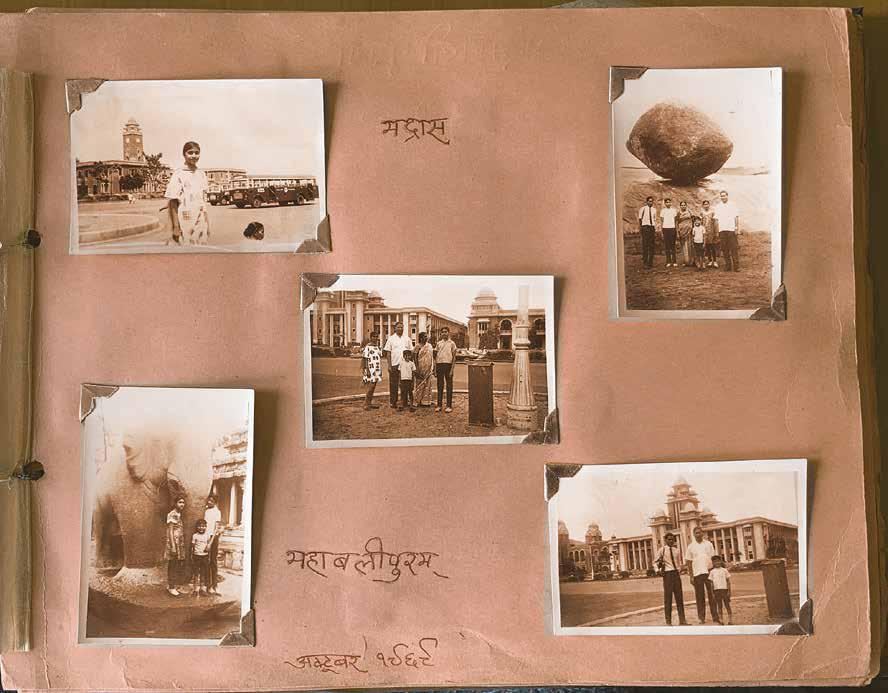
In a single-room accommodation, amid bare minimum necessities for a family of three, stood a wooden cabinet. Waist high and slightly worn down, with a loose panel on the side, the cabinet used to be my go-to spot during the hot and leisurely afternoons of summer vacations. Being in a family of working parents, my afternoons would often be spent on self-assigned projects of rummaging through the bookshelves, or reading. Sometimes, the thick family albums kept amid the books peeped from the shelves.
The albums were myriad; their presentation of photos changing with their physical form. Some were elaborate, with photos of my mother from her college days, her friends, of her playing the sitar in a gathering of distant family members. There were photos of my father, on his way to getting married—his face, young, marked by the hardships of labour from his teenage years as a refugee, yet his bright eyes set him apart from the other young men in the photographs. I was there too, in that small room cramped with cheap furniture, covered with towels, with a paper sword in my hand.
These photos are a testament to the quiet resilience of a family and their idea of belonging. Marked in each photo stuck in these albums is an anthology of life lived, people coming and going, a reflection of both—what was and what was endured.
Family photographs, an asset often tucked away neatly in a corner of such cabinets in households across our country, (and Southeast Asia) have not been a part of mainstream academic discourse. A form of legitimate anthropological study material, these albums give a sense of preservation of both private and public memory.
In the book,

Cette histoire est tirée de l'édition April 21, 2025 de Outlook.
Abonnez-vous à Magzter GOLD pour accéder à des milliers d'histoires premium sélectionnées et à plus de 9 000 magazines et journaux.
Déjà abonné ? Se connecter
PLUS D'HISTOIRES DE Outlook

Outlook
The Spectacle of the Woman Accused
Media narratives—especially when women are involved—can end up amplifying suspicion and weaponising gender

7 mins
March 11, 2026

Outlook
The Stink of Epstein
Why are the rich and powerful of the world scared of what lies buried in the Jeffrey Epstein files?
6 mins
March 11, 2026

Outlook
Passing the Watermelon
Narendra Modi's presence in Israel is being read not just as a bilateral engagement, but as an endorsement of Israeli action in Gaza and the West Bank
5 mins
March 11, 2026

Outlook
For Phoolan, Who Wasn't a Devi
“Whether or not it is the Truth is no longer relevant. The point is that it will, (if it hasn’t already) - become the Truth. Phoolan Devi, the woman has ceased to be important. (Yes of course she exists. She has eyes, ears, limbs, hair etc. Even an address now) But she is suffering from a case of Legenditis. She’s only a version of herself. There are other versions of her that are jostling for attention. Particularly Shekhar Kapur’s “Truthful” one, which we are currently being bludgeoned into believing.”–Arundhati Roy in ‘The Great Indian Rape-Trick I’, on the film Bandit Queen by Shekhar Kapur based on Phoolan, whom he never met because he didn’t think he needed to meet her. The film was based on journalist Mala Sen’s book India’s Bandit Queen: The True Story of Phoolan Devi.
5 mins
March 11, 2026

Outlook
The Chic Cartel
Women are not just victims or side characters in recent crime-and-power OTT dramas. They are complex forces-capable of empathy, strategy and ruthlessness-whose narratives demand both recognition and reckoning
5 mins
March 11, 2026

Outlook
The Hierarchy of Sympathy
In crimes against women, justice is shaped not only in courtrooms but in newsrooms where narrative determines whose suffering becomes national conscience and whose fades into procedural silence
5 mins
March 11, 2026

Outlook
Dasyu Sundari
Media accounts simultaneously cast her as victim and avenger, until a life shaped by caste violence and gendered oppression was repackaged into a consumable myth of dishonour and revenge
8 mins
March 11, 2026

Outlook
Prince Pervert
Are rumours of the death of the rule of law vastly exaggerated?
4 mins
March 11, 2026
Outlook
Together, Apart
Poonam Saxena's translations of Mannu Bhandari and Rajendra Yadav's memoirs present a portrait of the trailblazing Hindi writer-couple's marriage and of newly independent India
3 mins
March 11, 2026

Outlook
The Great Indian Rape Trick'
The trope of transforming sexual violence against women into a springboard for rage that can only be channelled through counter-violence has long served as a popular framework in cinema, both globally and in India
6 mins
March 11, 2026
Listen
Translate
Change font size