Essayer OR - Gratuit
In My Tongue
Outlook
|July 01, 2025
The CBSE's move to implement the 'mother tongue first' policy aims to enhance early learning and equity, but there are practical hurdles in implementing it in linguistically diverse Indian classrooms
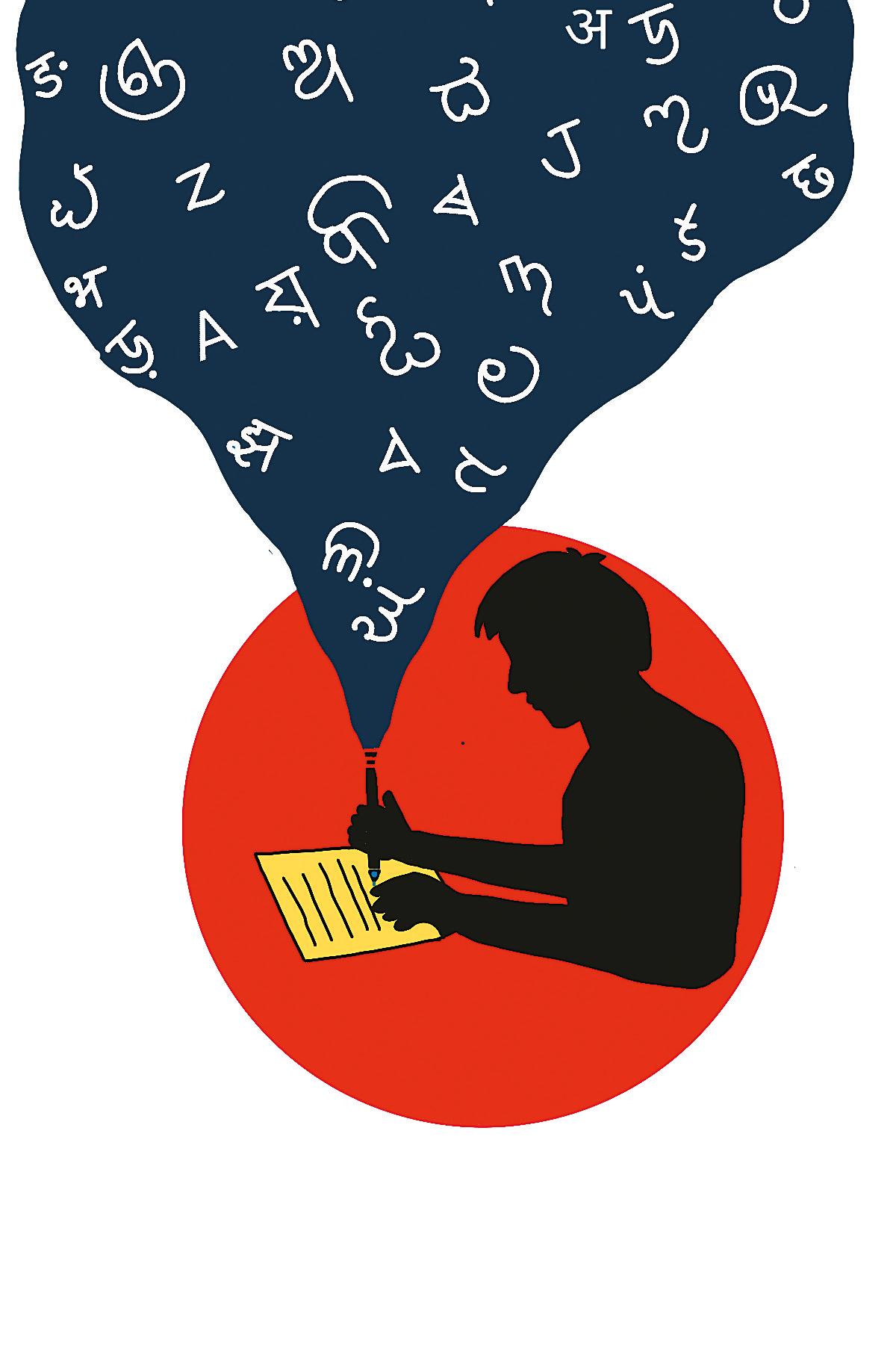
THE recent Central Board of Secondary Education (CBSE) circular to offer education in the mother tongue or the dominant language prevalent in the state at the primary level has led to intense debates. This is only to be expected in a multilingual country like India. International organisations like UNESCO have argued that early teaching in the mother tongue will have a positive impact on the child's cognitive capabilities. Eminent philosopher Paulo Freire argued that the mother tongue plays a crucial role in shaping a critical consciousness, especially among marginalised groups. However, the historical trajectory of every society is unique when it comes to the evolution and usage of languages.
In India, till the colonial encounter, Sanskrit and Persian were the languages of the court, patronised by the elite. Ordinary people inhabited a multiverse which was reflected in their oral and written traditions, be it the Bhakti-Sufi poets or the compositions in the local/regional/community dialects.
The 'infamous' Minute of Thomas Macaulay (February 2, 1835)—a pivotal document that significantly reshaped education in British India—added another layer to this language poser. For the British, everything worthy of knowledge was ingrained in their tongue and the rest of the native languages were considered unworthy of attention.
Needless to mention, gradually, a cleavage emerged in society due to the downward filtration theory of the colonial state. The elites quickly imbibed the lingo of the new ruling class and the Indian languages, now called ‘vernaculars’, became the domain of the socially inferior communities. Such ideas did not go unchallenged and Jyotiba Phule dubbed education as the ‘Trutiya Ratna’ or the Third Eye, crucial for the lower castes/ classes to attain wisdom and freedom.

Cette histoire est tirée de l'édition July 01, 2025 de Outlook.
Abonnez-vous à Magzter GOLD pour accéder à des milliers d'histoires premium sélectionnées et à plus de 9 000 magazines et journaux.
Déjà abonné ? Se connecter
PLUS D'HISTOIRES DE Outlook

Outlook
'Why GDP Growth Doesn't Always Translate Into Votes'
The recent election results have once again shown that economic growth alone does not guarantee electoral victory.

3 mins
June 06, 2026

Outlook
Lights, Camera, Othering
The establishment of Israel has been accompanied by a national cinema devoted to negating and erasing the Palestinian Other
5 mins
June 06, 2026

Outlook
Goodbye to All That
Booker-winning British author Julian Barnes' Departure(s) is a unique hybrid work: playful, philosophical, whimsical
4 mins
June 06, 2026

Outlook
Collapse of Trust
As the NEET-UG 2026 paper leak forced the cancellation of India’s biggest medical entrance exam, more than 22 lakh aspirants find themselves trapped in uncertainty
11 mins
June 06, 2026

Outlook
NO LONGER A TWELFTH MAN
Bihar cricket, which has languished in the shadows for long, is all set to improve its strike rate, thanks to Vaibhav Sooryavanshi, the new Bihari kid on the block
5 mins
June 06, 2026
Outlook
BLAZE OF GLORY
The challenges of being a celebrity cricketer at a young age can be tough to handle
5 mins
June 06, 2026

Outlook
THE SWASHBUCKLERS
A new generation of fearless stars is emerging and finding its feet at the very top of an extremely competitive cricketing environment
5 mins
June 06, 2026

Outlook
THE TEEN TORNAD
At the age of 15, Vaibhav Sooryavanshi is already a cricketing legend
10 mins
June 06, 2026
Outlook
A Journey to Remember
The prerecorded message crackled over the din in the compartment: ‘Welcome to the Shatabdi Express.
4 mins
June 06, 2026

Outlook
Crossing Borders
Ruth Martin is the translator of German-Iranian author Shida Bazyar’s novel The Nights are Quiet in Tehran (originally written in German), which has been shortlisted for the 2026 International Booker Prize.
4 mins
June 06, 2026
Listen
Translate
Change font size