Essayer OR - Gratuit
WHAT'S NEXT FOR STOCKS?
Kiplinger's Personal Finance
|June 2025
A chaotic tariff policy buffets investors looking for clarity on the economy and inflation.
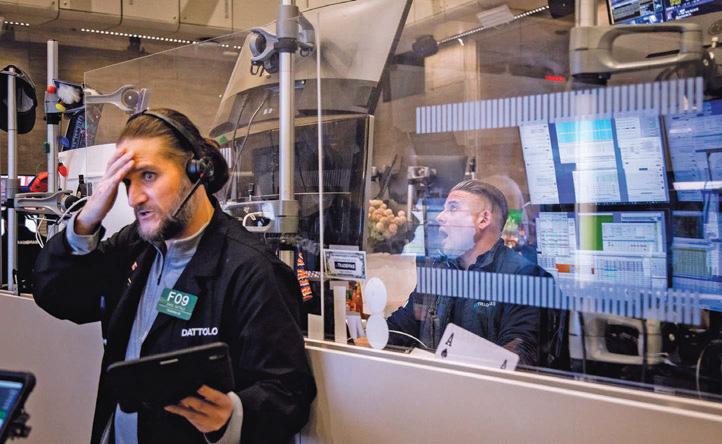
JUST weeks after hitting a record high, stocks spiraled dangerously close to a bear market in early April, then snapped like a bungee cord as the Trump administration's on-again, off-again tariffs whipsawed investors. From its peak on February 19, the S&P 500 index fell to within 1.1 percentage points of bear-market territory, defined as a drop of 20% or more, as Trump's tariff war escalated. More than $5 trillion in market value was erased in just a few days. Then, a reprieve. The White House announced a 90-day delay in the implementation of the most onerous levies on most of the countries facing them, and the broad market benchmark jumped nearly 10% in a single afternoon to close at 5457 on April 9—the biggest one-day gain since 2008. The next day? Down again.
Tariffs that took effect briefly in April were two-part: 10% on all imports, and so-called reciprocal tariffs for nearly 60 countries ranging from 11% to 50% and more. Although the 10% baseline tariffs remain, most of those reciprocal tariffs are paused—except for a 145% levy on Chinese goods, countering China’s 84% retaliatory tariff on U.S. products. Mexico and Canada are separate, operating under 25% tariffs that exclude goods compliant with earlier agreements (with some exceptions). Expect a volatile market—with significant shifts up or down—to continue to react to the trade news of the day. The stakes couldn’t be higher. “The expected fallout from ‘Trump 2.0’s Reign of Tariffs undercuts our former bullishness,” said strategist Ed Yardeni, of Yardeni Research, in an earlier note to clients. “It has also drained confidence in the U.S. economy on the parts of everyone from CEOs to consumers to investors.” Because consumers often bear the brunt of higher tariff costs, Moody’s chief economist Mark Zandi calculates that if all the proposed increases were to be implemented, the average American household would have to spend $2,100 more per year to buy the same goods they’re buying now.

Cette histoire est tirée de l'édition June 2025 de Kiplinger's Personal Finance.
Abonnez-vous à Magzter GOLD pour accéder à des milliers d'histoires premium sélectionnées et à plus de 9 000 magazines et journaux.
Déjà abonné ? Se connecter
PLUS D'HISTOIRES DE Kiplinger's Personal Finance

Kiplinger's Personal Finance
A TAX BREAK FOR MEDICAL EXPENSES
The editor of The Kiplinger Tax Letter responds to readers asking about health care write-offs.

2 mins
February 2026

Kiplinger's Personal Finance
Volunteering to Help Others at Tax Time
Through an IRS program, qualifying individuals can get free assistance with their tax returns.
2 mins
February 2026

Kiplinger's Personal Finance
CATCH-UP SAVERS FACE A TAXING 401(K) CHANGE
Under new rules, you may lose an up-front deduction but gain tax-free income once you retire.
2 mins
February 2026

Kiplinger's Personal Finance
The Case for Emerging Markets
Economic growth, earnings acceleration and bargain prices favor EM stocks.
3 mins
February 2026

Kiplinger's Personal Finance
THE NEW RULES OF RETIREMENT
Popular guidelines about how to save, invest and spend need to be updated and personalized to ensure you'll never run out of money.
15 mins
February 2026

Kiplinger's Personal Finance
Smart Ways to Share a Credit Card
Adding an authorized user has its benefits, but make sure you set the ground rules.
2 mins
February 2026

Kiplinger's Personal Finance
THE BEST AFFORDABLE FITNESS TRACKERS
These devices monitor your exercise, sleep patterns and more- and they don't cost an arm and a leg.
4 mins
February 2026
Kiplinger's Personal Finance
A VALUE FOCUS CLIPS RETURNS
THERE'S more to Mairs & Power Growth than its name implies. The managers favor firms with above-average earnings growth. But a durable, competitive position in their market- “a number-one or number-two position and gaining share,” says comanager Andrew Adams—and a reasonable stock price matter even more.
1 mins
February 2026

Kiplinger's Personal Finance
Look Beyond the Tech Giants
I am hooked on a podcast called Acquired, in which two smart guys do a deep analytical dive, typically lasting three or four hours, on a single successful company such as Coca-Cola or Trader Joe's. Ben Gilbert and David Rosenthal, a pair of venture capitalists, are especially adept at explaining what's behind the success of such tech giants as Alphabet (symbol GOOGL, $320), the former Google, which recently merited 11 hours and 42 minutes of dialogue all by itself.
4 mins
February 2026

Kiplinger's Personal Finance
How to Pay for Long-Term Care
A couple of months ago, I wrote that many Americans significantly underestimate how long they could live in retirement (see “Living in Retirement,” Dec.). With the possibility of a 30-year retirement becoming more common, retirees need to plan for so-called longevity risk to make sure their assets last a lifetime. And the longer you live, the more likely you'll need to pay for some form of long-term care. That can range from assistance with activities of daily living to in-home care to a nursing home stay.
2 mins
February 2026
Listen
Translate
Change font size