Essayer OR - Gratuit
VISITING HOURS
The New Yorker
|May 11, 2026
In Harriet Clark's début novel, a prisoner's daughter must find her way.
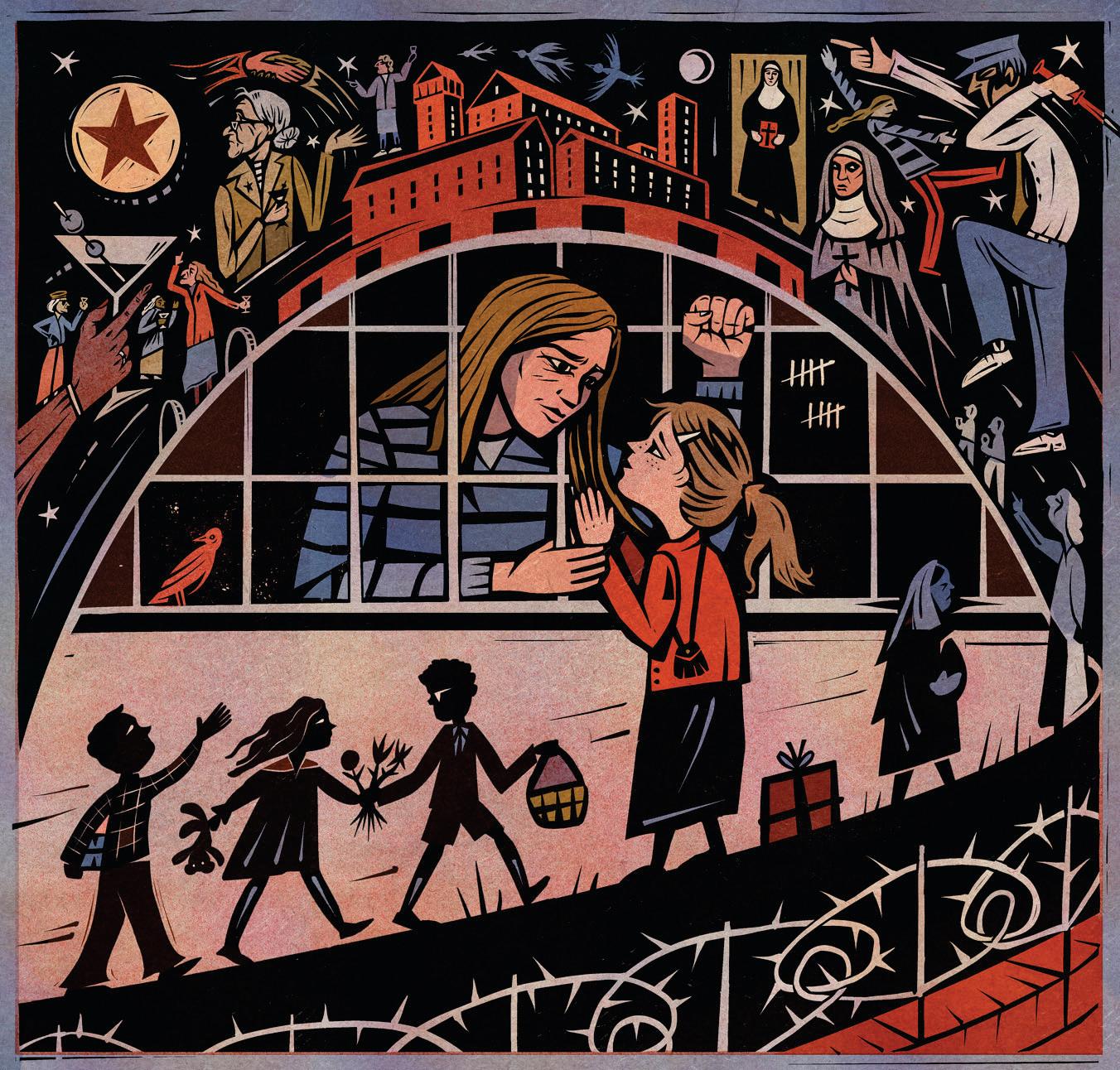
Amid visits to her mother, a girl must navigate a maternal legacy of radicalism.
The bildungsroman is the coming-of-age novel; it is also the coming-to-terms novel. The protagonist, usually a young man, undergoes a series of adventures that eventually spit him out wiser, stronger, set up for life’s journey. The form schools the hero in the ways of the world, and, even if he is rebellious (“A Portrait of the Artist as a Young Man”) or cynical (“Sentimental Education”), the ways of the world are taken as given. Or even embraced: perhaps the genre’s best-loved example, “David Copperfield,” ends with marriage.
It is curious that the bildungsroman, officially committed to interrogating the world, should be so at home in it. Then again, the novel, a worldly form and rather proud of it, has good reason not to question the basic terms of our existence. We shouldn’t be surprised that, with a few notable exceptions, the novel avoids any fundamental metaphysical skepticism: it may be a largely secular genre, but its secularism is settled, not unduly tormented. Traditionally, the bourgeois novel questioned the viability of bourgeois life, not the viability of life itself.

Cette histoire est tirée de l'édition May 11, 2026 de The New Yorker.
Abonnez-vous à Magzter GOLD pour accéder à des milliers d'histoires premium sélectionnées et à plus de 9 000 magazines et journaux.
Déjà abonné ? Se connecter
PLUS D'HISTOIRES DE The New Yorker
The New Yorker
VISITING HOURS
In Harriet Clark's début novel, a prisoner's daughter must find her way.

10 mins
May 11, 2026

The New Yorker
REVAMPS
Two new musicals on Broadway, \"Schmigadoon!\" and \"The Lost Boys.\"
7 mins
May 11, 2026

The New Yorker
RESOLVED
High-school debate, our real national pastime.
4 mins
May 11, 2026

The New Yorker
THE BIG PICTURE
Frederic Church turned landscape into a vision of national virtue.
17 mins
May 11, 2026

The New Yorker
COUTURE SHOCK
\"The Devil Wears Prada 2.\"
6 mins
May 11, 2026

The New Yorker
THE SHOT HEARD ROUND THE WORLD?
The American Revolution was just one front in a vast global war. Which went rather well for the Brits.
16 mins
May 11, 2026

The New Yorker
CROSSROADS
The inventor of “intersectionality” looks back—and ahead.
16 mins
May 11, 2026

The New Yorker
WHAT WE HOLD
The writing and meaning of the Declaration of Independence.
19 mins
May 11, 2026

The New Yorker
STANDINGS
My given name, Jeon-Gi, with a hard “G,” was one that some of the kids in my apartment complex enjoyed deforming.
33 mins
May 11, 2026

The New Yorker
AMERICAN TWEEN
In some ways, the world is cooked. But being a twelve-year-old still kind of eats.
33 mins
May 11, 2026
Listen
Translate
Change font size