Essayer OR - Gratuit
EXIT STRATEGY
The New Yorker
|October 27, 2025
A leading “dark ecologist” warns against hope.
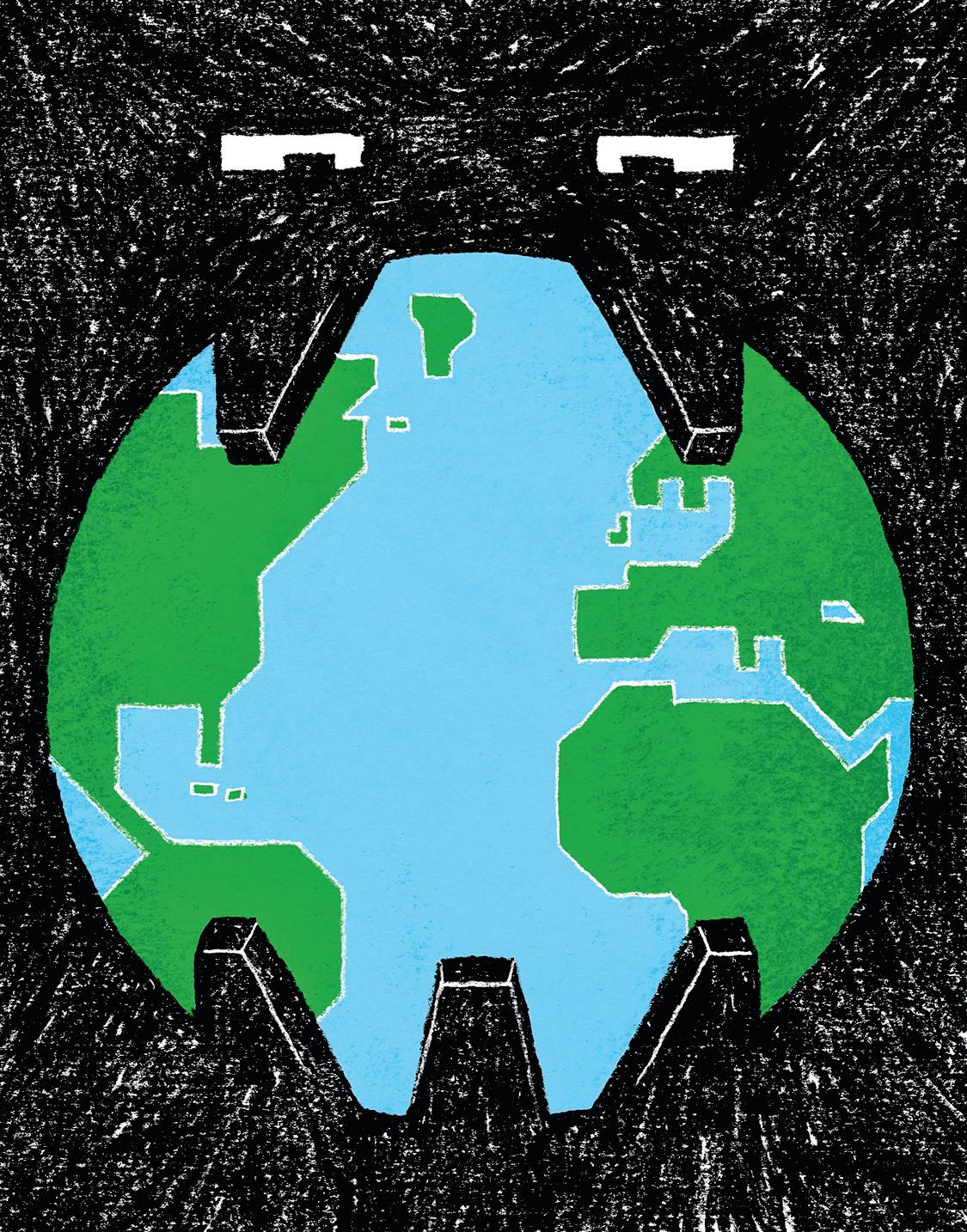
In 2014, Paul Kingsnorth was sunk in doubt. He was forty-one and had been on the green movement's front lines since the nineteen-nineties—working for Greenpeace and EarthAction, chaining himself to a bridge, getting teargassed outside a G-8 summit. In the course of two decades, he had become one of Britain’s leading environmentalists, and an accomplished novelist, too: “The Wake,” set in eleventh-century Lincolnshire and written in cod—Old English (“When i woc in the mergen all was blaec though the night had gan and all wolde be blaec after and for all time”), was long-listed that summer for the Booker Prize.
After twenty years of campaigns, though, he sensed that the movement was going nowhere—and missing the deeper point. Too many environmentalists had “no attachment to any actual environment,” he complained; they talked up the Earth but showed “no sign of any real, felt attachment to any small part of that Earth.” A few years earlier, he had co-founded the Dark Mountain Project to promote what he would call “dark ecology.” Its manifesto declared the fight against climate change lost and a “collapse” inevitable.
So, in the same year that the People’s Climate March drew the largest crowds the cause had ever seen, Kingsnorth moved in the opposite direction. He left England for rural Ireland, where, with his wife, who had been a psychiatrist, and their two children, he set about making a new life as a smallholder—planting trees, keeping animals, clearing brambles. He cut grass with a scythe and smashed the porcelain toilet in his house to replace it with one that composted waste. He’s lived there ever since, writing on his Substack,

Cette histoire est tirée de l'édition October 27, 2025 de The New Yorker.
Abonnez-vous à Magzter GOLD pour accéder à des milliers d'histoires premium sélectionnées et à plus de 9 000 magazines et journaux.
Déjà abonné ? Se connecter
PLUS D'HISTOIRES DE The New Yorker

The New Yorker
Amanda Petrusich on Katy Grannan's Photograph of Taylor Swift
There’s something uncanny about this still and stunning portrait of a twenty-one-year-old Taylor Swift, shot by Katy Grannan for Lizzie Widdicombe’s Profile of the singer, in 2011.

1 mins
January 12, 2026

The New Yorker
DEAL-BREAKER
Pam is seeing someone, but she’s not talking about it.
19 mins
January 12, 2026
The New Yorker
THE OTHER BOOMERS
Kathryn Bigelow, the director, and Alexandra Bell, the arms-control expert, are both nuclear-attack-submarine literate. Bigelow—whose new Netflix film, “A House of Dynamite,” imagines the U.S. government’s response to an incoming intercontinental ballistic missile (ICBM) eighteen minutes from impact—shot part of her 2002 submarine film, entitled “K-19:
3 mins
January 12, 2026

The New Yorker
THE MUSICAL LIFE BROADWAY BABY
At Joe’s Pizza on Carmine Street, Marc Shaiman, the celebrated composer and lyricist, dropped his slice on the floor. “Ugh, it’s the Shaiman vortex,” he said. “Everything I come near breaks.”
3 mins
January 12, 2026

The New Yorker
NOTORIOUS M.T.G.
Marjorie Taylor Greene and Donald Trump break up over Epstein.
26 mins
January 12, 2026

The New Yorker
YES, AND?
How consent can—and cannot—help us have better sex.
14 mins
January 12, 2026

The New Yorker
LET IT BLEED
When Helen Frankenthaler remade painting.
5 mins
January 12, 2026

The New Yorker
THE AMERICAN POPE
How the Chicago-born Robert Prevost became Leo XIV.
32 mins
January 12, 2026

The New Yorker
DEPT. OF RECYCLING SWIPE OUT
In 1994, when the MetroCard made Its 22, many straphangers were reluctant to say farewell to the subway token. Across the city, commuters struggled to master \"the swipe.
2 mins
January 12, 2026
The New Yorker
THE TALK OF THE TOWN
Easily missed on the back side of the November ballots that brought Zohran Mamdani to Gracie Mansion was a proposal for a new map of New York City.
4 mins
January 12, 2026
Listen
Translate
Change font size