Essayer OR - Gratuit
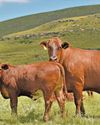
Following the herd to help reduce emissions
Farmer's Weekly
|November 10, 2023
Identifying and including a low-methane trait in livestock breeding programmes could be the answer to the methane problem faced by animal farmers globally. But how conclusive is the research and will it impact production traits? Lindi Botha reports.

For most South African farmers, surviving the cost-price squeeze is a far greater consideration than reducing methane emissions. While South Africans are not currently facing pressure to reduce carbon footprints like Europe and the US, emissions will need to be tackled in the near future. Considering the pressure the livestock industry faces globally for their methane emission contribution to greenhouse gases (GHG), it is expected that SA farmers will not be spared the scrutiny.
The good news is that, as the focus on methane emissions from livestock production has intensified, so has research to reduce methane production in livestock. And as gene sequencing has become common among breeders to select the right qualities for their herd, genes that reduce methane are under the spotlight.
About 90% of methane from cows is excreted by burping rumen gases from their mouths. This is a rumen fermentation by-product and is often referred to as enteric methane emissions. Multiple studies now show that the cow’s genetic make-up accounts for 24% of methane emission variation, with another 7% attributed to the rumen microbiome. Determining what genes affect rumen gases, and what effect these genes will have on production if deselected, has become a burning question, and one that requires far more research before conclusions can be drawn.
The Food and Agriculture Organization of the United Nations’ (FAO) report on methane emissions in livestock, published in September this year, states that at present there are only a few instances where methane is taken into consideration in breeding programmes across the world.
FAST FACTS
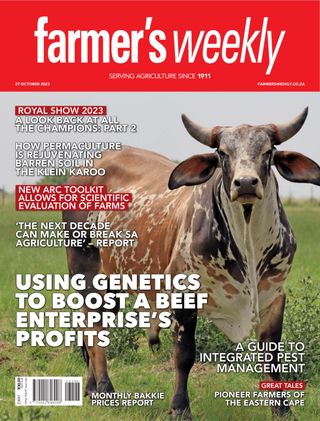
Genetics and the gut microbiome play a big role in methane production in cows.

Cette histoire est tirée de l'édition November 10, 2023 de Farmer's Weekly.
Abonnez-vous à Magzter GOLD pour accéder à des milliers d'histoires premium sélectionnées et à plus de 9 000 magazines et journaux.
Déjà abonné ? Se connecter
PLUS D'HISTOIRES DE Farmer's Weekly

Farmer's Weekly
Pastry delights and cupcakes
The versatility of pastry in baking and cooking is best flaunted by two vastly different recipes appealing to the sweet and savoury tooth, while a novel way to bake those Christmas-themed cupcakes will also go down well.

4 mins
December 5-12, 2025
Farmer's Weekly
Specialised spider-hunting wasps
Wasps are apex predators of the insect world and have developed many survival strategies. One group of wasps focuses on hunting spiders to provide a source of food for their larval offspring
2 mins
December 5-12, 2025
Farmer's Weekly
From bulls to boardrooms: farming part-time as a professional
Maintaining a farm requires time, resources, and commitment. Farming part-time while being fully employed elsewhere can seem daunting and risky. Although it certainly presents unique challenges, it is feasible for some. Koot Klopper and Herman van Heerden spoke to Henning Naudé about how excellent time management and the delegation of resources, as part-time farmers, successfully keep their farms productive.
5 mins
December 5-12, 2025

Farmer's Weekly
Holy Shiitake: mastering the science of gourmet fungi
Mushroom production is inherently the practice of expanding mycelium. But since wanted and unwanted fungi flourish under the same circumstances, a mushroom farmer's biggest challenge is ensuring the right fungi prevails. Lindi Botha reports on Rory Brooks' learning curve.
9 mins
December 5-12, 2025
Farmer's Weekly
No more 'secret' price hikes?
'Secret' electricity price hikes in South Africa have been curbed in a game-changing court ruling, explains Felix Dube, lecturer in the Department of Law at the University of Venda.
4 mins
December 5-12, 2025
Farmer's Weekly
The cutworm scourge, and how to control it
The dominant cutworm, Agrotis segetum, is causing renewed, costly damage to South African maize, soya bean, and sunflower.
5 mins
December 5-12, 2025
Farmer's Weekly
Legislative gap requires a rethink on biosecurity controls
Since the dawn of democracy, the agriculture sector has cemented its place as one of the essential and trusted pillars for economic growth, job creation, and foreign earnings in South Africa.
2 mins
December 5-12, 2025

Farmer's Weekly
From kitchen experiments to a thriving meat empire
What started as an after-hours kitchen project in the Truter household has grown into the fully fledged meat empire Deli-Co. Brothers Pieter and Hendri Truter told Glenneis Kriel how they turned a local favourite into a multigenerational family business.
7 mins
December 5-12, 2025
Farmer's Weekly
Brushing up on your 'cow speak'
Experienced stockman and cattle judge Willie de Jager spoke to Sabrina Dean about some of the basics of reading cattle behaviour and how best to handle these animals.
8 mins
December 5-12, 2025

Farmer's Weekly
Corporate day job fuels farming dream
Marius Smit lives in the middle of Gauteng in Centurion and spends his workdays in the fast-paced high-stress corporate sector as a group forensic head for Discovery.
5 mins
December 5-12, 2025
Translate
Change font size